
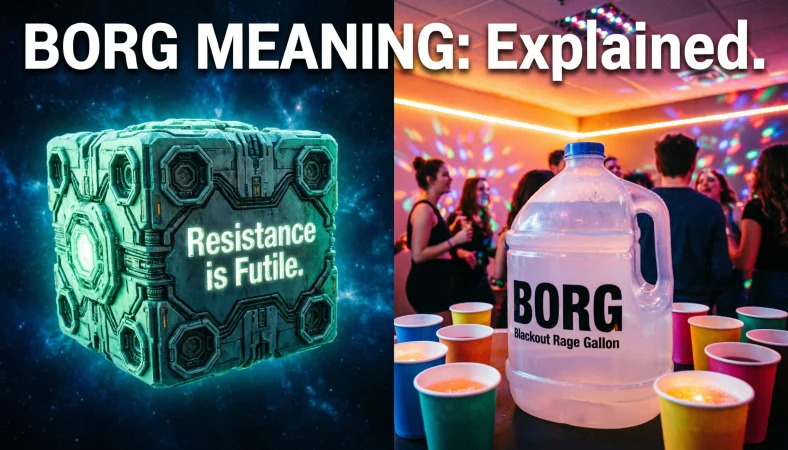

The term “borg” primarily refers to a fictional alien race from the Star Trek franchise cybernetic organisms that assimilate other species into their collective consciousness. In modern slang, “borg” has evolved to describe overwhelming systems, groupthink, or an unstoppable force that absorbs everything in its path. It can also refer to “blackout rage gallons,” a dangerous drinking trend on college campuses.
Picture this: You’re watching Star Trek: The Next Generation, and a deep, robotic voice intones, “Resistance is futile.” That chilling phrase belongs to the Borg one of the most iconic antagonists in science fiction history. But here’s the thing: the borg meaning has expanded far beyond the starship Enterprise. Today, you might hear someone call a massive corporation “the Borg” or describe a social media echo chamber as a “collective” that consumes individuality.
Whether you’re a Trekkie, a linguistics nerd, or just someone trying to decode modern slang, understanding the borg meaning is more relevant than ever. It’s a term that bridges pop culture, sociology, and even internet meme culture. And yes, there’s also a completely different and frankly alarming meaning involving alcohol and college parties.
So, grab your favorite beverage (preferably not a borg cocktail), and let’s dive deep into the fascinating layers of this six-letter word. By the end of this article, you’ll not only know the borg definition inside and out, but you’ll also be able to use it confidently in conversation, recognize its various contexts, and impress your friends with your linguistic versatility. 🧠
Borg Meaning – The Core Definition
At its most basic level, the borg meaning splits into three primary categories:
| Context | Definition | Example |
|---|---|---|
| Sci-Fi (Star Trek) | A cybernetic alien species that assimilates other lifeforms into a hive mind collective | “The Borg ship appeared on the viewscreen, and everyone knew resistance was futile.” |
| Modern Slang (Corporate/Cultural) | An overwhelming, impersonal system or organization that consumes individuality | “Working for that tech giant feels like being part of the Borg—no one thinks for themselves.” |
| College Drinking Trend | “Blackout Rage Gallon”—a gallon-sized jug mixed with alcohol, water, and flavoring, popular at parties | “She brought a borg to the tailgate, but we warned her to pace herself.” |
The Linguistic Evolution
The word “borg” is a shortened form of “cyborg” (cybernetic organism), which itself was coined in 1960 by Manfred Clynes and Nathan Kline. However, the borg meaning that most people recognize today owes its existence to Gene Roddenberry’s Star Trek franchise, where the Borg were introduced in 1989 as a terrifying new enemy.
But here’s where it gets interesting: the term has evolved semantically. In the original Star Trek context, the Borg represent the ultimate loss of individuality a cautionary tale about technology, conformity, and the erosion of human identity. This thematic richness is precisely why the word has been borrowed for so many other uses.
The Origin Story – Where Did the Borg Come From?
From Cyborg to Borg
To fully grasp the borg meaning, we need to travel back to 1989 when Star Trek: The Next Generation writers Maurice Hurley and Michael Piller introduced the Borg in the episode “Q Who?” (Season 2, Episode 16). The concept was simple yet terrifying: an alien race that didn’t conquer through typical warfare but through assimilation.
Key Borg characteristics in Star Trek:
- The Collective: All Borg share a single consciousness through a neural transceiver network
- Assimilation: They forcibly integrate other species into their hive mind via nanoprobes
- The Queen: A central figure who personifies the collective’s will
- The Phrase: “Resistance is futile” – one of the most quoted lines in TV history
The Symbolic Power of the Borg
What made the Borg resonate so deeply wasn’t just their cool design (those menacing cybernetic implants!) but what they represented. In the late 80s and early 90s, fears about technology, globalization, and the loss of cultural identity were growing. The Borg became a perfect metaphor for:
- Corporate homogenization – big companies swallowing up smaller ones
- Technological dependency – losing our humanity to our devices
- Political conformity – groupthink overriding individual conscience
- Cultural assimilation – dominant cultures erasing minority identities
This is why the borg meaning has such staying power. It taps into genuine anxieties about modernity while remaining wrapped in the friendly, familiar garb of pop culture.
Modern Usage – How People Use “Borg” Today
In Corporate and Professional Settings
You’ll frequently hear the borg meaning invoked in workplace conversations, usually with a hint of dark humor. When employees describe their company as “the Borg,” they’re typically commenting on:
- Impersonal bureaucracy – endless processes that crush creativity
- Groupthink culture – where dissenting opinions are discouraged
- Resistance is futile – the feeling that fighting the system is pointless
- Loss of individuality – everyone dressing, speaking, and thinking alike
Example (Neutral/Professional Tone):
“After the merger, our startup culture was completely absorbed by the parent company. It felt like we’d been assimilated by the Borg – all our quirky traditions disappeared overnight.”
In Pop Culture and Internet Slang
The borg meaning has also found a home in memes, social media, and everyday conversation. Here are some common modern applications:
- “Borg energy” – describing an overwhelming, unavoidable force
- “Going full Borg” – when someone becomes overly obsessed with assimilation or conformity
- “The Borg of [Industry]” – a dominant player that’s consuming all competition
Example (Friendly/Casual Tone):
“Netflix is basically the Borg of streaming services—they just keep absorbing every show and movie in existence! 🖖”
In College Culture – The “Blackout Rage Gallon”
And then there’s the darker side of the borg meaning. In recent years, “borg” has become shorthand for a dangerous drinking phenomenon: Blackout Rage Gallons. These are gallon-sized plastic jugs filled with a mixture of:
- Vodka or grain alcohol
- Water
- Electrolyte powder or drink mix
- Often served with a spigot for easy dispensing
This trend emerged on college campuses in the early 2020s and quickly spread via TikTok and Instagram. While the intent is to prevent hangovers (hence the electrolytes), the massive alcohol content makes it incredibly dangerous.
Example (Educational/Warning Tone):
“Some students think borgs are a clever hack for partying safely, but with upwards of 15-20 shots per gallon, they’re actually a fast track to alcohol poisoning.”
Borg Meaning in Context – Real-World Examples
Understanding the borg meaning requires seeing it in action. Here are examples spanning different tones and situations:
🤖 Friendly/Playful Context
“My friend group is basically the Borg if one of us discovers a new restaurant, we all end up there by the weekend!”
🏢 Neutral/Professional Context
“Amazon has been called the Borg of e-commerce due to its aggressive expansion and market dominance.”
⚠️ Warning/Educational Context
“Before you mix that borg for the party, remember that the ER sees more alcohol poisoning cases from these than from any other type of drink.”
😬 Negative/Dismissive Context
“His management style is so Borg-like—he expects everyone to think exactly like him and shuts down any new ideas.”
Comparison with Related Terms
The borg meaning overlaps with several other concepts. Here’s how they compare:
| Term | Definition | Similarity to Borg | Key Difference |
|---|---|---|---|
| Hive Mind | A collective consciousness where individuals share thoughts | Very similar – both involve loss of individuality | Hive mind is broader; borg specifically involves cybernetics and forced assimilation |
| Groupthink | Conformity within a group to avoid conflict | Shares the conformity aspect | Groupthink is psychological; borg is more about systemic, technological control |
| Cyborg | A being with both organic and biomechatronic parts | The root word | Cyborgs can be individuals; borg are a collective |
| The Collective | A group acting as one | Almost synonymous in many contexts | “The Collective” is more generic; “Borg” specifically references Star Trek |
| Monoculture | A single culture dominating others | Both involve assimilation | Monoculture is cultural; borg is technological/social |
Borg vs. Hive Mind: What’s the Difference?
While often used interchangeably, there’s a subtle distinction. Hive mind implies a natural or organic connection (like bees or ants), while the borg meaning carries connotations of technology, force, and the erasure of identity. The Borg don’t just share thoughts they actively strip away everything that made you you and replace it with the collective’s programming.
Alternate Meanings and Lesser-Known Uses
Beyond the primary definitions, the borg meaning occasionally pops up in other contexts:
In Gaming
- Borg (verb): To swarm or overwhelm an opponent in strategy games
- Borg-like: Describing a playstyle that focuses on overwhelming numbers
In Tech Culture
- Borg server: In some IT circles, a “borg” refers to a server that has absorbed multiple smaller servers (a nod to the assimilation theme)
In Linguistics
- Borg as a slang term for “boring” (though this is rare and usually spelled “boring” in context)
In Scandinavian Countries
- Borg means “castle” or “fortress” in Scandinavian languages (e.g., “Visby ringmur” is a medieval city wall, but “borg” appears in place names)
Polite and Professional Alternatives to “Borg”
If you’re in a professional setting and want to convey the borg meaning without the sci-fi baggage, consider these alternatives:
| Context | Instead of “Borg” | Try This |
|---|---|---|
| Describing a dominant company | “They’re the Borg of the industry” | “They’ve achieved market dominance through strategic acquisitions” |
| Feeling overwhelmed by bureaucracy | “This place is like the Borg” | “The organizational structure feels very rigid and impersonal” |
| Groupthink in meetings | “Everyone’s gone full Borg” | “There seems to be a strong pressure for consensus” |
| Homogeneous corporate culture | “We’re being assimilated” | “There’s a noticeable lack of diversity in thought and approach” |
When to Use “Borg” vs. Alternatives
- Use “Borg” when you’re in a casual setting, among colleagues who appreciate the reference, or when you want to be playful
- Avoid “Borg” when discussing sensitive topics (like culture clashes), in formal presentations, or when your audience might not know the reference
The Borg Meaning in Popular Culture – A Timeline
To truly appreciate how the borg meaning has evolved, let’s look at its cultural footprint:
- 1989 – Introduced in Star Trek: TNG as a new alien threat
- 1996 – Star Trek: First Contact establishes the Borg Queen
- 2000s – “Borg” becomes slang for overwhelming corporate entities
- 2010s – Memes about “Borg-like” behavior proliferate on social media
- 2020s – “Blackout Rage Gallons” emerge, giving “borg” a dangerous new meaning
- 2023 – The term appears in mainstream news coverage of college drinking trends
- 2024-2025 – Continued use in both tech criticism and pop culture commentary
Why Did This Word Stick?
The borg meaning has endured because it’s remarkably versatile. It can be:
- A noun (the Borg, a borg drink)
- An adjective (Borg-like, Borg energy)
- A verb (to borg out, borging)
- A cultural shorthand (everyone understands “resistance is futile”)
FAQs
1. What does “borg” mean in slang?
In modern slang, “borg” typically describes an overwhelming, impersonal system or organization that erases individuality. It can also refer to a dangerous type of alcoholic drink popular on college campuses.
2. What does the Borg in Star Trek stand for?
It doesn’t stand for anything it’s simply “Borg,” a shortened form of “cyborg.” The term was chosen to evoke the idea of a cybernetic, collective organism.
3. Is “borg” a positive or negative term?
Generally, it’s negative or neutral, depending on context. Describing something as “Borg-like” usually implies negative connotations of loss of individuality or overwhelming force. However, in geek culture, it’s often used affectionately.
4. What is a “borg” at a college party?
A “borg” (Blackout Rage Gallon) is a gallon-sized jug mixed with alcohol, water, and electrolytes. It’s a controversial trend that health officials warn can lead to severe alcohol poisoning.
5. What’s the difference between “borg” and “hive mind”?
While both involve collective consciousness, “borg” specifically carries technological, sci-fi, and sometimes negative connotations of forced assimilation. “Hive mind” is more generic and can refer to natural or organic collective intelligence.
6. Is “Borg” copyright or trademarked?
The name is trademarked by CBS/Paramount for use in the Star Trek franchise. However, the generic usage of “borg” in slang is not protected.
7. Can “borg” be used in a professional email?
It’s generally best to avoid using “borg” in formal professional correspondence unless you’re sure your audience will appreciate the reference. In most cases, it’s better to use more straightforward language.
8. Why do people say “resistance is futile”?
“Resistance is futile” is the Borg’s catchphrase from Star Trek, and it’s used to indicate that opposing a powerful force is pointless. It’s often used humorously in everyday conversation.
Conclusion
From the distant reaches of the Delta Quadrant to your local college party, the borg meaning has undergone a remarkable journey. What started as a terrifying sci-fi villain has morphed into a versatile piece of cultural vocabulary that speaks to modern anxieties about conformity, technology, and social pressure.
Key Takeaways:
- Sci-Fi Roots: The original Borg from Star Trek remain one of the most iconic villains in television history, symbolizing the threat of technology and conformity
- Modern Slang: Today, the borg meaning extends to any overwhelming, impersonal system that consumes individuality
- Dangerous Trend: The “blackout rage gallon” borg is a serious health concern that needs to be approached with caution
- Versatile Word: “Borg” works as a noun, adjective, and verb, giving it remarkable linguistic flexibility
- Cultural Shorthand: Phrases like “resistance is futile” have become part of everyday vocabulary
Practical Tips for Using “Borg” Correctly:
- Consider your audience – Not everyone will get the Star Trek reference
- Be aware of context – Don’t confuse the sci-fi borg with the drinking borg
- Use with humor – Most uses of “borg” in modern slang are tongue-in-cheek
- Know your alternatives – In professional settings, opt for clearer language
- Stay safe – If you encounter a drinking borg, be cautious and drink responsibly
Whether you’re a casual fan of Star Trek, a language enthusiast, or someone trying to decode modern slang, understanding the borg meaning adds depth to your vocabulary and cultural literacy. It’s a word that encapsulates fears of the future, critiques of the present, and a touch of dark humor about the world we live in.
So the next time you hear someone say, “Resistance is futile,” you’ll know exactly what they mean—and maybe even have a clever response ready.