
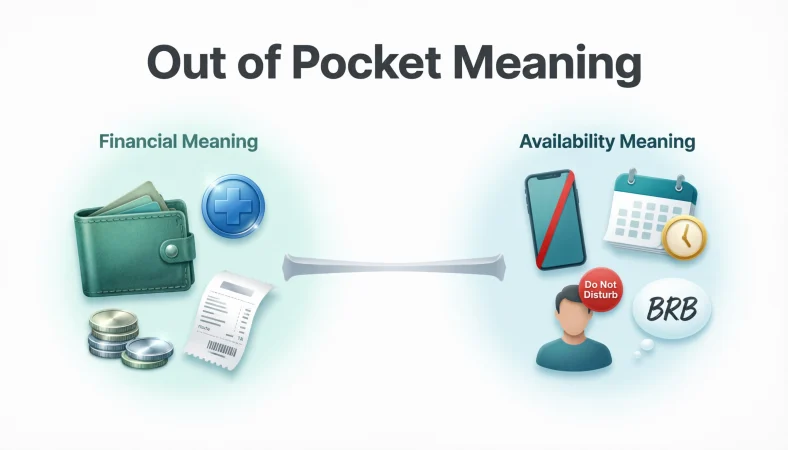

“Out of pocket” has two common meanings. In business and workplace communication, it usually means temporarily unavailable or unable to respond to calls, emails, or messages. In finance and healthcare, it refers to money you pay yourself without reimbursement or insurance coverage. The correct meaning depends on the context in which the phrase is used.
If you’ve received a message saying someone is “out of pocket,” you might wonder whether they’re unavailable, traveling, or talking about money. The phrase can be confusing because it has multiple meanings, and the right interpretation depends on the situation.
In modern workplace communication, out of pocket most often means a person is temporarily unavailable and may not be able to respond to emails, calls, or text messages. However, in financial and healthcare contexts, it refers to expenses paid with your own money rather than being covered by an employer or insurance.
This guide explains the out of pocket meaning, how it’s used in business, texting, healthcare, and everyday conversations, along with real-life examples, common mistakes to avoid, and the difference between out of pocket and similar expressions like out of office. By the end, you’ll know exactly what the phrase means in any context and how to use it naturally.
Out of Pocket Meaning – The Complete Definition
Definition:
Out of pocket” has two primary meanings:
- Financial: Costs that you pay directly from your own personal funds, rather than through insurance, reimbursement, or a company expense account.
- Availability: Being temporarily unavailable, unreachable, or not present, often used in workplace or social contexts.
Breaking Down the Financial Meaning
When used in a financial context, out of pocket meaning refers to expenses that require immediate, personal cash outlay. These are costs you bear directly, without third-party assistance, insurance coverage, or employer reimbursement.
Think of it this way: any time money leaves your wallet, bank account, or credit card to pay for something that isn’t immediately reimbursed, you’re incurring an out-of-pocket expense.
Common financial scenarios include:
- Medical expenses: Copays, deductibles, and prescriptions not fully covered by insurance
- Business expenses: Supplies or travel costs you pay upfront before getting reimbursed
- Personal purchases: Routine shopping where you pay the full retail price
- Emergency expenses: Unexpected car repairs or home maintenance
Breaking Down the Availability Meaning
The social or professional use of “out of pocket” has gained significant traction in recent years, particularly in workplace communication. In this context, being “out of pocket” means you’re unavailable, unreachable, or otherwise inaccessible.
This could be because you’re:
- In a meeting without your phone
- Traveling without reliable signal
- Taking personal time off
- Overwhelmed and intentionally disconnecting
- Simply in a location where you can’t respond quickly
The Origin and Evolution of “Out of Pocket”
Where Did the Financial Meaning Come From?
The financial usage of “out of pocket” traces back to the 17th century, when the phrase literally referred to money physically leaving one’s pocket the traditional place where people carried coins and small bills.
Historical records show the term being used in accounting and legal contexts as early as the 1600s. It described any expense that required a person to reach into their own pocket and hand over actual cash.
Over time, as payment methods evolved beyond physical currency, the phrase adapted to include any personal expenditure, regardless of whether actual coins or bills were involved.
How Did the Availability Meaning Emerge?
The “unavailable” definition is a more recent development, emerging in American workplace vernacular during the late 20th and early 21st centuries.
Language experts suggest this usage evolved from the idea of someone being “out of reach” or “out of touch” extending the metaphor of things being out of one’s pocket (i.e., not in one’s immediate possession or control).
The rise of mobile communication may have accelerated this meaning’s popularity. As we became increasingly reachable via cell phones and messaging apps, the act of being “unreachable” became more noticeable and more deserving of a concise, catchy phrase.
Why Both Meanings Persist
Language often preserves words and phrases that serve useful communication needs. The dual meaning of “out of pocket” fills two distinct gaps:
- Financial: A concise way to describe personal vs. covered expenses
- Availability: A casual, efficient way to announce you’re not responding
Neither meaning shows signs of disappearing, so context remains king.
Real-World Usage Examples
Understanding the out of pocket meaning in action helps clarify which definition applies. Let’s explore examples across different tones and contexts.
Financial Examples (Neutral/Professional Tone)
Example 1: Healthcare
“My insurance covered most of the surgery, but I still had $2,500 in out-of-pocket expenses between my deductible and copays.”
Context: Neutral, informational
Meaning: Personal financial costs
Example 2: Business
“Please submit your receipts for any out-of-pocket travel expenses, and we’ll process reimbursement within 10 business days.”
Context: Professional, formal
Meaning: Costs paid personally that will be repaid
Example 3: Budgeting
“When calculating your monthly budget, don’t forget to account for out-of-pocket medical expenses like prescriptions and specialist copays.”
Context: Advisory, helpful
Availability Examples (Casual/Professional Tone)
Example 4: Work Communication
“I’ll be out of pocket for the next couple of hours during our team presentation. I’ll respond to emails afterward.”
Context: Professional, courteous
Meaning: Temporarily unavailable
Example 5: Text Message
“Going hiking this weekend with no cell service. I’ll be out of pocket until Sunday night. Catch you then! 📵”
Context: Friendly, social
Meaning: Unreachable
Example 6: Informing Colleagues
“Just a heads up I’m taking a mental health day tomorrow, so I’ll be out of pocket until Wednesday. For urgent matters, please contact Sarah.”
Context: Professional, transparent
Negative or Dismissive Tone Example
While “out of pocket” typically has a neutral tone in both financial and availability contexts, it can occasionally carry a negative connotation particularly when it implies someone is avoiding responsibility.
Example 7: Dismissive Usage
“We’ve tried reaching our project manager four times today, but she’s conveniently out of pocket whenever we need approvals. 🙄”
Context: Frustrated, critical
Meaning: Unavailable in a way that feels evasive
Comparing “Out of Pocket” with Similar Terms
Understanding how “out of pocket” relates to other expressions helps clarify its precise meaning and appropriate usage.
Financial Comparisons
| Term | Definition | Key Difference from “Out of Pocket” |
| Out of Pocket | Direct personal expenses without reimbursement | Focuses on personal cash outlay |
| Deductible | Fixed amount you pay before insurance starts covering | Specifies a threshold, not total costs |
| Copay | Fixed fee per service (e.g., $50 for a doctor visit) | Fixed amount; doesn’t include all personal costs |
| Reimbursement | Money paid back for expenses you already covered | Opposite perspective getting money back |
| Outlay | Total money spent on something | Broader term; doesn’t specify personal vs. corporate |
Availability Comparisons
| Term | Definition | Key Difference from “Out of Pocket” |
| Out of Pocket | Temporarily unavailable | Suggests short-term unavailability |
| Out of Office (OOO) | Formally away, usually vacation or business travel | Often planned and communicated in advance |
| Offline | Not connected to internet or communication channels | Typically technology-focused |
| Unavailable | Not able to be reached or contacted | More formal; lacks the casual workplace nuance |
| Incommunicado | Not able to communicate with others | Often implies deliberate isolation; more dramatic |
| Ghosting | Ignoring someone deliberately | Usually social/romantic; implies avoidance |
Alternate Meanings of “Out of Pocket”
While the financial and availability definitions dominate modern usage, “out of pocket” has appeared in a few other contexts worth noting:
1. Sports Terminology
In some sports contexts, an “out of pocket” quarterback refers to a player who has left the protective area behind the offensive line (the “pocket”) to make a play.
2. Gambling Slang
Historically, gamblers used “out of pocket” to describe running out of money to wager.
3. Vintage Accounting
Older accounting texts sometimes used “out of pocket” to describe any expense that wasn’t capitalized or depreciated essentially all operating expenses.
4. Australian Slang
In some parts of Australia, “out of pocket” can colloquially mean “out of sorts” or “feeling off” though this usage is relatively rare.
5. Insurance Jargon
Insurance professionals sometimes use “out-of-pocket maximum” to describe the most you’ll pay in a year before coverage takes over entirely.
Professional and Polite Alternatives to “Out of Pocket”
While “out of pocket” is widely understood, you may want alternatives depending on your audience or the formality of the situation.
For Financial Contexts
| Situation | Recommended Alternative |
| Formal business writing | “Personal expenses,” “direct costs,” or “out-of-pocket expenditures” |
| Healthcare conversations | “Patient responsibility,” “personal share,” or “direct medical costs” |
| Budget discussions | “Personal outlay,” “cash expenses,” or “immediate costs” |
| Tax documentation | “Unreimbursed expenses” or “deductible personal costs” |
For Availability Contexts
| Situation | Recommended Alternative |
| Formal workplace emails | “I’ll be unavailable,” “I’ll have limited access,” or “I’ll be away from my desk” |
| Client communication | “I won’t have access to messages,” or “I’ll be in transit” |
| Vacation announcements | Out of office,” “on leave,” or “away on vacation” |
| Technical situations | “Offline,” “without service,” or “unreachable” |
| Casual settings | “Off the grid,” “MIA,” or “tied up” |
When to Avoid “Out of Pocket”
Consider avoiding the phrase when:
- Writing to international colleagues who may not recognize the American usage
- Communicating with older generations who may only know the financial meaning
- Drafting formal legal or medical documents where precision matters
- When the dual meaning could create genuine confusion
Complete Example Table – “Out of Pocket” in Action
| Context | Phrase Usage | Meaning | Tone |
| Healthcare | “My out-of-pocket costs for the year hit $3,200.” | Direct personal expenses | Neutral |
| Workplace | “I’ll be out of pocket during the conference.” | Temporarily unavailable | Casual/Professional |
| Business Travel | “Keep all receipts for out-of-pocket meals.” | Personal expenses needing reimbursement | Professional |
| Text Message | “At the gym out of pocket for an hour! 🏋️” | Unreachable | Casual/Friendly |
| Insurance | “The plan has a $5,000 out-of-pocket maximum.” | Maximum personal expense limit | Formal |
| Project Management | “Our lead developer is out of pocket this sprint.” | Unavailable to work | Professional |
| Personal Finance | “Emergency funds cover unexpected out-of-pocket expenses.” | Direct personal costs | Advisory |
| Customer Service | “Our support team is out of pocket during system maintenance.” | Unavailable to assist | Professional |
| Social Media | “Going camping out of pocket all weekend! 🌲” | Unreachable | Casual/Enthusiastic |
| Financial Planning | “Budget for out-of-pocket healthcare before choosing a plan.” | Direct personal expenses | Advisory |
Practical Tips for Using “Out of Pocket” Correctly
Tip 1: Always Provide Context
The dual meaning of “out of pocket” means you should clarify which definition you mean especially in mixed company.
Instead of: “I’ll be out of pocket next week.”
Better: “I’ll be out of pocket next week for a medical procedure, so I’ll need to cover some expenses personally before reimbursement.” (Financial)
Or: “I’ll be out of pocket next week while traveling for work I won’t have reliable service.” (Availability)
Tip 2: Consider Your Audience
- Clients and executives: Use “unavailable” or “away from my desk” for professionalism
- Colleagues and team members: “Out of pocket” works perfectly
- International contacts: Clarify which meaning you intend
- Healthcare or financial settings: The financial meaning is universally understood
Tip 3: Set Clear Expectations When Unavailable
When using the availability meaning, include:
- When you’ll be unavailable
- How long you’ll be unreachable
- Who to contact for urgent matters
- When you’ll respond to messages
Example:
“I’ll be out of pocket during tomorrow’s training from 9 AM–3 PM. For urgent matters, reach out to Maria. I’ll respond to all emails by 4 PM.”
Tip 4: Track Out-of-Pocket Expenses Diligently
For the financial meaning, always:
- Keep receipts
- Note the date and purpose of each expense
- Document whether reimbursement is expected
- Separate personal vs. business costs
- Review your insurance plan’s out-of-pocket maximum
Tip 5: Use Hyphens Correctly
Remember this distinction:
- “I paid out of pocket.” (no hyphen)
- “I had out-of-pocket expenses.” (hyphens when modifying the noun)
The Cultural Impact of “Out of Pocket”
In Popular Culture
“Out of pocket” has appeared in countless TV shows, films, and songs, often in both financial and availability contexts. Its versatility has made it a favorite among screenwriters looking for authentic, natural dialogue.
Examples in media:
- Workplace comedies often feature characters saying they’re “out of pocket” to avoid awkward meetings
- Healthcare dramas use the financial meaning to highlight characters’ struggles with medical costs
- Reality TV contestants frequently use the availability meaning when going “off the grid
In Modern Communication
The phrase’s popularity has grown alongside:
- Remote work: More people need ways to announce digital unavailability
- Healthcare discourse: Rising insurance costs make “out-of-pocket expenses” a frequent talking point
- Social media: Quick, catchy phrases for temporary digital disconnection
Generational Usage
| Generation | Primary Understanding |
| Baby Boomers | Often financial, sometimes availability |
| Gen X | Both meanings, familiar with workplace usage |
| Millennials | Both meanings, comfortable with casual workplace communication |
| Gen Z | More likely availability meaning, especially in text/social media |
| Gen Alpha | Growing up with both meanings |
FAQs
1. What does “out of pocket” mean at work?
It usually means someone is temporarily unavailable and may not respond to calls, emails, or messages right away.
2. Is “out of pocket” hyphenated?
Use out of pocket as a phrase and out-of-pocket when it describes a noun, such as out-of-pocket expenses.
3. What does “out of pocket” mean in healthcare?
It refers to medical expenses you pay yourself that aren’t covered by insurance.
4. Is “out of pocket” a negative phrase?
No. It’s generally neutral, though it can sound dismissive if used repeatedly without context.
5. How do you use “out of pocket” in a work message?
Example: “I’ll be out of pocket this afternoon but will respond to your email by the end of the day.”
6. What’s the difference between “out of pocket” and “out of office”?
Out of pocket means temporarily unavailable, while out of office usually means you’re away from work for a longer period.
7. Can “out of pocket” mean something offensive?
In rare cases, it can mean out of line or acting inappropriately, but this usage is uncommon.
8. How should I respond when someone says they’re “out of pocket”?
A simple response is: “No problem. I’ll wait until you’re back. Thanks for letting me know!”
Conclusion:
The phrase “out of pocket” carries two distinct meanings that couldn’t be more different yet both are essential to everyday communication. Financially, it refers to the real money that leaves your wallet for expenses like medical copays, business supplies, or personal purchases that aren’t immediately reimbursed costs that directly impact your budget and financial planning. In workplace and social settings, it has evolved into a polite shorthand for being temporarily unavailable or unreachable, whether you’re in a meeting, traveling without signal, or simply taking time to disconnect.
The key to mastering this versatile phrase lies entirely in context: when you hear or use it, quickly assess whether the conversation is about money or availability, and if there’s any chance of confusion, add a brief clarifying detail. Understanding both meanings not only prevents awkward misunderstandings but also makes you a more confident and effective communicator, whether you’re tracking expenses or setting healthy boundaries with your time. 💸📵