
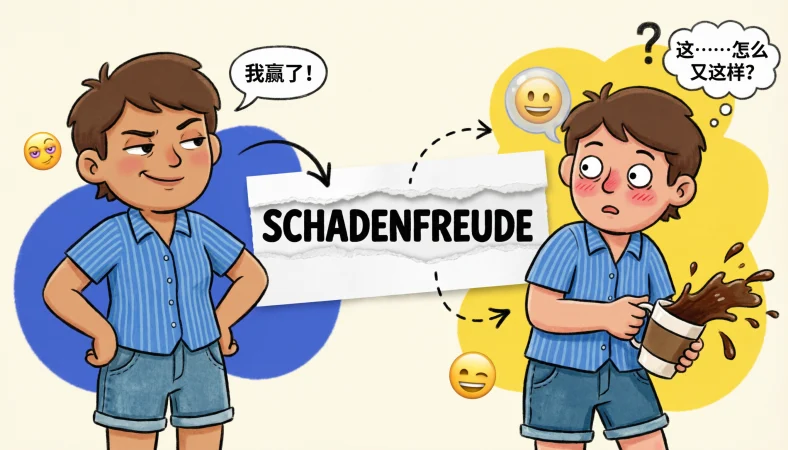

Schadenfreude means taking pleasure in another person’s misfortune or failure. The term comes from German, where Schaden means “damage” or “harm” and Freude means “joy.” It is commonly used to describe the feeling of satisfaction when someone else’s setbacks bring unexpected amusement or relief.
Have you ever felt a tiny, secret thrill when a rival trips on stage? Or experienced a quiet, private smile when the office bully gets publicly reprimanded? If so, you’ve experienced schadenfreude that peculiar, morally ambiguous feeling of pleasure derived from another person’s misfortune.
The term might sound exotic, but the experience is universal. In fact, schadenfreude is one of those concepts that immediately clicks once you understand it, like finally learning the word for that specific feeling you’ve had a hundred times but couldn’t quite name.
But here’s where it gets interesting: schadenfreude isn’t simply “being mean.” Psychology reveals it’s far more nuanced—a complex emotional cocktail influenced by fairness, social comparison, and even our deepest insecurities. Understanding the schadenfreude meaning can actually help you navigate social situations more skillfully, recognize your own emotional patterns, and maybe even choose more constructive responses when those awkward moments arise.
Ready to explore this fascinating human experience? Let’s dive into the schadenfreude meaning, its origins, and why we all feel it even when we’d rather not admit it.
The Origin and Rise of “Schadenfreude”
Etymology
The word schadenfreude comes from two German components:
- Schaden = “damage” or “harm”
- Freude = “joy” or “pleasure”
Literally translated, it means “harm-joy.” The term has been used in German literature since the 18th century, with the earliest recorded usage appearing in works from the 1740s.
How Schadenfreude Entered English
Interestingly, the schadenfreude meaning didn’t enter mainstream English vocabulary until much later. While there were earlier mentions in academic psychology texts, the term gained wider recognition in English during the late 20th century.
The turning point was likely the 1991 publication of The Schadenfreude by the English poet and critic John Mole, followed by its increasing appearance in media and popular culture. Today, it’s a well-understood term among educated English speakers, frequently appearing in newspapers, television, and everyday conversation.
Cultural Acceptance
What’s particularly interesting about the schadenfreude meaning is how our understanding has evolved. While the concept has existed across cultures for millennia the ancient Greeks called it epichairekakia the adoption of a specific German term reflects something important: we’re now more willing to acknowledge and discuss this uncomfortable emotional experience.
The modern conversation around schadenfreude has moved from condemning it as purely malicious to understanding it as a complex psychological phenomenon that reveals much about human nature.
Real-World Usage: When and Why We Experience Schadenfreude
Fairness and Justice
One of the most common triggers for schadenfreude is perceiving that someone “deserves” their misfortune. When the arrogant celebrity faces public downfall, or the rude driver gets pulled over, we feel a sense of poetic justice. In these cases, the schadenfreude meaning aligns closely with “just deserts” it’s not about relishing suffering for its own sake, but about witnessing the universe restore balance.
Social Comparison
Much of human behavior is driven by how we compare ourselves to others. When someone we perceive as superior falls, it temporarily equalizes the playing field, boosting our self-esteem through what psychologists call “downward comparison.”
Group Identity
Schadenfreude strengthens group bonds. Sports fans experience it when rivals lose. Political groups feel it when opponents face scandals. This tribal aspect of schadenfreude shows how the emotion connects to our fundamental need for belonging and identity.
Watching the Guilty Get Their Due
| Scenario | Type of Misfortune | Typical Response |
|---|---|---|
| Celebrity caught in scandal after being self-righteous | Public humiliation | Wide public schadenfreude |
| Bully getting expelled from school | Social exclusion | Fellow students feeling justice is served |
| Rude customer being corrected by staff | Being publicly wrong | Witnesses feeling quietly satisfied |
| Political figure accused of hypocrisy | Damaged reputation | Political opponents (and sometimes neutrals) experiencing pleasure |
| Arrogant colleague failing at a presentation | Professional embarrassment | Some co-workers feeling vindicated |
Examples of Schadenfreude in Context
Neutral Example
“When I heard that the self-proclaimed ‘expert’ blogger who constantly mocked others for their mistakes had published a post with numerous factual errors, I couldn’t help but experience a bit of schadenfreude.”
Tone: Neutral to slightly negative, but not actively malicious. The pleasure comes from witnessing the irony the self-appointed expert being exposed.
Friendly Example
“We were all secretly delighted when it rained on our rival team’s tournament parade. I know it’s schadenfreude, but we’d been training harder than anyone—and they’d been so cocky!” 🏆
Tone: Light and group-bonding. This type of schadenfreude is typical in competitive situations where there’s no real harm, just bruised pride.
Negative/Dismissive Example
“The way she gleefully texted everyone about his demotion was pure, ugly schadenfreude. It wasn’t justice she just wanted to see him suffer, and that’s frankly disgusting.” 😒
Tone: Strongly negative. This example highlights when schadenfreude crosses into mean-spiritedness, especially when the person enjoying the misfortune had some role in causing it or is unusually enthusiastic about it.
Comparison with Similar Terms
Understanding how schadenfreude differs from related concepts can help you distinguish between different types of misfortune-based emotions:
| Term | Definition | Key Difference |
|---|---|---|
| Schadenfreude | Pleasure from others’ misfortune | The other person’s misfortune is the direct source of joy |
| Sadism | Pleasure from causing pain | Involves actively inflicting harm, not just witnessing it |
| Envy | Pain at others’ good fortune | Opposite dynamic—you feel bad when someone else is doing well |
| Jealousy | Fear of losing what you have to another | About protection, not observation |
| Epicaricacy | A rarely-used English synonym for schadenfreude | Exact same meaning but archaic and obscure |
| Freudenfreude | Joy at others’ success | The positive opposite of schadenfreude |
| Spite | A desire to hurt others, even at cost to yourself | Involves actively harming, not passively enjoying |
Psychological Distinctions
The most important distinction is between schadenfreude and sadism. Sadism involves active harm—you want to cause suffering. Schadenfreude is passive the misfortune happened without your involvement, and you’re just witnessing it. This is why schadenfreude can feel more acceptable; you’re not culpable for the harm.
Alternate Meanings and Variations
Schadenfreude in German
In German, the schadenfreude meaning is essentially the same as in English, though native speakers often note a slightly narrower usage. There’s also a related term:
- Schadenfroh (adjective): “Gloating” or “being happy about someone else’s misfortune”
Freudenfreude (The Opposite)
While our focus is on schadenfreude meaning, it’s worth briefly discussing its positive counterpart: freudenfreude (or mudita in Buddhist psychology). This describes genuine pleasure in others’ success and happiness. Research suggests actively cultivating freudenfreude might actually be a more psychologically healthy approach to social comparison.
“Tall Poppy Syndrome”
This Australian and British term describes the cultural tendency to criticize and “cut down” those who achieve too much. While not identical to schadenfreude, it reflects the social dynamics that sometimes trigger it.
Epicaricacy
This ancient Greek-derived English word means the same as schadenfreude, though it’s so rare that many dictionaries list it as obsolete. If you’re feeling particularly intellectual, you might drop it into conversation—but most people won’t know what you mean.
Polite and Professional Alternatives
Sometimes acknowledging your schadenfreude directly isn’t appropriate, especially in professional settings. Here are more diplomatic alternatives:
Professional Contexts:
- “I understand how that situation might be seen as… poetic justice.”
- “There’s a certain irony in what happened to them, isn’t there?”
- “I suppose one could view that as karmic resolution.”
Casual Conversation:
- “I can’t help but feel like that was a bit of karma.”
- “Well, what goes around comes around, I guess.”
- “Can’t say I’m shedding any tears over that.”
Empathetic Approaches:
- I don’t wish ill on anyone, but I can see why people might be having a certain reaction to this.
- “It’s complicated—I feel for them, but I also understand why others might not.”
These alternatives help you acknowledge the situation’s dynamics without sounding like you’re actively celebrating someone’s misfortune.
The Psychology Behind Schadenfreude
Why We Feel It
Research has identified several psychological conditions that make schadenfreude more likely:
Low Self-Esteem: When people feel insecure about themselves, they’re more prone to enjoying others’ failures as a way to bolster their own self-worth.
Unfairness: Witnessing unfairness triggers schadenfreude when the “unfairly advantaged” person experiences a setback.
Dislike: Obviously, we’re more likely to enjoy bad things happening to people we dislike, but even people we like can trigger mild schadenfreude in certain circumstances.
Collective Identity: The “my team, your team” mentality strongly predicts schadenfreude, especially in sports, politics, and competitive environments.
The Neuroscience
Brain imaging studies have revealed that schadenfreude activates the brain’s reward centers—the same areas associated with pleasure from food, sex, and social status. Interestingly, this activation appears stronger when people perceive the person’s misfortune as deserved rather than random.
The Dark Side of Schadenfreude
When It Becomes Problematic
While occasional, mild schadenfreude is normal, it can become unhealthy when:
- You actively seek out others’ failures
- You feel sustained happiness from someone’s ongoing suffering
- It interferes with your ability to empathize or connect with others
- It’s paired with rumination and obsessive thinking about others’ problems
- It prevents you from supporting people who deserve it
Research and Social Impact
Studies suggest that people high in “dark triad” personality traits (narcissism, Machiavellianism, psychopathy) experience more intense and frequent schadenfreude, especially in situations where the victim is entirely innocent.
Conversely, people with high empathy levels tend to experience lower levels of schadenfreude, and when they do, they also feel guilty or uncomfortable about it.
How to Deal with Your Own Schadenfreude
Strategies for Self-Awareness
- Acknowledge it honestly: Recognizing that you feel schadenfreude doesn’t make you a bad person—it makes you human. Denying or suppressing it can actually make it more intense.
- Examine the source: Is it about fairness? Insecurity? Group identity? Understanding why you feel it can help you address the root cause.
- Balance with empathy: Actively try to understand the person’s situation and suffering. This doesn’t mean you have to like them, but recognizing their humanity can soften the pleasure.
- Focus on yourself: If schadenfreude is driven by insecurity, work on building your own self-worth rather than tearing others down.
- Practice freudenfreude: Actively celebrate others’ successes. This rewires your brain to experience positive social emotions rather than competitive ones.
When to Speak Up
In professional or personal situations where someone is experiencing real misfortune (not just mild embarrassment or minor setbacks), it’s generally best to:
- Express appropriate concern
- Offer support if you can
- Keep any schadenfreude feelings to yourself
FAQs
1. What is the exact definition of schadenfreude?
Schadenfreude is the experience of pleasure, satisfaction, or joy derived from observing the misfortunes, failures, or suffering of others. It’s a German loanword with no direct English equivalent.
2. Is schadenfreude a bad thing?
Not necessarily. While it can be unkind, mild schadenfreude is a normal human emotion. It’s often triggered by perceptions of fairness like when someone who has been arrogant or unfair faces consequences. However, it becomes problematic when you actively seek others’ suffering or feel sustained pleasure from their ongoing pain.
3. What’s the opposite of schadenfreude?
The opposite is freudenfreude (or mudita in Buddhist psychology) genuine pleasure in others’ success and happiness. This is actually considered a more psychologically healthy emotional response.
4. Can you feel schadenfreude for someone you like?
Yes! Research shows that people can experience mild schadenfreude even toward those they care about, especially in competitive situations or when the person has been arrogant or unfair. It’s usually tempered with more guilt or empathy in these cases.
5. Why do we experience schadenfreude?
Psychologically, schadenfreude can:
- Boost self-esteem: “At least I’m not them”
- Restore fairness: “They finally got what they deserved”
- Strengthen group bonds: “My team is better than their team”
- Reduce envy: “Now we’re on equal footing”
6. Is there a word for schadenfreude in English?
While there’s no direct common English equivalent, the word epicaricacy (from ancient Greek) means the same thing. However, it’s extremely rare and most people wouldn’t understand it. Schadenfreude itself is now widely used in English.
7. How is schadenfreude different from gloating?
Gloating is the expression of pleasure at others’ misfortune—it’s the outward behavior, like boasting or laughing. Schadenfreude is the internal feeling. You can experience schadenfreude without gloating, but gloating always involves some degree of schadenfreude.
8. Can schadenfreude be a positive force?
In some cases, mild schadenfreude can:
- Help you process feelings of injustice
- Motivate you to avoid similar mistakes
- Reduce envy and improve your outlook on life
- Strengthen group bonds in healthy competition
Table: Understanding Schadenfreude Through Examples
| Trigger | Example Scenario | Intensity | Moral Acceptability | Typical Context |
|---|---|---|---|---|
| Deserved Misfortune | A dishonest politician caught in a scandal | Moderate to high | Often seen as acceptable | Political discussion |
| Justice | A bully getting suspended from school | Moderate | Widely considered acceptable | Educational settings |
| Rivalry | Opposing team’s star player being injured | Low to moderate | Morally questionable but common | Sports |
| Insecurity | A more successful former classmate losing their job | High (for the person) | Usually remains private | Internal thoughts |
| Accidental | Someone spilling coffee on themselves | Low | Generally harmless | Everyday observation |
| Innocent Victim | A nice person having a terrible day | Low to none | Not acceptable | Real-life situations |
| Public Humiliation | A celebrity’s embarrassing moment going viral | Varies widely | Often debated | Social media |
| Competitive Disappointment | A rival team missing the playoffs | Moderate | Common in sports culture | Fandom |
Final Thoughts:
Understanding schadenfreude meaning isn’t about excusing unkind behavior it’s about recognizing a fundamental human experience. We all feel it occasionally, and pretending otherwise denies the rich complexity of our emotional lives.
The key insights to remember:
Schadenfreude is normal, not evil – Mild, occasional schadenfreude doesn’t make you a bad person. It’s a natural emotional response that has evolved for social and psychological reasons.
Context matters enormously – Whether schadenfreude is “acceptable” depends entirely on the situation, the severity of the misfortune, and whether the person deserved it.
It signals something deeper – Frequent or intense schadenfreude often points to insecurity, envy, or unprocessed anger. If you notice these patterns, it might be worth exploring what’s really going on underneath.
You can choose your response – While you might feel schadenfreude, you can still act with compassion and support. This is emotional intelligence in action.
Freudenfreude is a healthier path – Cultivating genuine pleasure in others’ success is ultimately more fulfilling and better for your relationships.
In the end, being aware of the schadenfreude meaning and your own tendencies toward it can help you navigate social situations with more grace, understanding, and self-awareness. And isn’t that what emotional intelligence is all about?