
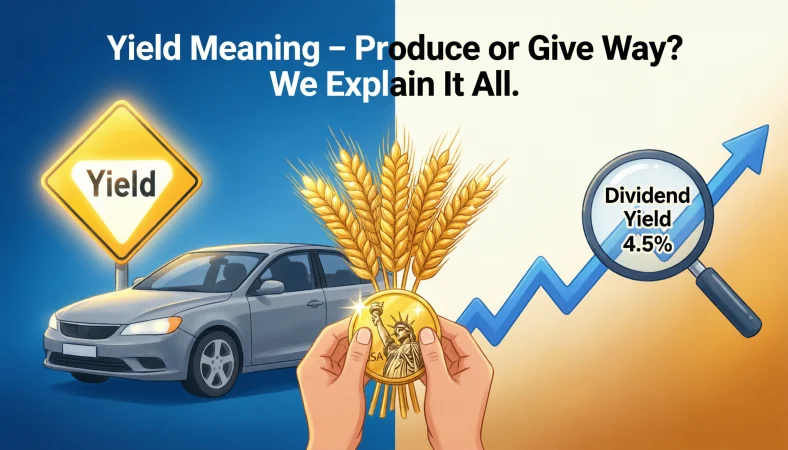

Yield (verb / noun) is a shape‑shifter of a word. As a verb, it usually means to produce, hand over, or give way. As a noun, it points to the amount you get back whether that’s bushels of wheat, dollars from a stock, or ground gained in a negotiation. In finance, it specifically means the return on an investment, often shown as a percentage.
Imagine you’re easing your car toward a junction. A red triangle with the word “YIELD” glints in the sun. You slow, check both ways, and let another driver merge ahead. Now flash to a different scene: you’re staring at your brokerage app, and a cheerful notification says, “Your bond portfolio has a 4.8% annual yield.” Same word. Totally different vibe.
That’s the magic and occasional confusion of “yield.” It slips between “produce” and “surrender” without missing a beat. Farmers talk about crop yield. Politicians debate yielding the floor. Chefs discuss yield per recipe. Investors obsess over dividend yield. And every day, millions of drivers obediently yield at intersections.
So why does one little word carry so much weight? Because it sits at the crossroads of action and outcome, of giving and getting, of effort and result. Whether you’re planting seeds, parking money, or parking your car, “yield” is there to measure what comes back or to remind you when it’s time to step aside.
This guide doesn’t just toss you a dry dictionary entry. We’ll walk through every shade of the yield meaning, from its Old English roots to its slick modern uses in finance, farming, manufacturing, and everyday chit‑chat. You’ll learn how to use it naturally, how to avoid awkward mix‑ups, and how to sound sharper in emails, meetings, and even casual conversation.
By the final paragraph, you’ll own this word and know exactly when to yield the floor, yield a profit, or yield to oncoming traffic.
A Quick Peek at the Two Big Branches of Yield Meaning
Before we zoom into details, let’s lock down the two main pillars of definition of yield:
| Branch | Core Idea | Example |
| To give way / surrender | Stepping back, letting others go first, conceding | “After hours of debate, he finally yielded to the majority vote.” |
| To produce / generate | Creating something valuable from effort or investment | “This orchard yields 200 bushels of apples per acre.” |
These two meanings aren’t enemies, they’re cousins. Both describe a relationship: between action and outcome, between pressure and release, between input and output. And once you grasp that, you can flex “yield” confidently across any setting.
Where Did “Yield” Come From? A Short Origin Story
Words, like people, have backstories. Yield traces its lineage straight back to Old English gieldan, which meant “to pay, repay, or reward.” In medieval times, if a lord demanded tribute, you’d gieldan your taxes. If a warrior surrendered, he would gieldan his sword handing it over. So even back then, the seeds of both meanings existed: paying back (production) and handing over (surrender).
Over centuries, the spelling softened into “yield,” and the meaning flowered. By the 14th century, farmers used it for harvests; by the 19th, financiers borrowed it for bond returns. Today, it’s a global utility player used everywhere from Wall Street trading floors to suburban kitchen tables.
Why has it endured so well? Because we constantly need a word that covers both what we get and what we let go. Life is a balance of producing and conceding, and “yield” captures that dance perfectly.
How to Use “Yield” in Real Life (With Tone & Context)
The beauty of this word is its flexibility, but that also means you need to read the room. Let’s break down how yield meaning shifts depending on tone, setting, and punctuation with real examples you can steal.
1. Friendly and Neutral Usage (Everyday Conversation)
When you’re chatting with friends, family, or coworkers, “yield” works best for describing results or polite concessions.
- “Our little vegetable patch yielded so many tomatoes this summer! I’m giving jars of sauce to everyone.” 🍅
- “I know you want the window seat I’ll yield to you this time.” 😊
- “That new study yielded some surprising findings about sleep and memory.”
In these examples, there’s no friction. You’re simply stating outputs or making small, gracious concessions.
2. Formal and Professional Tone (Business, Law, Finance)
Here, precision matters. “Yield” often appears in contracts, earnings calls, and legal documents.
- “The bond’s current yield is 3.2%, payable semi‑annually.”
- “Management decided to yield to shareholder demands for a more transparent ESG report.”
- “Our R&D team expects the clinical trial to yield actionable data by Q3.”
Professional contexts love “yield” because it sounds decisive and data‑driven without being cold.
3. Negative or Dismissive Tone (When You’re Not Impressed)
Sometimes “yield” carries a whiff of disappointment or stubborn resistance. Notice the shift.
- “After all that overtime, the project yielded exactly nothing useful.” 😤
- “The senator refused to yield the floor, even as the clock ran out.”
- “That expensive marketing campaign yielded a measly 0.5% conversion rate.”
In these cases, the word either flags a poor outcome or a frustrating refusal to budge.
4. With Punctuation for Emphasis
Want to add drama? Pair “yield” with emojis, bold, or italics.
- “Our new product launch? Yielded 10,000 pre‑orders in 24 hours!” 🚀
- “The negotiation? Zero yield. Zero compromise. We walked.” 💥
- “Please, just yield already I’m exhausted debating this.” 🙄
It’s remarkable how a simple word can carry so much emotional weight with just a little stylistic help.
Yield in Specific Industries: Where the Meaning Really Shines
📊 Finance & Investing – The Dividend Darling
This is the big one. When people Google yield meaning, half the time they’re staring at a stock ticker.
In finance, yield = the income your investment generates, typically from interest or dividends, expressed as a percentage of the investment’s cost or current price.
- Dividend yield – annual dividends per share divided by the stock price.
- Bond yield – the annual interest you receive relative to the bond’s face value or market price.
- Earnings yield – earnings per share divided by share price (the inverse of the P/E ratio).
Example: You buy a stock at $100. It pays $4 in dividends each year. That’s a 4% dividend yield. If the stock price drops to $80 but the dividend stays $4, your yield jumps to 5% (if you buy at the new price). Yields are dynamic and they move with prices.
Pro tip: A high yield isn’t always good. Sometimes it signals a falling stock price or a risky investment. Always pair yield with fundamentals.
🌾 Agriculture & Manufacturing – The Output King
Farmers and factory managers live and die by yield.
- Crop yield = amount of harvest per unit of land (bushels per acre, tons per hectare).
- Manufacturing yield = the percentage of good, usable products coming off a production line (vs. defective ones).
Example: A bakery oven yields 500 loaves per batch, but if 50 burn, the good yield is 450 loaves. Improving that yield saves flour, time, and money.
🚦 Traffic & Driving – The Polite Rule
The “Yield” sign is the polite cousin of the “Stop” sign. You don’t necessarily halt; you slow down and give priority to other vehicles or pedestrians.
Example: At a roundabout, you yield to cars already in the circle. It’s about flow, not full stop very different from “give way” in some countries, but essentially the same courtesy.
🗣️ Conversation & Negotiation – Yielding the Floor
In meetings or parliaments, “yield” means allowing someone else to speak.
- “I yield the floor to my colleague from marketing.”
- “She yielded her speaking time to the junior researcher.”
It’s a gracious, collaborative move that builds trust.
Comparison: Yield vs. Similar Terms You Might Mix Up
Let’s clear up the cousins and look‑alikes.
| Term | Meaning | How It Differs from Yield |
| Return | Total profit or loss on an investment, including price changes and income. | Return is broader; yield focuses only on income (interest/dividends). |
| Rate of Return | Percentage gain or loss over time. | Includes capital appreciation; yield doesn’t. |
| Production | The act of creating goods or services. | Yield is the quantity produced, not the process itself. |
| Concede | To acknowledge something reluctantly. | Yield is more neutral; concede often implies defeat or reluctance. |
| Surrender | To give up completely, often under force. | Yield feels less dramatic more like stepping aside than waving a white flag. |
| Throughput | The rate at which a system processes items. | Yield measures quality output; throughput measures speed of processing. |
So if you’re talking about your stock’s total gain (price up + dividends), say “return.” If you’re only talking about the dividend or interest, say “yield.” And if you’re stepping aside for a coworker, say “yield” not “surrender” (unless you’re in a spy movie).
Alternative and Related Meanings You Might Not Know
“Yield” also pops up in less common but still valid ways:
- Chemistry / Physics – the amount of product obtained from a chemical reaction (e.g., “This reaction yielded 85% purity”).
- Grammar – yield as a noun in linguistics (the total number of words or phrases produced in a corpus).
- Insurance – the return on an insurance policy’s cash value.
- Real Estate – rental yield = annual rent divided by property price.
Even though these are niche, they all orbit the same sun: output or concession.
Polite & Professional Alternatives to “Yield”
Sometimes you want to avoid repeating “yield” too often, or you need a softer or more formal option. Here’s a cheat sheet:
| Instead of “yield” (giving way) | Instead of “yield” (producing) |
| Step aside | Generate |
| Give way | Produce |
| Concede | Return (in finance context) |
| Defer | Deliver |
| Accommodate | Provide |
| Grant | Offer |
Example: Instead of “I yield to your request,” you might say, “I’m happy to accommodate your request.” Instead of “This farm yields 500 tons,” say “This farm produces 500 tons.”
But don’t abandon “yield” entirely it’s crisp, professional, and often more precise.
FAQs
1. What is the simplest definition of yield?
At its simplest, yield means either (1) to produce something (like crops, profit, or results) or (2) to give way or surrender (like letting someone merge in traffic). It’s a two‑face word, but both faces share the same DNA: action and outcome.
2. What does yield mean in finance?
In finance, yield is the income you earn from an investment, usually expressed as a percentage. For stocks, it’s dividends divided by price. For bonds, it’s interest divided by price. It does not include capital gains (price increases) that’s “total return.”
3. Is yield the same as return?
Nope. Return includes all changes in value price appreciation + income. Yield only counts the income (dividends or interest). So your total return could be 10% while your yield is only 3%.
4. What does it mean to yield in a conversation?
It means you give someone else the chance to speak. You “yield the floor” or “yield your time.” It’s a polite, collaborative gesture, often used in meetings, debates, and formal assemblies.
5. What is a good dividend yield?
It depends on the market. Generally, 2%–6% is considered healthy for stocks. Above 8% might signal extra risk. Bond yields vary by credit quality and central bank rates. Always benchmark against similar investments.
6. How do you calculate yield?
For a bond: (Annual interest payment ÷ Price) × 100. For a stock: (Annual dividend per share ÷ Stock price) × 100. For crops: (Total harvested amount ÷ Land area) – simple division.
7. Why do they put “Yield” on road signs?
To remind drivers to slow down and give priority to other vehicles or pedestrians. It’s a safety rule that keeps traffic flowing smoothly and is much more flexible than a full stop.
8. Can yield be negative?
In finance, nominal yields are rarely negative, but in some economic climates (e.g., Japan or Europe), bond yields have dipped below zero. In farming, a negative yield makes no sense; you can’t harvest a negative amount, though bad weather can yield poor results.
Quick Comparison Table: Yield in Different Contexts
| Context | Meaning | Example Sentence |
| Traffic | Give priority | “Please yield to pedestrians at the crosswalk.” |
| Finance | Income return | “This bond offers a 4.5% annual yield.” |
| Farming | Harvest amount | “The cornfield yielded 180 bushels per acre.” |
| Manufacturing | Good output rate | “Our quality yield improved from 92% to 97%.” |
| Meeting | Let others speak | “I yield my remaining time to the CFO.” |
| Chemistry | Product from reaction | “The experiment yielded 2.3 grams of pure compound.” |
| Negotiation | Concede or compromise | “Both sides yielded on minor points to seal the deal.” |
Practical Tips for Using “Yield” Like a Pro
- In emails – Use “yield” to sound decisive but polite. “Our analysis yielded three clear options. I yield to your preference on the final choice.”
- In presentations – Define your terms early. “When I say yield, I mean annual dividend income, not total price appreciation.”
- In casual chat – Keep it light. “My garden yielded enough basil for a year’s worth of pesto!”
- In negotiations – Use “yield” to show flexibility without weakness. “We’re willing to yield on delivery dates, but not on quality standards.”
- In writing – Vary your vocabulary. If you’ve used “yield” three times in a paragraph, swap in “produce,” “generate,” or “provide” to keep it fresh.
Final Takeaway: Why Understanding Yield Matters
We’ve walked a long road from medieval tax payments to modern stock tickers, from farm fields to roundabout signs. What ties it all together? The beautiful duality of yield means: sometimes you give (way, time, space), and sometimes you get (returns, harvests, insights). Both are essential to how we navigate life, business, and money.
If you take one thing from this guide, let it be this: context is king. Before you use “yield,” pause for half a second and ask, am I talking about producing or surrendering? The answer shapes your sentence and ensures you’re understood perfectly.
And don’t be afraid to use it often. It’s professional without being stuffy, flexible without being vague. Whether you’re drafting an investment memo, planning next season’s crops, or simply letting a colleague speak first, “yield” has your back.
So go ahead yield to that merging car, yield that impressive quarterly report, and yield the floor when someone else has something important to say. You’ll be wielding one of the most useful words in the English language.