

Quick Answer
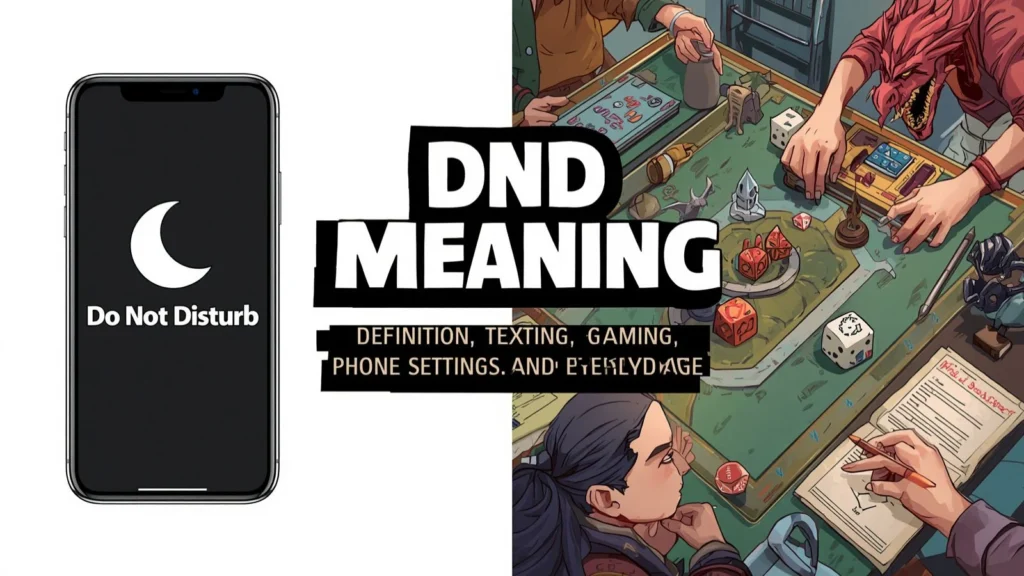
The DND meaning most commonly stands for “Do Not Disturb.” It refers to a feature on smartphones, computers, and messaging apps that silences calls and notifications. In other contexts, DND can also stand for “Dungeons & Dragons,” the popular tabletop role-playing game.
If you’ve seen DND in a text message, on someone’s social media status, or in your phone settings, you may have wondered what it means. In most situations, DND stands for “Do Not Disturb,” a mode that helps people avoid interruptions by muting notifications, calls, and alerts while they work, study, sleep, or attend meetings.
However, DND can also refer to Dungeons & Dragons, one of the world’s most famous fantasy role-playing games. The correct meaning depends entirely on the conversation. Understanding the DND meaning makes it easier to interpret messages, online posts, and everyday conversations.
DND Meaning at a Glance
| Term | DND |
|---|---|
| Full Form | Do Not Disturb |
| Alternative Meaning | Dungeons & Dragons |
| Pronunciation | Dee-En-Dee |
| Part of Speech | Acronym |
| Primary Meaning | A mode that silences notifications and calls. |
| Common Contexts | Smartphones, texting, gaming, social media, work, and messaging apps |
| Tone | Informative, casual |
| Example Sentence | My phone is on DND while I’m in class. |
What Does DND Mean?
The most common meaning of DND is “Do Not Disturb.”
When someone says they’re on DND, it usually means they don’t want to be interrupted because they’re sleeping, working, studying, or focusing on something important.
Example:
“Sorry I didn’t answer. My phone was on DND.”
The Origin of DND
The phrase Do Not Disturb has been used for decades on hotel room signs requesting privacy.
As smartphones and computers became more advanced, technology companies adopted the phrase for a feature that temporarily silences notifications.
Today, nearly every major operating system includes a Do Not Disturb mode.
DND Meaning in Different Contexts
On Smartphones
DND silences incoming calls, messages, and notifications.
Example:
“I turn on DND every night before bed.”
In Text Messages
People often use DND to explain why they didn’t reply.
Example:
“I wasn’t ignoring you. My phone was on DND.”
On Social Media
Users sometimes add DND to their profile or status to show they’re unavailable.
Example:
“DND. Working on a project.”
At Work
Employees use DND mode to minimize distractions during meetings or focused work.
Example:
“Please message me later. I’m on DND until noon.”
In Gaming
DND can also stand for Dungeons & Dragons, the classic fantasy tabletop role-playing game.
Example:
“Our DND campaign starts every Saturday evening.”
Common Uses of DND
Sleeping
People activate DND to avoid late-night notifications.
Example:
“I always enable DND before sleeping.”
Studying
Students use it to maintain focus.
Example:
“My phone stays on DND during exams.”
Meetings
Professionals use DND to prevent interruptions.
Example:
“Please wait until my meeting ends. I’m on DND.”
Gaming
Players use DND when discussing Dungeons & Dragons.
Example:
“We’re creating new DND characters tonight.”
Examples of DND in Sentences
- My phone is on DND during work hours.
- She forgot to turn off DND this morning.
- DND helps me focus while studying.
- I missed your call because I was on DND.
- Our DND game lasted five hours.
- Many people schedule DND automatically at night.
- He changed his status to DND.
- DND mode prevents unnecessary distractions.
Other Meanings of DND
Although Do Not Disturb is the most common meaning, DND may also refer to:
- Dungeons & Dragons
- Department of National Defence (in some countries)
- Various company or organization abbreviations depending on the context
Synonyms of DND (Do Not Disturb)
Depending on the situation, similar expressions include:
- Silent mode
- Focus mode
- Quiet mode
- Notification mute
- Sleep mode
- Privacy mode
- Busy mode
DND vs Silent Mode
Although similar, they are not identical.
| DND | Silent Mode |
|---|---|
| Blocks or limits notifications and calls. | Primarily silences the phone’s ringtone. |
| Can allow selected contacts to reach you. | Usually silences all incoming sounds. |
| Often includes scheduling and customization. | Simpler sound-only setting. |
Why Is DND So Popular?
DND has become an essential feature because it helps people reduce distractions and improve focus.
You’ll commonly see it used on:
- Smartphones
- Tablets
- Computers
- Discord
- Slack
- Gaming communities
Its flexibility makes it useful for work, school, sleep, and personal time.
FAQs
What does DND mean?
DND most commonly stands for Do Not Disturb, a feature that silences calls and notifications. It can also mean Dungeons & Dragons depending on the context.
What does DND mean in texting?
In texting, DND usually means the sender’s phone was on Do Not Disturb, so they may not have seen messages immediately.
Does DND block phone calls?
It can. Many devices allow users to block all calls or allow calls only from selected contacts.
What is the difference between DND and Silent Mode?
DND offers more advanced controls, such as scheduling, contact exceptions, and notification management, while Silent Mode mainly mutes sounds.
What does DND mean in gaming?
In gaming, DND often refers to Dungeons & Dragons, the famous tabletop role-playing game.
How do you pronounce DND?
It is commonly pronounced Dee-En-Dee.
Conclusion
The DND meaning most commonly refers to Do Not Disturb, a feature that helps people avoid interruptions by silencing calls and notifications. Depending on the conversation, it can also stand for Dungeons & Dragons, one of the world’s most popular tabletop games. Understanding the context makes it easy to identify which meaning is intended, whether you’re texting a friend, checking your phone settings, or joining a gaming session.