
Quick Answer
The fight or flight response is the body’s automatic reaction to a perceived threat or stressful situation. It prepares you to either face the danger or get away from it by increasing alertness, heart rate, breathing, and muscle readiness.
Top alternatives: fight or flight response meaning, stress response, acute stress response, fight flight freeze response, survival response
Ever felt your heart suddenly race before an important presentation, scary moment, argument, or unexpected problem? That reaction can be your fight or flight response kicking in. Your brain detects a possible threat and quickly prepares your body to deal with it. Your heart may beat faster, your breathing can become quicker, and your muscles may feel tense or ready to move. Despite the name, you don’t always have to physically fight or run away. The same response can appear during everyday stress, such as exams, public speaking, difficult conversations, or stressful work situations. Understanding how this response works can make those strange physical sensations feel a lot less mysterious. It can also help you recognize when your body is reacting to stress rather than an actual immediate danger.
What Is the Fight or Flight Response?
The fight or flight response is an automatic physiological reaction to a perceived threat.
It prepares the body to respond quickly to danger.
The two classic choices are:
Fight: Face or confront the threat.
Flight: Escape or move away from the threat.
The response is closely connected to the body’s sympathetic nervous system.
Why Does the Fight or Flight Response Happen?
Your body is designed to respond quickly when it detects potential danger.
The brain evaluates information from the environment and can activate the stress response when something seems threatening.
This can happen because of:
- Physical danger
- Sudden noises
- Arguments
- Work pressure
- Public speaking
- Financial stress
- Social rejection
- Traumatic reminders
- Unexpected events
The body doesn’t always distinguish perfectly between a physical threat and an intense emotional stressor.
How Does the Fight or Flight Response Work?
The process happens quickly.
A simplified version looks like this:
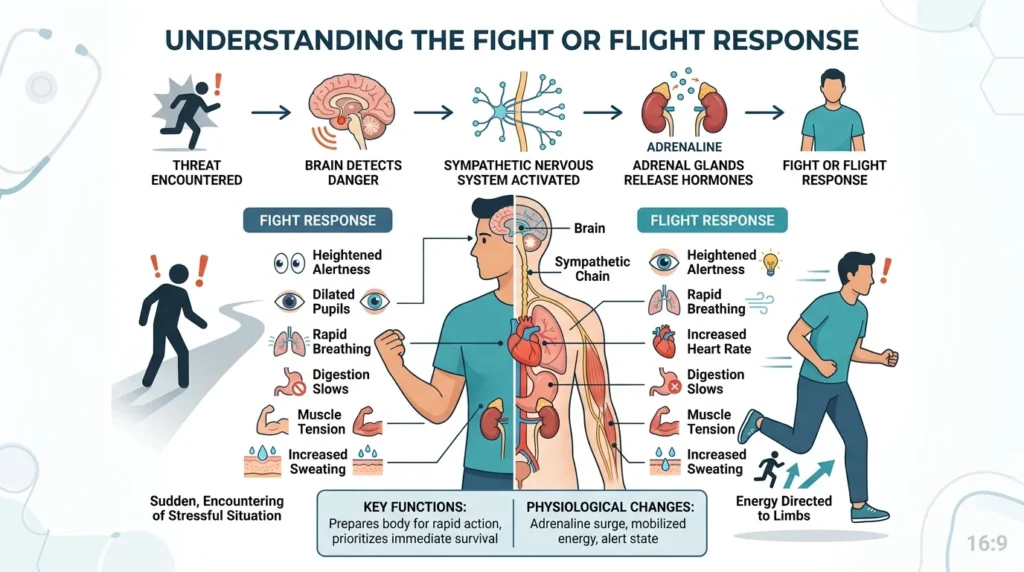
Perceived threat → Brain detects danger → Stress system activates → Adrenaline increases → Body prepares for action
The sympathetic nervous system becomes more active.
Stress hormones such as adrenaline help prepare the body for rapid action.
Fight Response
The fight response prepares you to confront a perceived threat.
You might notice:
- Increased heart rate
- Muscle tension
- Faster breathing
- Irritability
- Anger
- Increased alertness
- Strong urge to argue or confront
- Feeling physically energized
For example, during a heated argument, someone may suddenly feel extremely defensive and ready to fight back verbally.
Flight Response
The flight response prepares you to escape from danger.
Possible reactions include:
- Rapid heartbeat
- Faster breathing
- Restlessness
- Sweating
- Trembling
- Strong urge to leave
- Difficulty staying still
- Feeling overwhelmed
For example, someone experiencing intense fear before speaking in front of a crowd may suddenly want to leave the room.
Fight or Flight Symptoms
Common physical symptoms can include:
| Symptom | What You May Notice |
|---|---|
| Faster heartbeat | Heart feels like it’s pounding |
| Rapid breathing | Breathing becomes quicker |
| Sweating | Increased perspiration |
| Muscle tension | Body feels tight or stiff |
| Shaking | Hands or body may tremble |
| Dry mouth | Mouth feels unusually dry |
| Increased alertness | More focused on potential danger |
| Stomach changes | Nausea or butterflies |
| Dilated pupils | Eyes become more sensitive to visual information |
| Reduced appetite | Digestion temporarily becomes less important |
Not everyone experiences every symptom.
Fight or Flight Response Examples
Public Speaking
Your presentation starts, and suddenly your heart is racing.
Your body may interpret the situation as a threat even though you’re physically safe.
Job Interview
You know the answers, but your hands start sweating as soon as the interview begins.
Stress has activated your body’s alert system.
Road Accident
A car suddenly swerves toward you.
Your body can react before you have time to consciously process everything.
Argument
Someone becomes aggressive during an argument.
You may feel an immediate urge to defend yourself or walk away.
Exam Stress
Your test begins, and your heart starts pounding.
Your brain may interpret the high-pressure situation as a threat.
Fight or Flight vs Freeze
Not everyone responds to stress by fighting or running.
Some people experience a freeze response.
Freeze can involve:
- Feeling unable to move
- Going blank
- Feeling disconnected
- Difficulty speaking
- Feeling stuck
- Becoming unusually quiet
Freeze is another protective response to perceived danger.
Fight, Flight, Freeze, and Fawn
People sometimes describe four common stress-response patterns:
Fight: Confront the perceived threat.
Flight: Escape from the perceived threat.
Freeze: Become still or mentally stuck.
Fawn: Try to reduce danger by pleasing or appeasing another person.
These labels are useful for describing patterns, but human stress responses can be more complicated than four simple categories.
Fight or Flight and the Nervous System
The sympathetic nervous system plays an important role in the fight or flight response.
It helps prepare the body for immediate action.
The parasympathetic nervous system generally supports recovery and relaxation after the threat has passed.
A simplified comparison is:
| System | General Role |
|---|---|
| Sympathetic nervous system | Mobilizes the body during stress |
| Parasympathetic nervous system | Supports rest and recovery |
Both systems are essential.
Fight or Flight Hormones
The adrenal glands release hormones including epinephrine, also called adrenaline, during acute stress.
Adrenaline can contribute to:
- Increased heart rate
- Increased blood flow to muscles
- Increased alertness
- Faster breathing
- Increased energy availability
Another important stress hormone is cortisol, which is involved in the body’s broader stress response.
What Happens to Your Heart?
During the fight or flight response, your heart rate can increase.
This helps circulate blood more rapidly through the body.
The purpose is to support physical action.
That’s useful if you actually need to run away from danger.
It’s less helpful when the “danger” is simply an email from your boss saying, “Can we talk?”
What Happens to Your Breathing?
Breathing can become faster during acute stress.
The body is preparing for increased physical activity.
Some people may notice:
- Rapid breathing
- Short breaths
- Feeling unable to take a satisfying breath
- Chest tightness
Stress can make breathing feel uncomfortable even when there isn’t a physical emergency.
What Happens to Digestion?
During acute stress, the body prioritizes systems needed for immediate action.
Digestive activity can change.
This may contribute to:
- Butterflies
- Nausea
- Stomach discomfort
- Changes in bowel habits
That explains why stressful moments can sometimes make your stomach feel like it has joined the drama.
Why Do You Shake During Fight or Flight?
Shaking or trembling can happen when your body is highly activated.
Muscles may become tense and ready for action.
After the stressful event passes, some people notice more obvious trembling as their body begins returning toward a calmer state.
Why Do You Sweat During Stress?
Sweating helps regulate body temperature and is also part of the body’s stress response.
During intense stress, you may notice sweating on your:
- Palms
- Face
- Underarms
- Feet
This can happen even when the environment isn’t particularly hot.
Fight or Flight During Everyday Life
The response isn’t limited to emergencies.
Everyday situations can activate stress responses.
Examples include:
- Giving a presentation
- Meeting a deadline
- Taking an exam
- Going on a first date
- Receiving unexpected news
- Having a difficult conversation
- Driving in heavy traffic
- Speaking in a meeting
The body can react strongly even when the situation isn’t physically dangerous.
Fight or Flight and Anxiety
Anxiety can involve repeated activation of the body’s threat-response systems.
Someone experiencing anxiety may notice symptoms such as:
- Racing heart
- Muscle tension
- Restlessness
- Rapid breathing
- Sweating
- Feeling on edge
However, occasional fight or flight reactions are a normal part of human physiology.
Persistent or severe symptoms may deserve professional evaluation.
Fight or Flight and Stress
Stress can activate the body’s threat-response systems.
Short-term activation can be useful because it increases alertness and prepares you to act.
Problems can arise when stress becomes frequent, prolonged, or difficult to manage.
Long-term stress can affect sleep, mood, concentration, and overall well-being.
How Long Does Fight or Flight Last?
The immediate response can happen within seconds.
How long the physical effects continue varies depending on:
- The intensity of the threat
- Whether the threat continues
- Individual biology
- Previous experiences
- Ongoing stress
Once the brain determines that the threat has passed, the body can gradually move toward a calmer state.
What Happens After Fight or Flight?
After the stressful event, you may feel:
- Tired
- Shaky
- Relieved
- Emotional
- Hungry
- Drained
- Sleepy
This happens because the body has been using energy while operating in a highly activated state.
How to Calm the Fight or Flight Response
If you’re experiencing a stress response and you’re physically safe, several simple techniques may help.
Slow Your Breathing
Try taking slower, comfortable breaths.
Avoid forcing extremely deep breaths if they make you feel uncomfortable.
Relax Your Muscles
Gently release tension from your shoulders, jaw, hands, and legs.
Ground Yourself
Pay attention to things you can see, hear, and physically feel around you.
Move Your Body
A gentle walk can help you shift attention and release some physical tension.
Reduce Stimulation
Move away from unnecessary noise, arguments, or overwhelming environments when possible.
Give Yourself Time
The nervous system doesn’t always switch from high alert to completely calm instantly.
Fight or Flight at Work
Work situations can trigger stress responses too.
Common examples include:
- Presentations
- Performance reviews
- Difficult meetings
- Conflict with coworkers
- Deadlines
- Public criticism
- Job interviews
Recognizing the reaction can help you pause before responding impulsively.
Fight or Flight in Relationships
Relationship conflict can activate strong emotional and physical reactions.
Someone may:
- Become defensive
- Want to leave the conversation
- Become silent
- Try to appease the other person
- Feel physically tense
Recognizing these patterns can make difficult conversations easier to navigate.
Fight or Flight During Public Speaking
Public speaking is a classic example of a nonphysical situation that can trigger a physical stress response.
You might experience:
- Sweaty palms
- Racing heart
- Shaky voice
- Dry mouth
- Rapid breathing
- Blank thoughts
Preparation and gradual exposure can help many people become more comfortable with public speaking.
Fight or Flight During an Emergency
In a genuine emergency, the fight or flight response can be extremely useful.
It can:
- Increase alertness
- Speed up reactions
- Mobilize energy
- Prepare muscles for movement
- Focus attention on immediate danger
The response exists because it has helped humans survive threatening situations.
Is Fight or Flight Bad?
No.
The fight or flight response is a normal survival mechanism.
It becomes a concern when the body’s alarm system activates too frequently, lasts too long, or causes significant problems in everyday life.
The goal isn’t to eliminate the response.
The goal is to understand it and manage stress effectively.
Fight or Flight vs Stress Response
The terms are closely related.
Fight or flight response usually refers to the body’s rapid reaction to perceived danger.
Stress response can describe a broader collection of physiological and psychological reactions to stress.
The stress response can involve several systems throughout the body.
Fight or Flight vs Panic Attack
A panic attack can include intense symptoms that overlap with the fight or flight response.
These may include:
- Racing heart
- Sweating
- Trembling
- Shortness of breath
- Dizziness
- Fear
However, a panic attack is a specific clinical phenomenon, while fight or flight is a normal physiological response to perceived threat.
When Should You Seek Help?
Occasional stress reactions are normal.
Consider talking with a qualified healthcare professional if intense stress symptoms:
- Happen frequently
- Interfere with daily activities
- Affect sleep
- Make you avoid normal situations
- Feel difficult to control
- Cause significant distress
If symptoms are new, severe, or potentially related to a medical emergency, seek appropriate medical care rather than assuming they’re caused by stress.
Fight or Flight Response in Simple Terms
Here’s the entire concept in one sentence:
Your brain detects a possible threat, your body shifts into high alert, and you become physically prepared to deal with the situation.
That’s the fight or flight response.
FAQs
What is the fight or flight response?
It’s the body’s automatic reaction to a perceived threat that prepares you to confront or escape from danger.
What causes the fight or flight response?
Physical danger, emotional stress, fear, conflict, and other situations that the brain interprets as threatening can trigger it.
What are common fight or flight symptoms?
A racing heart, faster breathing, sweating, muscle tension, shaking, and increased alertness are common symptoms.
Is fight or flight normal?
Yes. It’s a normal and important part of the body’s survival system.
Can anxiety trigger fight or flight?
Yes. Anxiety can activate the body’s threat-response systems even when there isn’t an immediate physical danger.
What is the difference between fight and flight?
Fight involves confronting a perceived threat, while flight involves trying to escape or move away from it.
What is the freeze response?
Freeze is a stress reaction where someone may become still, unable to act, mentally stuck, or unusually quiet.
Can fight or flight happen without real danger?
Yes. The brain can activate the response when it perceives a situation as threatening, even when there is no immediate physical danger.
How can I calm a fight or flight response?
If you’re safe, slowing your breathing, relaxing your muscles, grounding yourself, and moving to a calmer environment may help.
How long does the fight or flight response last?
The initial response can happen within seconds, while the physical effects may take longer to settle depending on the situation.
Conclusion
The fight or flight response is your body’s built-in alarm system. When your brain senses a possible threat, it can quickly increase your heart rate, breathing, alertness, and muscle readiness so you’re prepared to respond. Sometimes that system kicks in during a genuine emergency. Other times, it reacts to an exam, argument, presentation, deadline, or stressful message.
Understanding the difference can make those sudden physical sensations much less confusing. Remember, fight or flight isn’t your body failing you. It’s your body trying to protect you. The key is learning how to recognize the response and give yourself time to return to a calmer state when the threat has passed.
See Also More :
- 300+ How to See Replies on X (Twitter): Complete Guide for Mobile, Desktop and Hidden Conversations 2026
- Responses
- 200+ Happy Mother’s Day Replies: That Are Sweet, Emotional & Perfect to Send