

Quick Answer
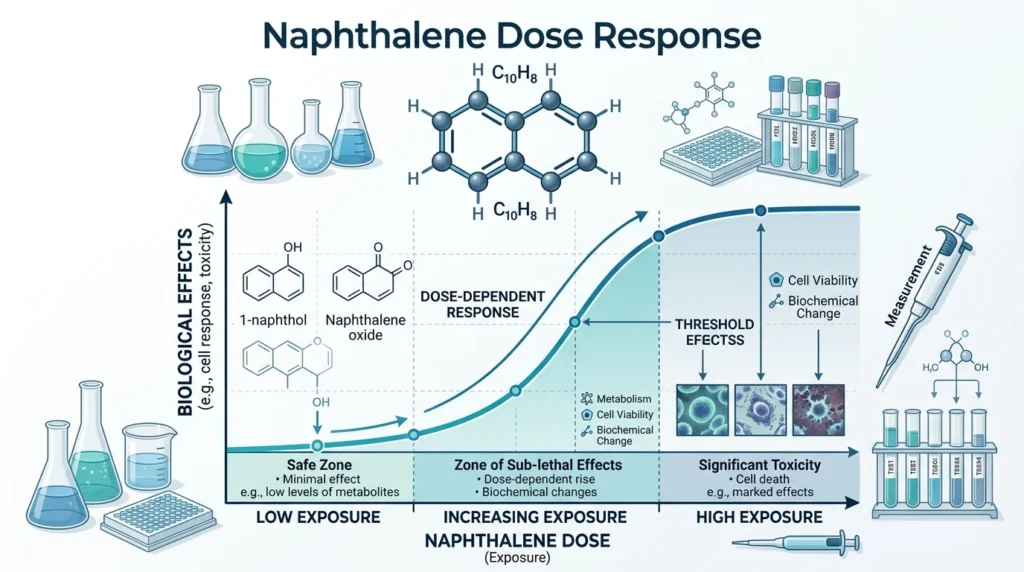
Naphthalene dose response describes how the type or severity of a health effect changes as exposure increases. For naphthalene, the available evidence shows important differences depending on the exposure route, duration, and health outcome. EPA’s established reference values are based largely on animal data, while human dose-response information remains limited.
Top points: naphthalene toxicity, dose-response relationship, oral exposure, inhalation exposure, health effects
Naphthalene is a chemical best known for its use in moth repellents and for its presence in some industrial environments. When people search for “naphthalene dose response,” they’re usually looking for information about how increasing exposure may change the risk or severity of harmful effects. That question isn’t quite as simple as finding one toxic dose. The response can depend on whether exposure happens by inhalation, ingestion, or another route, how long the exposure lasts, and which health effect is being considered. Research has linked naphthalene exposure with effects such as hemolytic anemia and respiratory or nasal tissue damage. However, reliable human dose-response data are limited, which is why regulatory assessments often rely heavily on animal studies and modeling.
What Does Naphthalene Dose Response Mean?
A dose-response relationship describes how a biological effect changes as exposure to a substance increases.
In simple terms:
More exposure → potentially greater biological response
But that doesn’t mean every health effect increases in exactly the same way.
The response can depend on:
- Amount of exposure
- Exposure route
- Exposure duration
- Frequency of exposure
- Individual susceptibility
- Metabolism
- The specific health outcome
EPA defines a dose-response relationship as the connection between a quantified exposure and the proportion or degree of a biological response.
Why Naphthalene Dose Response Is Important
Understanding dose response helps scientists estimate potential health risks.
It can help answer questions such as:
- At what exposure levels do effects appear?
- Which organs are most sensitive?
- Does longer exposure increase risk?
- Are some populations more vulnerable?
- How much uncertainty exists in the available evidence?
These questions are important when developing health-based exposure guidelines.
How Naphthalene Affects the Body
Naphthalene is metabolized into several compounds in the body.
Some metabolites can contribute to toxic effects.
The current toxicological evidence focuses on several potential targets, including:
- Blood
- Respiratory tissues
- Nasal tissues
- Eyes
- Liver
- Other tissues depending on exposure conditions
The mechanism can differ between species, which is one reason researchers use physiologically based pharmacokinetic models when interpreting animal findings for humans.
Naphthalene Oral Dose Response
Oral exposure means naphthalene enters the body through ingestion.
Human poisoning reports have associated acute oral exposure with effects including:
- Hemolytic anemia
- Eye effects
- Other signs of toxicity
However, EPA previously noted that adequate human dose-response data for these effects were not available.
This means you shouldn’t interpret a particular reported poisoning dose as a safe or generally applicable threshold.
Naphthalene Inhalation Dose Response
Inhalation exposure occurs when naphthalene vapor or particles are breathed in.
Animal studies have identified nasal tissue effects as important endpoints.
EPA’s established inhalation reference concentration is 0.003 mg/m³, based on nasal effects observed in chronic mouse inhalation research. The underlying point of departure was a human-equivalent concentration of 9.3 mg/m³, with a large uncertainty factor used in deriving the reference concentration.
This value is a risk assessment reference value, not a statement that exposure above it will immediately cause illness.
Naphthalene Oral Reference Dose
EPA’s historical IRIS assessment lists an oral reference dose of 0.02 mg/kg-day.
The value was based on decreased terminal body weight in male rats and included a large uncertainty factor because of limitations in the available evidence. EPA gives the confidence in this value a low rating.
A reference dose should not be interpreted as a toxic dose or a recommended exposure level.
Human Naphthalene Dose Response
Human dose-response information is one of the biggest limitations in naphthalene risk assessment.
EPA’s evidence review found that available epidemiological studies often have limitations involving exposure measurement and other factors, making them less suitable for quantitative dose-response analysis. Animal studies currently provide stronger datasets for developing reference values.
That’s why researchers should be careful when translating animal doses directly into human exposure levels.
Naphthalene and Hemolytic Anemia
One of the important human health concerns associated with naphthalene exposure is hemolytic anemia.
This happens when red blood cells are destroyed faster than the body can replace them.
Susceptibility can vary between people.
EPA has specifically identified people with glucose-6-phosphate dehydrogenase deficiency as potentially more susceptible to naphthalene-induced hemolysis. Newborns can also be particularly sensitive.
Naphthalene and Nasal Effects
Nasal tissue is an important target in inhalation studies.
Chronic mouse studies identified:
- Hyperplasia of respiratory epithelium
- Metaplasia of olfactory epithelium
as critical effects used in EPA’s inhalation assessment.
These findings are part of the reason inhalation dose response receives significant attention in toxicology research.
Naphthalene and Eye Effects
Eye effects have also been reported in connection with naphthalene exposure.
Human reports have included cataracts following overexposure, while animal studies have also identified ocular effects.
However, the relationship between exposure dose and these effects isn’t sufficiently characterized in humans to provide a simple dose-response threshold.
Acute vs Chronic Naphthalene Exposure
Exposure duration matters.
Acute Exposure
Acute exposure happens over a relatively short period.
Potential concerns can include significant poisoning and blood-related effects.
Chronic Exposure
Chronic exposure occurs repeatedly or over a long period.
Research has focused on potential:
- Respiratory effects
- Nasal tissue changes
- Cancer-related concerns
- Other systemic effects
The response may differ substantially between short-term and long-term exposure.
Dose vs Concentration
These terms aren’t interchangeable.
Dose generally refers to the amount entering or administered to an organism.
Concentration describes how much of a chemical is present in a particular medium, such as air.
For inhalation risk assessments, concentration is commonly expressed as:
mg/m³
For oral reference doses, exposure is commonly expressed as:
mg/kg-day
Understanding the units is essential when interpreting toxicology data.
Naphthalene Dose Response in Animal Studies
Animal studies provide much of the quantitative evidence used in current risk assessment.
Researchers have studied naphthalene using different:
- Species
- Exposure routes
- Exposure concentrations
- Exposure durations
- Biological endpoints
The resulting data can help identify points of departure for risk assessment.
However, animal findings aren’t automatically equivalent to human outcomes.
Why Animal Data Are Used
Human studies often lack precise information about how much naphthalene an individual actually absorbed.
Animal experiments can control:
- Dose
- Concentration
- Timing
- Exposure route
- Duration
- Biological measurements
EPA’s systematic evidence review concluded that available animal studies are generally more suitable than epidemiological studies for quantitative dose-response evaluation of naphthalene.
What Is a NOAEL?
NOAEL stands for No-Observed-Adverse-Effect Level.
It refers to the highest tested exposure level at which a specific adverse effect wasn’t observed under the conditions of a particular study.
A NOAEL is not necessarily a universal “safe dose.”
It depends on the study design and endpoint.
What Is a LOAEL?
LOAEL means Lowest-Observed-Adverse-Effect Level.
It is the lowest tested exposure level at which an adverse effect is observed.
EPA’s historical naphthalene inhalation assessment used a human-equivalent LOAEL of 9.3 mg/m³ as part of the basis for the inhalation reference concentration.
What Is an RfD?
An RfD is a Reference Dose.
It is an estimate of a daily oral exposure that is unlikely to cause appreciable risk of harmful effects during a lifetime, including uncertainty and variability considerations.
EPA’s historical naphthalene RfD is:
0.02 mg/kg-day
The agency gives the value low confidence because of limitations in the available database.
What Is an RfC?
An RfC is a Reference Concentration for inhalation exposure.
EPA’s historical naphthalene RfC is:
0.003 mg/m³
It was derived using nasal effects observed in chronic mouse inhalation studies.
Naphthalene Dose Response and Cancer
Naphthalene has also been studied for potential carcinogenic effects.
Cancer risk assessment is more complicated than simply identifying one toxic dose because researchers consider:
- Cancer incidence
- Exposure duration
- Route
- Mechanism of action
- Species differences
- Dose-response modeling
EPA has continued to examine the evolving evidence surrounding naphthalene toxicity and dose-response assessment.
Factors That Change Naphthalene Response
People may respond differently to the same exposure.
Important factors can include:
- Age
- Genetics
- Metabolic differences
- Existing health factors
- Exposure route
- Exposure duration
- Individual susceptibility
Some populations may be particularly vulnerable to specific effects.
Naphthalene Exposure Routes
Common exposure pathways can include:
Inhalation
Breathing naphthalene vapor or contaminated air.
Ingestion
Swallowing naphthalene-containing material.
Dermal Exposure
Skin contact can contribute to exposure depending on the substance and conditions.
Environmental Exposure
Naphthalene can occur in certain industrial and environmental settings.
The risk assessment needs to consider the complete exposure scenario rather than focusing only on the amount of chemical present.
Naphthalene Dose Response and Uncertainty
There is no single number that perfectly predicts how every person will respond.
Risk assessments therefore use uncertainty factors.
These factors can account for:
- Animal-to-human differences
- Individual variability
- Study limitations
- Exposure duration
- Missing data
EPA’s historical oral and inhalation reference values use substantial uncertainty factors.
Naphthalene Dose Response Table
| Exposure Area | Important Finding |
|---|---|
| Oral exposure | Human dose-response data are limited |
| Inhalation | Nasal effects are important in animal studies |
| Blood | Hemolytic anemia is an important human concern |
| Eyes | Cataracts have been associated with overexposure |
| Animal research | Provides much of the quantitative evidence |
| Oral RfD | 0.02 mg/kg-day in EPA’s historical IRIS assessment |
| Inhalation RfC | 0.003 mg/m³ in EPA’s historical IRIS assessment |
| Confidence | Historical reference values have important uncertainties |
How Researchers Study Dose Response
Researchers may compare several exposure groups.
For example:
Low exposure → Medium exposure → High exposure
They then measure a specific endpoint.
The endpoint might be:
- Tissue damage
- Blood changes
- Body weight
- Respiratory effects
- Tumor development
Researchers can then evaluate whether the response changes as exposure increases.
Why One Dose Does Not Tell the Whole Story
A single exposure number cannot explain every possible outcome.
For example, two people exposed to the same environmental concentration may have different internal doses because of differences in:
- Breathing rate
- Metabolism
- Exposure duration
- Body size
- Biological susceptibility
This is one reason modern toxicology increasingly uses physiologically based models.
Physiologically Based Models
Physiologically based pharmacokinetic models can help researchers estimate how naphthalene moves through the body.
They can account for factors such as:
- Blood flow
- Tissue volumes
- Ventilation
- Metabolism
- Chemical distribution
These models can help bridge the gap between animal studies and human risk assessment.
Is There a Safe Naphthalene Dose?
There isn’t one universal “safe dose” that applies to every situation.
Regulatory reference values are designed for risk assessment and include uncertainty factors.
They should not be used to calculate how much naphthalene a person can intentionally consume or inhale.
If someone has swallowed naphthalene or experienced significant exposure, medical advice should be obtained rather than trying to calculate a dose from a reference value.
Naphthalene Poisoning Concerns
Significant exposure can cause serious health effects.
Potential warning signs can include:
- Nausea
- Vomiting
- Abdominal symptoms
- Weakness
- Confusion
- Breathing problems
- Unusual fatigue
- Signs associated with red blood cell destruction
Serious poisoning requires professional medical assessment.
How Dose Response Helps Risk Assessment
Dose-response information helps regulators and scientists estimate risk from environmental exposure.
It can influence:
- Exposure guidelines
- Cleanup standards
- Workplace controls
- Environmental regulations
- Public health recommendations
The goal isn’t simply to find a “toxic dose.”
The goal is to understand how exposure relates to potential health outcomes.
Current Research on Naphthalene Dose Response
Naphthalene risk assessment remains an evolving area.
EPA released a systematic evidence map examining human and animal studies and identifying evidence that could support updated reference values. EPA also released a protocol for a new IRIS assessment in 2023.
That means older reference values should be interpreted with their historical context in mind.
FAQs
What does naphthalene dose response mean?
It describes how health effects may change as exposure to naphthalene increases.
What is the EPA oral reference dose for naphthalene?
EPA’s historical IRIS assessment lists an oral RfD of 0.02 mg/kg-day.
What is the EPA inhalation reference concentration for naphthalene?
The historical IRIS value is 0.003 mg/m³.
Does naphthalene affect red blood cells?
Yes. Hemolytic anemia is an important health concern associated with significant naphthalene exposure.
Can naphthalene affect the nose?
Yes. Chronic inhalation studies in mice identified nasal tissue changes as important toxicological endpoints.
Can naphthalene cause cataracts?
Cataracts have been associated with naphthalene overexposure, although precise human dose-response data are limited.
Is naphthalene dose response the same in humans and animals?
No. Differences in metabolism and tissue sensitivity can make direct comparisons difficult.
Why are uncertainty factors used?
They account for limitations such as animal-to-human differences, individual variability, and gaps in the available evidence.
Is there one toxic dose of naphthalene?
No. Toxicity depends on factors such as exposure route, duration, dose, and individual susceptibility.
What should someone do after significant naphthalene exposure?
They should seek professional medical or poison-control advice rather than attempting to estimate toxicity from a reference dose.
Conclusion
Naphthalene dose response is more complicated than finding one number and labeling it dangerous or safe. Exposure route, duration, biological response, individual susceptibility, and uncertainty all matter. Current evidence identifies important concerns involving blood, nasal tissues, eyes, and other health outcomes, while quantitative human dose-response information remains limited.
EPA’s historical reference values are useful for understanding risk assessment, but they should not be treated as personal exposure limits or instructions for safe consumption. For scientific or workplace decisions, the exposure scenario should be evaluated using current toxicological guidance and appropriate professional expertise.
See Also More :
- 200+ Happy Mother’s Day Replies: That Are Sweet, Emotional & Perfect to Send
- 300+ How to See Replies on X (Twitter): Complete Guide for Mobile, Desktop and Hidden Conversations 2026