

Quick Answer
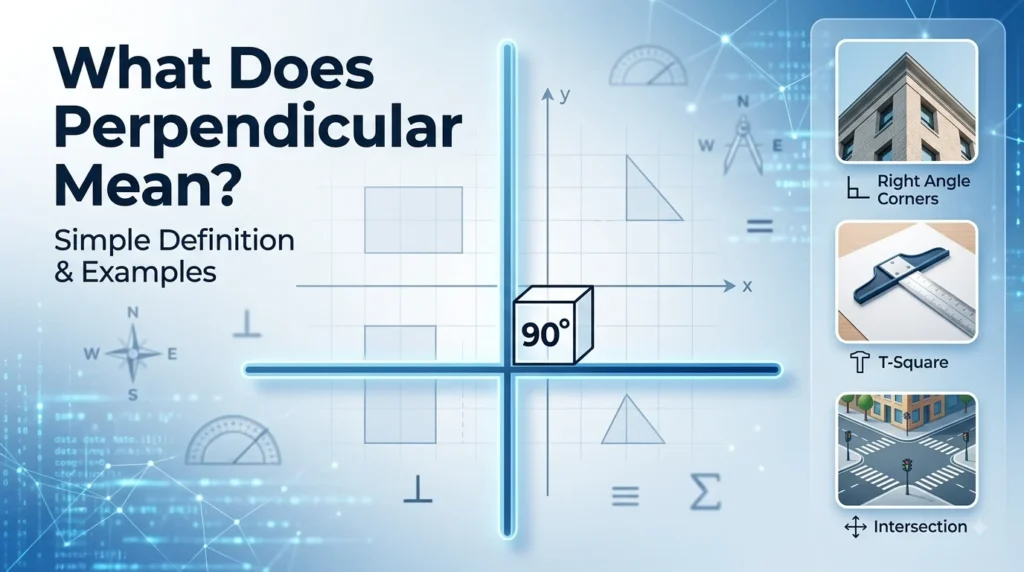
What does perpendicular mean? Perpendicular means that two lines, line segments, rays, or planes meet at a 90 degree angle. A 90 degree angle is called a right angle. In geometry, two lines that meet at 90 degrees are called perpendicular lines.
The perpendicular symbol is ⊥. For example, AB ⊥ CD means line AB is perpendicular to line CD. A simple way to remember the concept is to picture the corner of a square. The two sides meeting at that corner are perpendicular.
If you’re looking for the perpendicular meaning, think: two directions meeting at a perfect right angle.
Why Does Perpendicular Mean 90 Degrees?
Picture the corner of a notebook, a window, or a square tile. One edge travels in one direction while the other changes direction by exactly 90 degrees. That corner represents the basic idea behind perpendicularity.
In mathematics, the word perpendicular describes a precise geometric relationship. Two objects don’t become perpendicular merely because they cross. They must meet at a right angle.
For example, these two situations are different:
- Two roads cross at 45 degrees: they are intersecting, but not perpendicular.
- Two roads cross at 90 degrees: they are perpendicular.
- Two roads never meet and remain equally spaced: they are parallel.
This distinction matters throughout geometry, algebra, construction, architecture, and coordinate mathematics.
Perpendicular Definition
A simple perpendicular definition is:
Two geometric objects are perpendicular when they meet or intersect at a 90 degree angle.
The relationship is commonly represented with the symbol ⊥.
So if a geometry problem says:
AB ⊥ BC
you immediately know that angle ABC measures 90 degrees.
What Does Perpendicular Mean in Math?
If you’re asking what does perpendicular mean in math, the core answer remains the same: perpendicular objects meet at a right angle.
Mathematics uses perpendicularity to describe exact relationships between geometric figures. You may encounter it when studying:
- Lines
- Line segments
- Rays
- Angles
- Triangles
- Rectangles
- Squares
- Coordinate planes
- Slopes
- Three-dimensional planes
The concept starts with a simple angle, but it becomes much more powerful when you use it to solve problems.
For instance, knowing that two lines are perpendicular tells you that the angles they create are right angles. On a coordinate plane, perpendicularity can also tell you something about the slopes of those lines.
That means one small symbol can provide a major clue in a geometry problem.
What Is Perpendicular in Mathematics?
Perpendicular in mathematics describes objects that meet at right angles.
If two straight lines intersect at 90 degrees, they’re perpendicular. If two line segments meet at 90 degrees, they can also be perpendicular. The same general relationship extends into three-dimensional geometry.
The important measurement is always 90 degrees.
What Does Perpendicular Mean in Geometry?
If you’re wondering what does perpendicular mean in geometry, imagine two straight paths crossing to form a perfect corner.
That’s the basic picture.
In formal geometry, perpendicularity describes two geometric objects that meet at right angles. The objects might be full lines, segments, rays, or planes depending on the problem.
Perpendicular Lines Definition
The perpendicular lines definition says that two intersecting lines are perpendicular when they form four right angles.
Why four?
When two straight lines cross at 90 degrees, the intersection creates four angles around the same point. Each one measures 90 degrees.
So:
90° + 90° + 90° + 90° = 360°
The four angles are also congruent, meaning they have equal measurements.
Perpendicular Meaning in Geometry
The perpendicular meaning in geometry becomes easier when you connect it to familiar shapes.
A square has four 90 degree corners. Therefore, every pair of adjacent sides forms a perpendicular relationship.
A rectangle works the same way. Its adjacent sides meet at right angles, while its opposite sides are parallel.
A right triangle also contains perpendicular sides. The two sides that create the 90 degree angle are perpendicular to each other.
What Are Perpendicular Lines?
Perpendicular lines are lines that intersect at exactly 90 degrees.
A simple diagram looks like this:
        |
        |
        |
--------+--------
        |
        |
        |
The horizontal and vertical lines cross at a right angle.
The visual direction isn’t the important part. The 90 degree measurement is.
You can rotate the entire diagram and the lines can still be perpendicular. They don’t have to look like a plus sign.
Perpendicular Lines Examples
Here are some simple perpendicular lines examples:
| Example | Why They Are Perpendicular |
|---|---|
| Horizontal and vertical graph axes | They meet at 90° |
| Adjacent sides of a square | Each corner is 90° |
| Adjacent sides of a rectangle | Each corner is 90° |
| Two lines crossing like a perfect plus sign | Their angles are 90° |
| Two edges meeting at a square corner | They form a right angle |
The easiest test is always the same: Do the objects meet at 90 degrees?
If yes, they have a perpendicular relationship.
What Is a Right Angle?
A right angle definition is simple: a right angle measures exactly 90 degrees.
You may recognize a right angle from the small square placed inside a geometry diagram.
For example:
|
|____
The little square is a conventional marker showing that the angle is 90 degrees.
Why Is a Right Angle Important?
A right angle gives you direct evidence of perpendicularity.
If two lines meet and one of the angles is marked with a small square, you can conclude that the lines are perpendicular.
This shortcut saves time in geometry problems because you don’t need to calculate the angle again.
Perpendicular Angles
People sometimes use the phrase perpendicular angles, although technically perpendicularity describes the relationship between the lines or segments forming the angles.
When two lines are perpendicular, they create four right angles.
Each angle measures:
90°
Because all four angles have the same measure, they’re congruent.
What Is the Perpendicular Symbol?
The perpendicular symbol is:
⊥
It’s also commonly called the perpendicular sign.
For example:
AB ⊥ CD
This statement means:
Line AB is perpendicular to line CD.
The symbol is especially useful in geometry because it communicates a complete relationship in a single character.
How to Read the Symbol
Suppose a diagram gives you:
m ⊥ n
You can read it as:
Line m is perpendicular to line n.
That tells you that the lines intersect at 90 degrees.
The symbol doesn’t mean “vertical” or “horizontal.” It specifically represents perpendicularity.
What Are Perpendicular Segments?
Perpendicularity doesn’t require two infinite lines.
Two perpendicular segments can also meet at 90 degrees.
Imagine two sides of a square. Each side is a finite line segment rather than an infinite line. When adjacent sides meet, they form a right angle.
Therefore, they’re perpendicular segments.
Perpendicular Line Segments
A perpendicular line segment is a segment that intersects another segment at a right angle.
For example:
      |
      |
      •────────
If the angle at the intersection is 90 degrees, the segments are perpendicular.
This idea appears frequently when studying triangles, polygons, geometric constructions, and coordinate geometry.
Can Rays Be Perpendicular?
Yes. Perpendicular rays can form a right angle too.
A ray begins at one endpoint and continues forever in one direction. If two rays share an endpoint and form a 90 degree angle, they are perpendicular.
For example:
      |
      |
      •────────
The shared point is the vertex of the right angle.
This distinction is useful because geometry doesn’t only deal with full lines. It also studies segments and rays.
Perpendicular Sides of Squares and Rectangles
Some of the easiest perpendicular shapes to understand are squares and rectangles.
Perpendicular Sides of a Square
A square has four equal sides and four right angles.
Because each interior angle measures 90 degrees, every pair of adjacent sides is perpendicular.
Consider this square:
A -------- B
|          |
|          |
|          |
D -------- C
The perpendicular relationships include:
AB ⊥ BC
BC ⊥ CD
CD ⊥ DA
DA ⊥ AB
However, AB and CD aren’t perpendicular. They’re parallel.
Likewise, AD and BC are parallel.
This example demonstrates why understanding perpendicular and parallel lines together is useful.
Perpendicular Sides of a Rectangle
A rectangle also has four right angles.
Therefore, its adjacent sides are perpendicular.
For example:
AB ⊥ BC
At the same time:
AB ∥ CD
This gives rectangles two important relationships:
- Adjacent sides are perpendicular.
- Opposite sides are parallel.
What Are Some Real Life Examples of Perpendicular Lines?
You can find real life examples of perpendicular lines almost everywhere.
Look around a room and you’ll probably see several.
Wall and Floor
A vertical wall and horizontal floor are idealized examples of perpendicular surfaces.
They meet at approximately 90 degrees.
Door Frame
The vertical side of a rectangular door frame meets its horizontal top at a right angle.
Those edges form perpendicular relationships.
Window Frame
A rectangular window has adjacent edges that meet at 90 degrees.
Therefore, those edges are perpendicular.
Notebook Corner
The two edges of a rectangular notebook meet at a right angle.
That gives you a simple physical example of perpendicular sides.
Table Leg and Floor
A straight vertical table leg designed to stand upright forms a right-angle relationship with a level floor.
Graph Paper
The horizontal and vertical grid lines form perpendicular intersections.
Examples of Perpendicular Objects
| Object | Perpendicular Relationship |
|---|---|
| Wall and floor | Meet at approximately 90° |
| Door frame | Adjacent edges form right angles |
| Window frame | Adjacent edges form right angles |
| Square tile | Adjacent edges meet at 90° |
| Picture frame | Adjacent sides are perpendicular |
| Table leg and floor | Upright leg meets floor at a right angle |
| Coordinate axes | x-axis and y-axis meet at 90° |
Real-world objects aren’t always perfectly precise. Geometry treats these examples as idealized shapes so the underlying relationship stays clear.
How to Identify Perpendicular Lines
Learning how to identify perpendicular lines becomes much easier when you use a few reliable tests.
Look for a Right Angle Marker
A small square at an intersection is the fastest clue.
If the diagram marks a right angle, the lines forming that angle are perpendicular.
Measure the Angle
If there is no marker, check the angle measurement.
If it equals:
90°
the lines are perpendicular.
If it measures 80°, 100°, or 45°, they’re intersecting but not perpendicular.
Check the Slopes
Coordinate geometry provides another method.
For two nonvertical lines, multiply their slopes.
If:
m₁ × m₂ = -1
the lines are perpendicular.
For example:
m₁ = 2
m₂ = -1/2
Then:
2 × (-1/2) = -1
Therefore, the lines are perpendicular.
What Is Perpendicular Slope?
Perpendicular slope is one of the most useful concepts in coordinate geometry.
Two nonvertical lines are perpendicular when their slopes are negative reciprocals.
A negative reciprocal is found in two steps:
- Flip the fraction.
- Change its sign.
For example:
2 = 2/1
Flip it:
1/2
Change the sign:
-1/2
Therefore, the negative reciprocal of 2 is -1/2.
More Negative Reciprocal Examples
Suppose a line has a slope of:
4
Its perpendicular slope is:
-1/4
If the original slope is:
-3
the perpendicular slope is:
1/3
If the original slope is:
1/5
the perpendicular slope is:
-5
Here’s a quick reference:
| Original Slope | Perpendicular Slope |
|---|---|
| 2 | -1/2 |
| 4 | -1/4 |
| -3 | 1/3 |
| 1/5 | -5 |
| -2/7 | 7/2 |
The signs always switch, and the numerator and denominator trade places.
Why Does the Slope Rule Work?
Slope describes how much a line rises or falls as it moves horizontally.
A perpendicular line changes direction by 90 degrees. For two nonvertical lines, that geometric rotation produces the negative reciprocal relationship.
You don’t need to memorize the deeper proof to solve basic problems, but understanding the reason makes the rule easier to remember.
How to Find Perpendicular Lines on a Coordinate Plane
Knowing how to find perpendicular lines depends on the information given.
You might have two slopes, two equations, or a graph.
When the Slopes Are Given
Suppose:
m₁ = 3
and:
m₂ = -1/3
Multiply:
3 × (-1/3) = -1
The lines are perpendicular.
When Equations Are Given
Consider:
y = 2x + 5
and:
y = -1/2x + 3
The slope of the first equation is 2.
The slope of the second is -1/2.
Because these slopes are negative reciprocals, the lines are perpendicular.
When Coordinates Are Given
Suppose you have two points on each line.
First, calculate each slope using:
m = (y₂ – y₁) / (x₂ – x₁)
Then compare the results.
If the slopes are negative reciprocals, the nonvertical lines are perpendicular.
What Happens With Horizontal and Vertical Lines?
Horizontal and vertical lines are an important special case.
A horizontal line has a slope of:
0
A vertical line has an undefined slope.
Even though multiplying their slopes isn’t possible in the usual way, the lines are still perpendicular.
For example:
        |
        |
--------+--------
        |
        |
The horizontal line and vertical line meet at exactly 90 degrees.
So remember:
Horizontal ⊥ Vertical
This is especially useful when working with coordinate grids.
How to Prove Lines Are Perpendicular
Learning how to prove lines are perpendicular depends on the type of problem.
Prove a 90 Degree Angle
If you can show that two lines form an angle measuring 90 degrees, you’ve established perpendicularity.
For example:
If:
∠ABC = 90°
then:
AB ⊥ BC
Use Slopes
For coordinate geometry, calculate the slopes.
If two nonvertical slopes are negative reciprocals, the lines are perpendicular.
For example:
m₁ = 5
m₂ = -1/5
Therefore:
m₁ × m₂ = -1
The lines are perpendicular.
Use the Pythagorean Theorem
The Pythagorean theorem can help establish that a triangle is a right triangle.
For a triangle with side lengths 3, 4, and 5:
3² + 4² = 5²
9 + 16 = 25
Because the relationship satisfies the converse of the Pythagorean theorem, the triangle has a right angle.
The two sides forming that right angle are perpendicular.
This method is useful when a problem gives you side lengths instead of angles or slopes.
Perpendicular vs Parallel: What’s the Difference?
The difference between perpendicular and parallel is easy to remember once you focus on what happens when the lines meet.
Perpendicular lines intersect at 90 degrees.
Parallel lines don’t intersect in the same plane.
Here’s a quick comparison:
| Feature | Perpendicular Lines | Parallel Lines |
|---|---|---|
| Intersect? | Yes | No |
| Angle relationship | 90° | Same direction |
| Symbol | ⊥ | ∥ |
| Slope | Negative reciprocals | Equal |
| Example | Wall and floor | Railroad tracks |
| Main idea | Meet at a right angle | Never meet in the same plane |
Perpendicular and Parallel Lines in a Rectangle
A rectangle gives you both concepts at once.
Adjacent sides are perpendicular.
Opposite sides are parallel.
For example:
AB ⊥ BC
but:
AB ∥ CD
This is one of the easiest ways to remember the difference.
Perpendicular vs Intersecting Lines
Every pair of perpendicular lines is a pair of intersecting lines.
However, not every pair of intersecting lines is perpendicular.
That’s an important distinction.
Consider three possibilities:
| Relationship | Do They Meet? | Must the Angle Be 90°? |
|---|---|---|
| Perpendicular | Yes | Yes |
| Intersecting | Yes | No |
| Parallel | No | No |
Two intersecting lines might create a 30 degree angle. They might create a 45 degree angle. They might create a 120 degree angle.
Only a 90 degree intersection qualifies as perpendicular.
Perpendicular Lines in Triangles
Perpendicularity plays an important role in triangles.
A right triangle contains one 90 degree angle. The two sides forming that angle are perpendicular.
For example:
A
|\
| \
|  \
|___\
B    C
If angle B measures 90 degrees, then:
AB ⊥ BC
The side opposite the right angle is called the hypotenuse.
Perpendicularity also appears when constructing an altitude.
An altitude is a segment drawn from a vertex perpendicular to the opposite side or its extension.
That means the defining feature of an altitude is its 90 degree relationship with the relevant side.
Perpendicular Lines in Coordinate Geometry
Coordinate geometry gives perpendicularity a numerical form.
The coordinate plane contains two major axes:
- x-axis
- y-axis
These axes intersect at the origin.
The x-axis is horizontal, while the y-axis is vertical. They meet at 90 degrees.
Therefore:
x-axis ⊥ y-axis
This relationship divides the coordinate plane into four quadrants.
Perpendicularity also helps when finding distances, equations, intersections, and geometric constructions on graphs.
Perpendicular Planes in Three-Dimensional Geometry
Perpendicularity isn’t limited to two-dimensional figures.
In three-dimensional geometry, perpendicular planes can meet at a right angle.
Imagine the floor and a wall in a room.
The floor can be viewed as one plane, while the wall represents another. Their meeting relationship provides an everyday model of perpendicular planes.
The idea becomes important in:
- Architecture
- Engineering
- Construction
- 3D modeling
- Computer graphics
- Spatial geometry
Three-dimensional geometry can become more complicated than flat geometry, but the basic idea remains familiar: perpendicular relationships involve right-angle geometry.
How to Draw a Perpendicular Line
Drawing a perpendicular line means creating a line that meets another line at exactly 90 degrees.
In basic geometry, you can use a ruler and a right-angle tool such as a set square.
Using a Set Square
Place one edge of the set square along the given line.
Then draw along the edge that forms a right angle.
The new line will be perpendicular to the original line.
Using a Compass and Straightedge
Classical geometry also provides a construction method using a compass and straightedge.
The basic process is:
- Mark points on the original line using a compass.
- Draw intersecting arcs from those points.
- Connect the appropriate arc intersections.
- The resulting line crosses the original at 90 degrees.
This construction is useful because it doesn’t depend on a protractor.
Common Mistakes When Learning Perpendicularity
Perpendicularity is simple once the core rule clicks, but several common mistakes can cause confusion.
Mistake: Assuming All Intersections Are Perpendicular
Two lines can intersect at many angles.
Intersection alone isn’t enough.
The angle must be 90 degrees.
Mistake: Thinking Perpendicular Lines Must Be Vertical and Horizontal
They don’t.
A pair of diagonal lines can be perpendicular.
Their orientation doesn’t matter. Their angle does.
Mistake: Confusing Equal Slopes With Perpendicular Slopes
Equal slopes indicate parallel lines, not perpendicular ones.
For example:
m₁ = 2
m₂ = 2
These lines are parallel if they are distinct.
For perpendicular lines:
m₁ = 2
m₂ = -1/2
Mistake: Forgetting the Sign
The reciprocal alone isn’t enough.
If the original slope is 3, the perpendicular slope isn’t 1/3.
It is:
-1/3
The sign must change.
Mistake: Applying the Slope Product Rule to Vertical Lines
Vertical lines have undefined slopes.
Instead of forcing the multiplication rule, recognize the geometric relationship directly.
A vertical line and horizontal line are perpendicular.
A Simple Way to Remember Perpendicular
Here’s an easy memory trick:
Perpendicular = perfect corner.
Picture a square.
Look at any corner.
The two adjacent sides meet at exactly 90 degrees. That’s perpendicularity.
You can also remember:
Perpendicular = 90°
Parallel = never meet
Intersecting = meet, but not necessarily at 90°
These three ideas cover a huge portion of basic geometry.
Perpendicularity at a Glance
| Term | Meaning |
|---|---|
| Perpendicular | Meets at 90° |
| Right angle | Angle measuring 90° |
| Perpendicular symbol | ⊥ |
| Perpendicular lines | Intersect at right angles |
| Perpendicular segments | Segments meeting at 90° |
| Perpendicular rays | Rays forming a 90° angle |
| Negative reciprocal | Slope relationship for nonvertical perpendicular lines |
| Parallel | Lines that don’t intersect in the same plane |
| Intersecting | Lines that cross |
| Congruent angles | Angles with equal measures |
FAQs
What does perpendicular mean?
Perpendicular means that two geometric objects meet at a 90 degree angle. Two perpendicular lines form four right angles at their intersection.
What does perpendicular mean in math?
In mathematics, perpendicular describes a relationship in which two lines, segments, rays, or other geometric objects meet at a right angle. The standard symbol is ⊥.
What is the perpendicular symbol?
The perpendicular symbol is ⊥. For example, AB ⊥ CD means line AB is perpendicular to line CD and meets it at 90 degrees.
How do you identify perpendicular lines?
Look for a right-angle marker, measure the angle, or compare slopes on a coordinate plane. For two nonvertical lines, negative reciprocal slopes indicate perpendicularity.
What is the difference between perpendicular and parallel?
Perpendicular lines intersect at 90 degrees. Parallel lines in the same plane never intersect. Their slopes are equal, while perpendicular nonvertical lines have negative reciprocal slopes.
Conclusion
Understanding what does perpendicular mean becomes much easier when you connect the word with one simple idea: 90 degrees.
Two lines that meet at a right angle are perpendicular. The same relationship can apply to segments, rays, and planes. The symbol ⊥ gives you a quick mathematical way to show that relationship.
You can recognize perpendicularity in squares, rectangles, triangles, coordinate grids, doors, windows, walls, floors, and countless other structures. In coordinate geometry, you can also test perpendicular lines using negative reciprocal slopes.
The most useful rule to remember is simple:
Perpendicular means meeting at a 90 degree angle.
Once that clicks, many geometry problems become considerably easier.
See Also More :
- Soliciting Meaning: The Word That Walks a Tightrope Between Asking and Offending for 2026
- Blue Heart Meaning: The Emoji That Speaks Without Words for 2026