

Quick Answer:
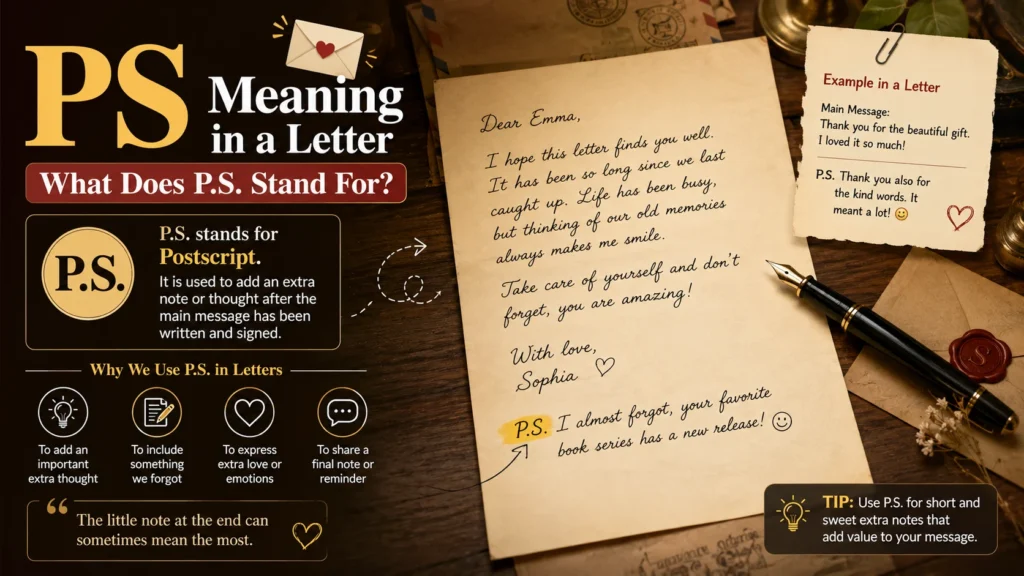
PS stands for “postscript” in a letter. It comes from the Latin phrase post scriptum, meaning “written after.” A PS is used after the main body of a letter to add an extra thought, reminder, or detail that you forgot to include earlier.
Have you ever reached the end of a letter and noticed “P.S.” followed by another sentence? If you’re wondering what PS stands for in a letter, the answer is simple: PS means “postscript.” It is an extra note written after the main message has already ended. You might use it to add a reminder, share a final thought, make a joke, or mention something you forgot. PS has been used in personal letters for a very long time, but it is still common today in emails, cards, newsletters, marketing messages, and casual writing. Understanding PS is useful because it can make a letter feel more personal and natural. In this guide, you’ll learn what PS means, where it came from, how to use it correctly, examples, common mistakes, and how PS differs from similar terms.
What Does PS Stand For in a Letter?
PS stands for “postscript.”
The word comes from the Latin expression post scriptum, which means “written after.”
A PS appears after the main body of a letter, usually after the signature.
For example:
Dear Sarah,
It was great seeing you last weekend. I hope we can meet again soon.
Best,
AlexP.S. Don’t forget to bring your camera next time!
The main letter has already finished. The PS adds one more thought.
Why Do People Use PS in Letters?
A PS is useful when you remember something after finishing the main message.
You can use it for:
- A reminder
- An extra detail
- A personal comment
- A funny thought
- A final message
- Something you forgot earlier
For example:
P.S. I still have your book!
The writer may have remembered this after completing the letter.
History of PS
The abbreviation P.S. comes from the Latin post scriptum, which means “written after.”
Before modern technology, people wrote letters by hand. If someone finished a letter and then remembered something important, they could add a postscript instead of rewriting the entire letter.
This made PS very practical.
Over time, PS became more than just a useful correction. Writers began using it for humor, emotional messages, reminders, and memorable final comments.
Today, the tradition continues in digital communication.
You can find PS in:
- Personal letters
- Greeting cards
- Emails
- Newsletters
- Marketing messages
- Social media captions
- Personal notes
How to Use PS in a Letter
The traditional placement is after the signature.
Example:
Love,
EmmaP.S. Call me when you get home.
You can also see it written as P.S. or PS.
Both forms are commonly understood.
Another Example
Dear Mike,
Thank you for helping me move last weekend. I really appreciate it.
Best,
JamesP.S. The pizza is on me next time!
Here, the PS adds a friendly extra thought.
PS Examples for Different Situations
Personal Letter
P.S. I miss you already!
Friendly Letter
P.S. Don’t forget our movie night!
Funny Letter
P.S. Yes, I ate the last cookie. Sorry!
Romantic Letter
P.S. You still make me smile every day.
Thank-You Letter
P.S. Your advice really helped me.
Business Email
P.S. I’ve attached the updated schedule.
Although PS is traditionally associated with letters, it can also appear in emails.
PS vs PPS
You may occasionally see P.P.S.
This means “post-postscript.”
It is used when someone adds another note after the PS.
For example:
P.S. Don’t forget your keys.
P.P.S. Bring an umbrella too!
PPS is much less common than PS.
| Term | Meaning | Usage |
|---|---|---|
| PS | Postscript | Common |
| PPS | Post-postscript | Less common |
| PPPS | Post-post-postscript | Very rare |
Common Mistakes When Using PS
One common mistake is putting PS in the middle of the letter.
Traditionally, PS comes after the main message.
Another mistake is using PS for information that should have been included in the main body.
If the information is important, it’s usually better to include it in the main message.
A PS works best for a small extra thought.
Is PS Still Used Today?
Yes.
Although modern writing tools make it easy to edit a message before sending it, PS remains popular because it adds personality.
Marketing emails often use PS because readers frequently notice the final section.
Personal writers also use it because it can make a message feel more spontaneous.
For example:
P.S. We need to try that restaurant again!
This feels casual and personal.
PS in Emails
PS is perfectly acceptable in many informal emails.
Example:
Hi David,
Thanks for sending the documents. I’ll review everything tonight and get back to you tomorrow.
Best,
MarkP.S. Great presentation today!
For formal business writing, however, important information should usually appear in the main body rather than being added as a PS.
FAQs
What does PS stand for in a letter?
PS stands for “postscript,” meaning an extra note added after the main message.
What does P.S. mean?
P.S. means postscript, from the Latin post scriptum, meaning “written after.”
Where does PS go in a letter?
A PS traditionally appears after the signature, at the very end of the letter.
Can I use PS in an email?
Yes. PS is commonly used in personal, casual, and marketing emails.
Is PS formal or informal?
PS can be used in both settings, but it is especially common in personal and informal writing.
What is PPS?
PPS means “post-postscript.” It is used to add another note after a PS.
Should PS be capitalized?
Both PS and P.S. are commonly used. The punctuated form is traditional.
Conclusion
So, what does PS stand for in a letter? It stands for “postscript,” meaning something written after the main message. A PS is normally placed at the end of a letter, often after the signature, and is used to add a forgotten detail, reminder, joke, or personal thought.
The abbreviation comes from the Latin post scriptum, but it remains useful in modern communication. Whether you’re writing a personal letter, email, greeting card, or casual note, a PS can be a simple way to add one final thought without changing the main message.
See Also More :
- ION Meaning: Definition, Texting, Science, Slang, and Everyday Usage for 2026
- OWI Meaning: Definition, Legal Meaning, Driving Laws, and Everyday Usage for 2026