
Quick Answer
When someone says “All guys are the same,” they are usually expressing frustration, disappointment, or hurt after a bad experience. The best response depends on your relationship with the person and the tone of the conversation.
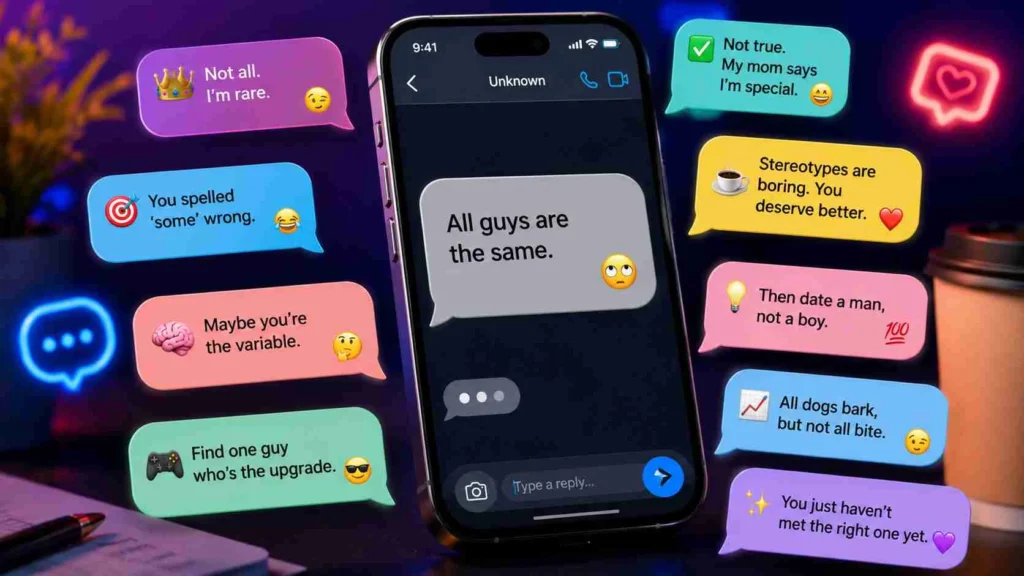
Top responses include “I can see why you feel that way.”, “Some guys might be, but definitely not all.”, “Sounds like someone really let you down.”, “That is a tough conclusion to reach.”, “I hope someone changes your mind someday.”
Few statements spark debate as quickly as “All guys are the same.”
You might hear it after a breakup, during a late night text conversation, in a group chat, on social media, or even face to face. Sometimes it is said jokingly. Other times it comes from genuine frustration after someone has been hurt, disappointed, or treated unfairly.
The challenge is figuring out how to respond without making the conversation worse. A defensive reply can create an argument. An insensitive joke can make someone feel unheard. On the other hand, the right response can show empathy, confidence, humor, or even help shift the discussion in a more positive direction.
Whether you want a funny comeback, a thoughtful reply, a flirty response, or a calm way to keep the peace, this collection of responses to “All guys are the same” gives you plenty of options for every situation.
Funny Responses to “All Guys Are the Same”
“Wow, I did not know we came from the same factory.”
Example: When the conversation is playful.
Meaning: You jokingly challenge the stereotype.
“I must have missed the group meeting.”
Example: During lighthearted banter.
Meaning: You humorously deny being included.
“Did someone forget to send me the guy handbook?”
Example: Casual conversation with friends.
Meaning: You joke that not all men behave alike.
“I want a refund if that is true.”
Example: When keeping things humorous.
Meaning: You playfully reject the idea.
“That is awkward because I thought I was limited edition.”
Example: Friendly teasing.
Meaning: You joke about being unique.
“I did not get the memo.”
Example: Casual texting.
Meaning: You humorously disagree.
“Apparently I skipped orientation.”
Example: Funny social conversation.
Meaning: You were not included in the stereotype.
“Who is the manager of all guys?”
Example: When joking.
Meaning: You point out how broad the statement is.
“I knew I should have read the terms and conditions.”
Example: Playful discussion.
Meaning: You make light of the claim.
“Well, that explains why my clone keeps causing trouble.”
Example: Humorous response.
Meaning: You turn the comment into a joke.
“I am still waiting for my matching personality update.”
Example: Casual banter.
Meaning: You tease the stereotype.
“So where is my identical twin everyone talks about?”
Example: Funny reply.
Meaning: You challenge the idea playfully.
“That sounds statistically suspicious.”
Example: With analytical friends.
Meaning: You joke about logic.
“I thought I was the deluxe version.”
Example: Lighthearted flirting.
Meaning: You playfully praise yourself.
“I guess individuality took the day off.”
Example: Friendly conversation.
Meaning: You humorously disagree.
Calm and Understanding Responses
“Sounds like someone really hurt you.”
Example: After hearing frustration.
Meaning: You acknowledge their feelings.
“I can understand why you feel that way.”
Example: Emotional conversation.
Meaning: You show empathy.
“That must have been disappointing.”
Example: After hearing a story.
Meaning: You recognize their experience.
“I am sorry you went through that.”
Example: When they are upset.
Meaning: You offer support.
“I can see where that opinion comes from.”
Example: Respectful discussion.
Meaning: You acknowledge their perspective.
“That sounds frustrating.”
Example: When listening carefully.
Meaning: You validate emotions.
“Not everyone has had your experience.”
Example: Gentle discussion.
Meaning: You offer another perspective.
“It seems like you have had some bad luck.”
Example: Supportive conversation.
Meaning: You separate experience from reality.
“I understand why you feel disappointed.”
Example: Breakup discussion.
Meaning: You show compassion.
“That is a lot to deal with.”
Example: Serious conversation.
Meaning: You acknowledge difficulty.
“Your feelings are valid.”
Example: Emotional support.
Meaning: You respect their emotions.
“That sounds exhausting.”
Example: After hearing repeated stories.
Meaning: You empathize.
“I hope things get better for you.”
Example: Encouraging response.
Meaning: You offer positivity.
“That would make anyone frustrated.”
Example: Listening actively.
Meaning: You understand their reaction.
“I appreciate you sharing that.”
Example: Deep conversation.
Meaning: You value openness.
Clever Responses That Make People Think
“If all guys were the same, dating would be much easier.”
Example: Thoughtful discussion.
Meaning: Diversity exists among people.
“That is a big conclusion from a small sample size.”
Example: Logical conversation.
Meaning: You challenge the generalization.
“One bad experience should not define millions of people.”
Example: Serious discussion.
Meaning: You encourage perspective.
“People are more complicated than categories.”
Example: Reflective conversation.
Meaning: Individuals differ greatly.
“Would you say the same about everyone else?”
Example: Thought provoking moment.
Meaning: You encourage reconsideration.
“Sometimes patterns feel bigger when emotions are involved.”
Example: Calm discussion.
Meaning: Feelings can influence perception.
“Maybe the problem is the type, not the entire group.”
Example: Dating discussion.
Meaning: Choices may play a role.
“There are billions of guys, that is a lot of people to know.”
Example: Logical reply.
Meaning: The statement is broad.
“A few experiences rarely represent everyone.”
Example: Mature conversation.
Meaning: You encourage balance.
“People deserve to be judged individually.”
Example: Respectful debate.
Meaning: Everyone is unique.
“That sounds more like frustration than a fact.”
Example: Thoughtful discussion.
Meaning: Emotion may be driving the statement.
“The exceptions are usually the interesting part.”
Example: Friendly conversation.
Meaning: Differences matter.
“Generalizations usually miss the details.”
Example: Reflective talk.
Meaning: Complexity matters.
“Every person has their own story.”
Example: Serious discussion.
Meaning: Individual experiences differ.
“Maybe the right person just has not shown up yet.”
Example: Encouraging reply.
Meaning: Hope remains.
Flirty Responses to “All Guys Are the Same”
“Then I guess I should not tell you how different I am.”
Example: Flirty conversation.
Meaning: You create intrigue.
“Good thing I like proving people wrong.”
Example: Playful flirting.
Meaning: You suggest you are different.
“Challenge accepted.”
Example: Confident flirtation.
Meaning: You want to change their opinion.
“I hope I get a chance to be the exception.”
Example: Romantic interest.
Meaning: You want to stand out.
“I was hoping to surprise you.”
Example: Light flirting.
Meaning: You present yourself differently.
“That is a bold claim considering you just met me.”
Example: Early conversation.
Meaning: You invite curiosity.
“Maybe you have been meeting the wrong guys.”
Example: Casual flirting.
Meaning: You hint at yourself.
“Well, now I feel pressure to impress you.”
Example: Playful banter.
Meaning: You keep the mood light.
“I am willing to audition for the role of exception.”
Example: Fun flirting.
Meaning: You want a chance.
“I prefer being unforgettable.”
Example: Confident flirting.
Meaning: You highlight uniqueness.
“Give me a chance before making me part of the group.”
Example: New connection.
Meaning: You seek individual judgment.
“I promise my customer reviews are different.”
Example: Funny flirting.
Meaning: You mix humor and charm.
“I think you might need more research.”
Example: Playful discussion.
Meaning: You suggest getting to know you.
“You seem determined to underestimate me.”
Example: Confident flirtation.
Meaning: You challenge their assumption.
“Maybe I am the plot twist.”
Example: Modern playful flirting.
Meaning: You claim uniqueness.
Short Responses for Text Messages
“Not all.”
Example: Quick response.
Meaning: Simple disagreement.
“That is unfair.”
Example: Casual texting.
Meaning: You challenge the statement.
“I doubt that.”
Example: Light conversation.
Meaning: You disagree politely.
“Maybe some.”
Example: Neutral discussion.
Meaning: You partially agree.
“That sounds personal.”
Example: Casual banter.
Meaning: You note the emotion behind it.
“I hope not.”
Example: Friendly reply.
Meaning: You stay optimistic.
“That is a strong statement.”
Example: Discussion.
Meaning: You highlight its intensity.
“I disagree.”
Example: Direct conversation.
Meaning: You state your view.
“That is not been my experience.”
Example: Sharing perspective.
Meaning: You offer another view.
“Maybe you need better examples.”
Example: Lighthearted reply.
Meaning: You challenge the claim.
“That is debatable.”
Example: Friendly discussion.
Meaning: You question it.
“I think there is more to it.”
Example: Thoughtful text.
Meaning: You seek nuance.
“Not every guy.”
Example: Quick reply.
Meaning: Individual differences matter.
“Fair enough, but still.”
Example: Balanced response.
Meaning: You partly understand.
“I hear you.”
Example: Supportive conversation.
Meaning: You acknowledge feelings.
Mature Responses for Serious Conversations
“I think people should be judged individually.”
Example: Deep discussion.
Meaning: Everyone deserves fairness.
“Your experience is real, but it is not universal.”
Example: Respectful debate.
Meaning: Experiences vary.
“I understand your frustration, but I would not generalize.”
Example: Serious conversation.
Meaning: You balance empathy and logic.
“People are shaped by different values and experiences.”
Example: Reflective talk.
Meaning: Individuals differ.
“The actions of a few do not define everyone.”
Example: Mature discussion.
Meaning: Avoid broad assumptions.
“I think there are good and bad people everywhere.”
Example: Balanced perspective.
Meaning: Character matters more than group identity.
“I prefer to look at individuals.”
Example: Thoughtful conversation.
Meaning: Fair judgment.
“That sounds like a reaction to pain.”
Example: Emotional discussion.
Meaning: Hurt may influence the view.
“There is always more nuance than that.”
Example: Reflective talk.
Meaning: Reality is complex.
“Everyone deserves to be evaluated on their own actions.”
Example: Serious debate.
Meaning: Individual accountability matters.
“I respect your experience even if I see it differently.”
Example: Mature discussion.
Meaning: You remain respectful.
“We all carry different stories.”
Example: Emotional conversation.
Meaning: Experiences vary.
“Life is rarely that simple.”
Example: Reflective moment.
Meaning: Human behavior is complex.
“People are individuals before they are categories.”
Example: Thoughtful debate.
Meaning: Personal identity matters.
“I think balance is important.”
Example: Calm conversation.
Meaning: You encourage perspective.
FAQs
What does “All guys are the same” mean?
It usually expresses frustration or disappointment after negative experiences with men or dating.
Should you argue when someone says it?
Not usually. Listening and responding calmly often works better than becoming defensive.
Can you respond with humor?
Yes. If the situation is lighthearted, a funny response can keep the conversation relaxed.
What is the best mature response?
“I understand why you feel that way, but I think people should be judged individually.”
Can this phrase be used jokingly?
Yes. Many people use it as a joke among friends, while others use it seriously after difficult experiences.
Conclusion
When someone says “All guys are the same,” the most effective response depends on the situation, the relationship, and the emotion behind the words. Sometimes a funny comeback is perfect. Other times empathy, understanding, or a thoughtful perspective is the better choice. The goal is not to win an argument but to keep the conversation respectful and meaningful.
you choose humor, confidence, kindness, or logic, the right response can turn a frustrating moment into a better discussion. Save your favorite replies, share them with friends, and use them whenever this common phrase comes up again.