

Quick Answer
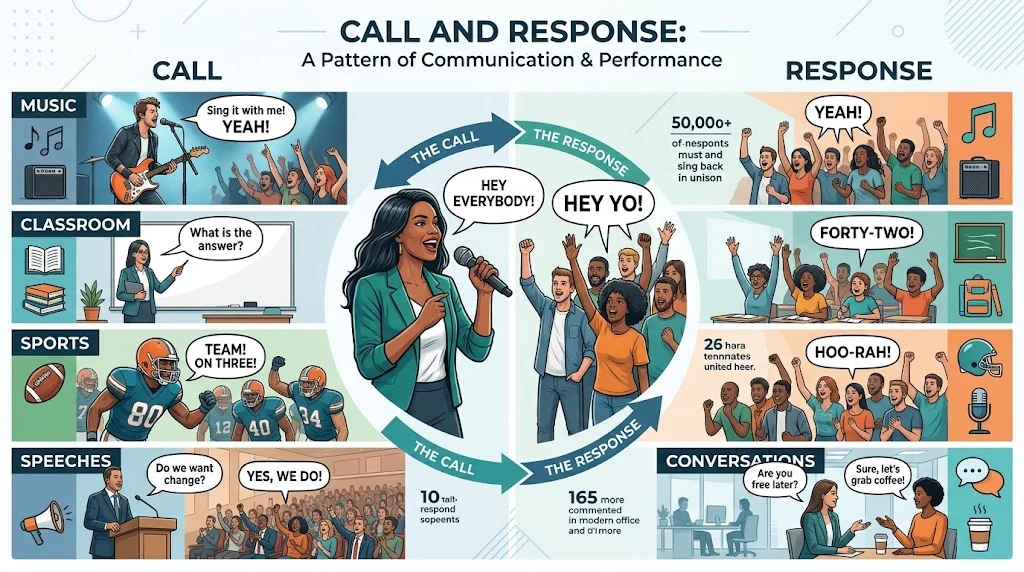
Call and response is a simple way of communicating where one person, group, or speaker makes a “call” and another person or group gives a “response.” You can find it in conversations, music, classrooms, speeches, religious gatherings, and group activities.
Common examples include question and answer, teacher and student, leader and group, singer and audience, and speaker and crowd.
What Does Call and Response Mean?
Call and response means that one person makes a statement, sound, question, or action, and another person responds to it.
The response can be spoken, sung, repeated, or even shown through an action. The main idea is interaction between two sides.
For example, a teacher might say, “Good morning, class,” and the students answer, “Good morning.”
The teacher makes the call, and the students provide the response.
How Does Call and Response Work?
The basic pattern is very simple:
Person or group A: Makes the call
Person or group B: Gives the response
Sometimes the response is exactly the same as the call. Other times, the response has different words or sounds.
For example:
Call: “Are you ready?”
Response: “Yes, we are!”
This pattern can be repeated several times to keep everyone involved.
Call and Response Examples
Here are some simple examples you might hear in everyday life:
| Call | Response |
|---|---|
| “How are you?” | “I’m good!” |
| “Good morning!” | “Good morning!” |
| “Are we ready?” | “Yes!” |
| “Everybody say hey!” | “Hey!” |
| “Can you hear me?” | “Yes!” |
| “Who wants pizza?” | “Me!” |
| “Let’s go!” | “Let’s go!” |
| “Are you with me?” | “Yes!” |
These examples show how the pattern can make a conversation or group activity more interactive.
Call and Response in Music
Call and response is especially common in music.
A singer, musician, or group performs one musical phrase, and another singer or group answers with another phrase.
The two parts can use the same melody, similar words, or completely different musical ideas.
This technique can make a song feel more interactive because listeners feel like they are part of the performance.
Call and Response in African Music
Call and response has a long history in many African musical traditions.
A lead singer may perform a phrase while a group responds. This creates a strong connection between the performer and the community.
The pattern can also help organize songs, dances, ceremonies, and other group activities.
Because the technique is based on participation, it can turn music from something people simply listen to into something they actively experience.
Call and Response in Gospel Music
Call and response is also strongly associated with gospel music.
A preacher or singer may deliver a line, and the congregation responds with words such as “Amen,” “Yes,” or another repeated phrase.
For example:
Leader: “Can I get an amen?”
Congregation: “Amen!”
This creates participation between the person leading the service and the people listening.
Call and Response in Classroom Activities
Teachers often use call and response to get students’ attention or encourage participation.
For example:
Teacher: “Class, class!”
Students: “Yes, yes!”
Another example is using a question followed by a group answer.
This technique can make lessons more interactive and can help students stay focused.
Call and Response in Speeches
Speakers can use call and response to create energy during a speech or presentation.
A speaker might ask the audience a question and encourage everyone to answer together.
For example:
Speaker: “Do we want change?”
Audience: “Yes!”
The technique works because the audience isn’t simply listening. They’re actively participating.
Call and Response in Religious Settings
Many religious traditions use call and response during worship, prayers, readings, and ceremonies.
One person may read a statement while the congregation gives a traditional response.
This can create a feeling of unity because everyone participates in the same pattern.
The exact form of call and response depends on the religion, tradition, and setting.
Call and Response in Everyday Conversation
Call and response doesn’t always have to involve a large group.
You can use the same pattern during normal conversations.
For example:
Person 1: “Guess what?”
Person 2: “What?”
Here, the first person creates the call and the second person responds.
Another simple example is:
Person 1: “You coming?”
Person 2: “Of course.”
These small exchanges happen naturally every day.
Call and Response in Social Media
You can also see call and response online.
A creator may post a question, and followers respond in the comments. A meme can also create a call and response pattern when one part of the joke sets up another.
For example:
Post: “What are you doing this weekend?”
Comments: “Absolutely nothing.”
The original post creates the call, while the comments provide the response.
Call and Response in Sports
Sports crowds often use call and response to support their teams.
A stadium announcer, leader, or group of fans may start a chant, and the rest of the crowd responds.
For example:
Leader: “Let’s go!”
Crowd: “Team!”
This creates energy and helps large groups participate together.
Why Is Call and Response Effective?
Call and response works because it encourages participation.
Instead of having one person speak while everyone else listens, the structure gives another person or group a clear chance to react.
It can also:
- Get people’s attention
- Create energy
- Encourage participation
- Make performances more memorable
- Build a sense of community
- Help groups stay organized
- Make communication more interactive
That’s why the technique appears in so many different situations.
Call and Response vs Question and Answer
Call and response and question and answer are similar, but they aren’t always the same.
A question usually asks for information.
Question: “What time is the meeting?”
Answer: “Three o’clock.”
Call and response can be more rhythmic or interactive.
Call: “Everybody ready?”
Response: “Yes!”
The response doesn’t necessarily provide new information. Its purpose can simply be participation.
Types of Call and Response
There are several common forms of call and response.
Leader and Group
One person speaks or sings, and a group responds.
This is common in music, classrooms, sports, and religious settings.
Question and Answer
One person asks something, and another person answers.
This is common in conversations and educational settings.
Musical Call and Response
One musical phrase is followed by another phrase.
This is common in many musical traditions.
Repetition
The second person or group repeats the original phrase.
This can make the interaction easy for everyone to follow.
Improvised Response
The responder creates a new answer instead of repeating the original call.
This is often used in music, comedy, and live performances.
Benefits of Using Call and Response
Call and response can make communication easier and more engaging.
It gives people a clear role and creates a natural rhythm between the speaker and the audience.
In group settings, it can also help people feel connected.
For example, a simple group chant can make everyone feel like they’re participating in the same activity rather than watching from the outside.
FAQs
What is call and response in simple terms?
Call and response is when one person or group says or does something and another person or group responds.
What is an example of call and response?
A simple example is, “Are you ready?” followed by “Yes!”
Where is call and response used?
It is used in music, conversations, classrooms, speeches, religious gatherings, sports, and social media.
What is call and response in music?
In music, one singer or group performs a musical phrase and another singer or group responds with another phrase.
Why is call and response important?
It encourages participation and creates interaction between people.
Is call and response the same as question and answer?
Not exactly. Question and answer usually provides information, while call and response can simply create interaction or participation.
Is call and response used in classrooms?
Yes. Teachers can use it to get students’ attention, teach concepts, or encourage group participation.
Is call and response used in speeches?
Yes. Speakers often use audience responses to create energy and make speeches more interactive.
What is a call in call and response?
The call is the first statement, sound, question, or action that starts the interaction.
What is the response in call and response?
The response is the reaction given by another person or group after the call.
Can call and response happen between two people?
Yes. It doesn’t need a large group. Two people can easily use a call and response pattern.
Is call and response only used in music?
No. It is used in many forms of communication, including conversations, education, speeches, sports, and religious settings.
Conclusion
Call and response is a simple communication pattern with many uses. One person or group makes a call, and another person or group responds. You can find this pattern in music, classrooms, speeches, religious gatherings, sports, conversations, and even social media.
Its main purpose is to create interaction. Instead of one person doing all the talking, everyone gets a chance to participate.
Whether you’re learning about music, preparing a presentation, teaching a class, or simply wondering what call and response means, the basic idea is easy to remember: one side calls, and the other side responds.
See Also More :
- 200+ Reply to “Have a Good Day Reply” That Sound Polite, Friendly & Memorable In 2026
- Can Someone Else Read Your Instagram Story Reply In 2026