

Quick Answer
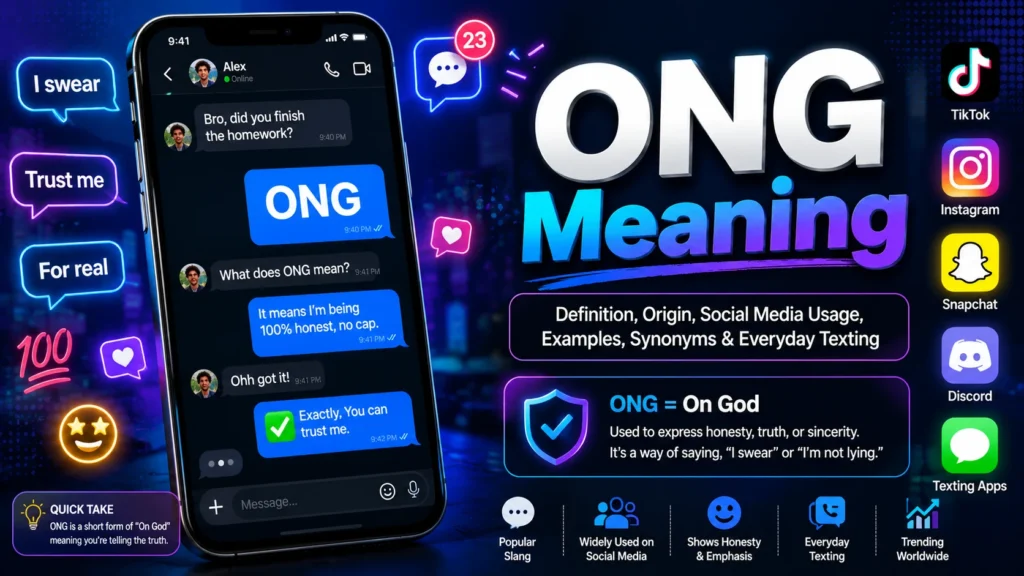
ONG is a popular internet slang that stands for “On God.” People use it to show they are being completely honest, serious, or making a strong promise. It is especially common on TikTok, Snapchat, Instagram, X, and in text messages.
If you’ve been scrolling through TikTok comments, reading Snapchat messages, or chatting with friends online, you’ve probably seen someone type ONG. At first glance, it may seem like just another random abbreviation, but it actually carries a strong meaning in modern internet culture.
The phrase has become one of the most widely used slang terms among Gen Z and young millennials. Someone says, “ONG that movie was amazing,” or “ONG I’m telling the truth,” the abbreviation adds emphasis and sincerity to a statement. In this guide, you’ll learn the complete ONG meaning, where it came from, how people use it, examples in conversations, synonyms, antonyms, and much more.
What Does ONG Mean?
The most common ONG meaning is “On God.”
It is used to emphasize that someone is telling the truth or feels strongly about what they are saying. It works similarly to saying:
- I swear.
- I promise.
- Honestly.
- Believe me.
People often use it when they want others to know they are being completely sincere.
Examples
- ONG, I didn’t touch your phone.
- That pizza was the best I’ve ever had, ONG.
- ONG I’m going to start working out tomorrow.
In each sentence, ONG adds emphasis and makes the statement sound more serious.
How Do You Pronounce ONG?
Most people pronounce it as:
“On God.”
Some people also spell out the letters individually as:
O N G
The pronunciation usually depends on the conversation and personal preference.
Origin of ONG
The phrase “On God” originated in African American Vernacular English (AAVE) and has been used in spoken language for many years.
Its popularity exploded thanks to:
- TikTok
- Snapchat
- YouTube
- X
- Online gaming
- Meme culture
Today, millions of people use ONG daily in text messages and social media comments.
What Does “On God” Actually Mean?
When someone says On God, they are making a serious statement.
They are basically saying:
- I’m telling the truth.
- I’m not lying.
- You can believe me.
- I really mean it.
It acts as a verbal promise to make what they’re saying sound more believable.
How Is ONG Used on Social Media?
Social media has made ONG incredibly popular because it’s short and easy to type.
You’ll commonly see it in:
- TikTok comments
- Instagram captions
- Snapchat chats
- X posts
- Discord servers
- Gaming chats
- YouTube comments
Examples include:
- ONG this song is fire.
- ONG she’s the funniest person ever.
- ONG I forgot the homework.
- ONG that ending made me cry.
ONG Meaning in Text Messages
In texting, ONG usually appears at the beginning or end of a sentence.
Examples:
Friend: Did you really meet him?
You: ONG I did!
Friend: Are you coming tonight?
You: ONG I’ll be there.
Friend: Was the movie good?
You: ONG it was incredible.
Adding ONG makes the response sound more convincing.
Different Ways People Use ONG
Although the meaning stays mostly the same, people use it in different situations.
To Promise
ONG I’ll pay you back tomorrow.
To Show Excitement
ONG this game is amazing!
To Express Surprise
ONG I can’t believe that happened.
To Defend Yourself
ONG I wasn’t the one who did it.
To Agree
ONG you’re absolutely right.
Examples of ONG in Everyday Conversations
Conversation 1
Alex: Did you finish the project?
Ryan: ONG I submitted it yesterday.
Conversation 2
Emma: Is the restaurant really that good?
Sophia: ONG it’s my favorite place.
Conversation 3
Jake: Are you serious?
Chris: ONG I’m serious.
Conversation 4
Lisa: Did you actually win?
Mia: ONG I couldn’t believe it either.
Is ONG Formal or Informal?
ONG is highly informal.
It should only be used in casual conversations.
Good places to use it:
- Friends
- Family
- Social media
- Gaming
- Text messages
Avoid using it in:
- Business emails
- School assignments
- Professional reports
- Job applications
- Academic writing
Instead, use words like:
- Honestly
- Truly
- Certainly
- Indeed
- I assure you
Synonyms of ONG
Here are several expressions that have similar meanings.
- I swear
- Honestly
- Believe me
- Trust me
- For real
- No joke
- Seriously
- I’m telling the truth
- Hand on my heart
- No cap
Each of these phrases adds emphasis to what someone is saying.
Antonyms of ONG
Some opposite expressions include:
- I’m joking.
- Just kidding.
- Not really.
- Maybe.
- I guess.
- I’m unsure.
- Probably not.
- I’m lying. (literal opposite)
These phrases reduce certainty instead of strengthening it.
ONG vs OMG
People often confuse these abbreviations.
| ONG | OMG |
|---|---|
| Means On God | Means Oh My God |
| Used to show honesty | Used to show surprise |
| Adds emphasis | Expresses emotion |
| Common in texting | Common everywhere |
Example
ONG I finished the race.
OMG You actually won!
ONG vs NGL
These abbreviations have different meanings.
ONG
Means someone strongly believes what they are saying.
Example:
ONG that’s the best burger in town.
NGL
Means Not Gonna Lie.
Example:
NGL, I expected more.
Both emphasize honesty, but NGL is softer than ONG.
Is ONG Considered Religious?
Because On God mentions God, some people consider it a religious expression, while others simply view it as internet slang.
For many users, it is simply another way of saying:
- Honestly
- Seriously
- I promise
However, some people avoid using it out of personal or religious beliefs.
It’s always a good idea to be respectful of different perspectives.
Common Mistakes When Using ONG
Avoid these mistakes:
Using it in professional emails
Instead of:
ONG I’ll send the report today.
Write:
I assure you I’ll send the report today.
Overusing it
Using ONG in every sentence can make your messages sound repetitive.
Confusing it with OMG
Remember:
ONG = On God
OMG = Oh My God
Why Has ONG Become So Popular?
There are several reasons why ONG spread so quickly.
- It’s short.
- It’s easy to type.
- It adds emotion.
- Influencers use it.
- Gamers use it.
- It works well in memes.
- It’s popular on TikTok.
- It feels natural in texting.
Internet slang often spreads rapidly, and ONG is a perfect example.
Should You Use ONG?
Yes, if you’re talking casually with friends or posting on social media.
It’s a simple way to emphasize honesty or sincerity.
However, avoid using it in formal communication where professional language is expected.
Knowing when to use internet slang helps you communicate naturally without sounding inappropriate.
FAQs
What does ONG mean?
ONG stands for On God, a slang expression used to emphasize honesty, seriousness, or a promise.
What does ONG mean in texting?
In text messages, ONG usually means “I swear” or “I’m telling the truth.
Is ONG the same as OMG?
No. ONG means On God, while OMG means Oh My God.
Can I use ONG at work?
It is better not to. ONG is informal slang and isn’t suitable for professional communication.
Where is ONG most commonly used?
It is commonly used on TikTok, Snapchat, Instagram, Discord, X, and in text messages.
Is ONG rude?
No. It is generally not rude, but because it references God, some people may prefer not to use it for personal or religious reasons.
What are some alternatives to ONG?
You can use phrases like Honestly, Believe me, I swear, Seriously, or Trust me, depending on the context.
Conclusion
The ONG meaning is simple but powerful. It stands for “On God” and is used to emphasize honesty, sincerity, or a strong promise in casual conversations. Thanks to social media platforms like TikTok, Snapchat, Instagram, and X, the abbreviation has become a staple of modern internet slang.
While it’s perfect for chatting with friends and posting online, it’s best to avoid it in formal or professional settings. Understanding how and when to use ONG will help you communicate more naturally and keep up with today’s evolving digital language.