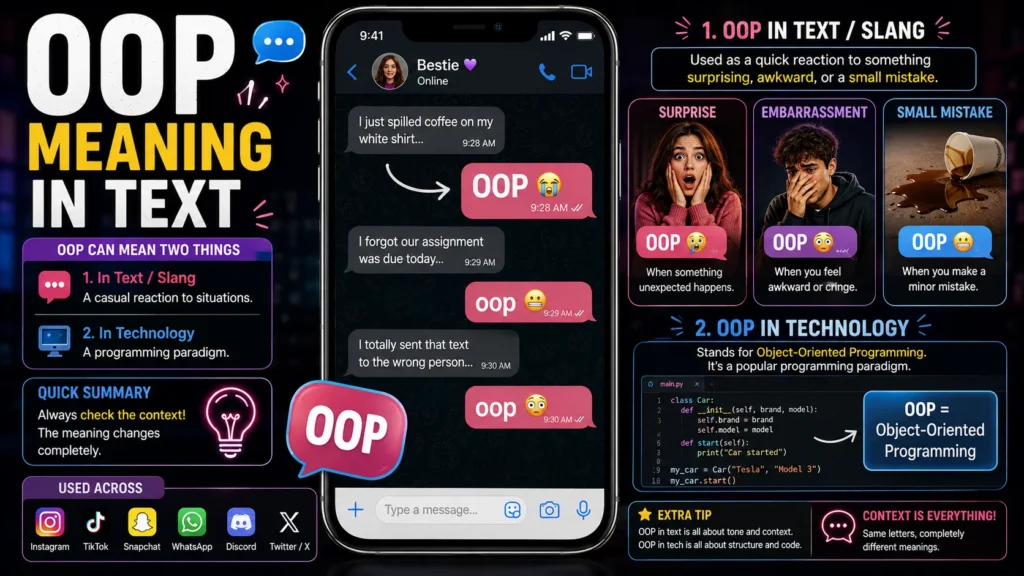

OOP in texting is usually an expression of surprise, embarrassment, or a sudden reaction, similar to “oops.” People often use it when something unexpected happens or when someone says something awkward. In other contexts, OOP can mean “Object-Oriented Programming,” especially in technology and coding.
Definition & Meaning
In casual texting and social media, OOP is commonly used as a reaction to something unexpected, awkward, or surprising.
It is similar to saying:
- “Oops”
- “Oh!”
- “Oh, wow”
- “Well, that happened”
- “I wasn’t expecting that”
For example:
Friend: “I accidentally sent the screenshot to the person I was talking about.”
You: “OOP 😭”
Here, OOP expresses surprise or amusement.
It can also be used when someone notices their own mistake.
“OOP, my bad 😂.”
This means something like:
“Oops, I made a mistake.”
The expression became especially popular online because it is short, expressive, and easy to add to a conversation.
However, OOP has another important meaning. In technology, OOP stands for Object-Oriented Programming, a programming approach based on objects and classes.
Therefore, context matters.
Background & History
The texting use of OOP developed from the word “oops.”
“Oops” has long been used in English when someone makes a small mistake or encounters something unexpected.
Internet users began modifying familiar expressions to make them shorter or more expressive. OOP became a popular written reaction, especially in online communities.
The expression is strongly associated with casual internet culture. It can communicate surprise without requiring a full sentence.
For example:
“OOP, didn’t see that coming 👀.”
The reaction is often playful rather than serious.
At the same time, OOP has existed as an abbreviation in technical fields for much longer. Programmers commonly use OOP to mean Object-Oriented Programming.
So there are two very different meanings:
OOP in texting: a reaction similar to “oops.”
OOP in programming: Object-Oriented Programming.
Usage in Various Contexts
Text Messages
“OOP 😂 I forgot to reply.”
The sender is acknowledging a small mistake.
Social Media
“OOP 👀 what happened here?”
This can express surprise or curiosity.
Group Chats
Friend: “I just told everyone your secret.”
You: “OOP 😭”
The response shows shock or playful disbelief.
TikTok and Instagram
OOP may appear in comments when someone sees something unexpected.
“OOP, the drama 👀.”
Here, it signals that the person noticed something interesting or surprising.
Gaming
Gamers may use OOP after making a mistake.
“OOP, wrong button 😂.”
It means something like “Oops, I pressed the wrong button.”
Common Misconceptions & Clarifications
A common misconception is that OOP always means “oops.”
Not necessarily.
If you’re talking about programming, OOP almost certainly means Object-Oriented Programming.
For example:
“I’m learning OOP in Python.”
This has nothing to do with surprise or embarrassment.
Another misconception is that OOP always indicates a serious mistake.
Usually, it doesn’t.
In casual online communication, OOP is often playful.
“OOP, I said that out loud 😂.”
The speaker may simply be joking about revealing something.
OOP vs Oops
Oops is the traditional English expression.
OOP is the internet-style version often used in informal digital communication.
Similar Terms & Alternatives
| Term | Meaning | Tone |
|---|---|---|
| OOP | Surprise or “oops” | Casual |
| Oops | Small mistake | Casual |
| OMG | Strong surprise | Informal |
| Oh no | Concern or surprise | Casual |
| Uh-oh | Something went wrong | Casual |
| Yikes | Discomfort or concern | Informal |
| LOL | Amusement | Casual |
OOP is usually lighter and more playful than expressions such as “Oh no!”
How to Respond to OOP
Your response depends on what happened.
Funny
“OOP indeed 😂.”
Casual
“Haha, yep.”
If They Made a Mistake
“No worries 😂.”
If Something Surprising Happened
“I know! I wasn’t expecting that either.”
Playful
“You saw nothing 👀.”
If someone simply sends “OOP”, you can also continue the conversation based on what caused the reaction.
Regional or Cultural Differences
The reaction-style use of OOP is most strongly associated with online English and social media culture.
People who spend more time on platforms such as TikTok, Instagram, X, Reddit, and Discord may recognize it quickly.
However, not everyone uses OOP in the same way.
Some people use:
- Oops
- Oop
- Oopsie
- Oh
- Oh wow
- Yikes
The exact choice often depends on age, personality, platform, and online community.
Comparison With Similar Terms
| Expression | Main Meaning | Typical Feeling |
|---|---|---|
| OOP | Unexpected moment | Surprise |
| Oops | Small mistake | Mild embarrassment |
| Yikes | Something uncomfortable | Concern |
| OMG | Strong reaction | Surprise |
| Uh-oh | Something went wrong | Concern |
| LOL | Something is funny | Amusement |
OOP is often used when the speaker wants to react quickly without explaining the whole situation.
Usage in Online Communities & Dating Apps
OOP can appear frequently in casual DMs and dating conversations.
For example:
Person 1: “I accidentally liked their photo from 2018.”
Person 2: “OOP 😭”
The response shows playful shock.
Another example:
Person 1: “I think I actually like you.”
Person 2: “OOP 👀”
Here, OOP can signal surprise and may even add a playful or flirty tone.
But OOP itself is not inherently romantic. The rest of the conversation determines the meaning.
Hidden or Offensive Meanings
OOP does not normally have an offensive meaning when used as internet slang.
It is generally a harmless reaction.
However, tone can change its effect.
“OOP.”
may sound neutral.
“OOP 😂”
sounds playful.
“OOP 👀”
can suggest surprise, curiosity, or teasing.
The expression itself isn’t offensive.
Suitability for Professional Communication
The reaction-style OOP is best avoided in formal professional communication.
For example, instead of:
“OOP, I forgot the attachment.”
write:
“Sorry, I forgot to include the attachment.”
In a technical workplace, however, OOP can be completely appropriate when discussing Object-Oriented Programming.
For example:
“We used OOP principles to structure the application.”
Here, OOP is a standard technical abbreviation.
FAQs
What does OOP mean in text?
OOP usually expresses surprise, embarrassment, or a small mistake, similar to saying “oops.”
What does OOP mean on social media?
On social media, OOP is commonly used as a quick reaction to something unexpected, awkward, funny, or surprising.
Is OOP the same as oops?
In casual texting, they are often used in a similar way. OOP is essentially an internet-style reaction based on “oops.”
Can OOP mean something else?
Yes. In programming and technology, OOP commonly means Object-Oriented Programming.
Is OOP slang?
The reaction-style use of OOP is informal internet slang or internet language. Its programming meaning is a standard technical abbreviation.
What does OOP mean from a girl or guy?
Usually, it simply means the person is surprised, amused, embarrassed, or reacting to something unexpected. The person’s gender does not change the basic meaning.
Is OOP a bad word?
No. OOP is generally harmless and is not considered an offensive word.
Conclusion
The OOP meaning in text is usually a quick reaction similar to “oops.” People use it to show surprise, embarrassment, amusement, or a reaction to something unexpected. It is especially common in casual texting, social media, group chats, and online communities.
However, context matters because OOP also means “Object-Oriented Programming” in technology and coding. If you’re reading a casual message, it probably represents a reaction. If you’re reading a programming discussion, it almost certainly refers to the programming concept.