

Quick Answer
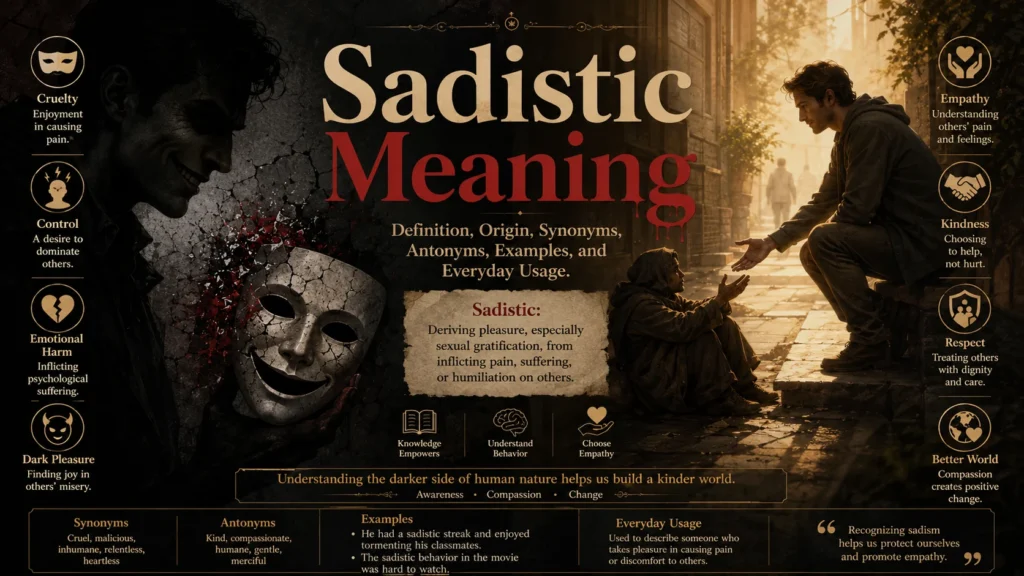
The sadistic meaning is taking pleasure in causing pain, suffering, humiliation, or discomfort to others. It can describe a person’s behavior, attitude, or actions and is commonly used in both psychological discussions and everyday language.
The word sadistic is often used to describe someone who seems to enjoy seeing others suffer, whether physically or emotionally. You might hear it in discussions about fictional villains, movies, books, psychology, or even casual conversations. However, people also use the term figuratively to describe someone who enjoys making difficult situations even harder, such as giving extremely tough exams or assigning impossible tasks.
While sadistic is sometimes used jokingly among friends, its literal meaning is much more serious. Understanding the sadistic meaning helps you recognize when the word is being used accurately and when it is simply being used as an exaggeration.
Sadistic Meaning at a Glance
| Word | Sadistic |
|---|---|
| Pronunciation | suh-DIS-tik |
| Part of Speech | Adjective |
| Primary Meaning | Enjoying or taking pleasure in causing pain or suffering to others. |
| Language of Origin | French |
| Common Contexts | Psychology, literature, movies, crime, and everyday conversations |
| Synonyms | Cruel, brutal, merciless, vicious, malicious |
| Antonyms | Compassionate, kind, caring, gentle, empathetic |
| Example Sentence | The movie’s villain had a sadistic personality. |
What Does Sadistic Mean?
Sadistic describes a person who enjoys causing pain, fear, humiliation, or suffering to others.
The word may describe:
- Physical cruelty
- Emotional cruelty
- Deliberate humiliation
- Enjoyment of another person’s suffering
Example:
The story featured a sadistic villain who enjoyed frightening innocent people.
The Origin of the Word Sadistic
The word sadistic comes from the name of the Marquis de Sade, an 18th-century French writer whose works described characters who gained pleasure from cruelty and violence.
His surname eventually gave rise to the term sadism, and the adjective sadistic is now used to describe behavior involving enjoyment of another person’s suffering.
Today, the term appears in psychology, literature, media, and everyday English.
Sadistic Meaning in Different Contexts
In Psychology
The word may describe behaviors involving pleasure from another person’s pain or humiliation. In professional settings, it should be used carefully and within appropriate clinical contexts.
Example:
The psychologist discussed sadistic behavior in the case study.
In Movies
Villains are often portrayed as sadistic.
Example:
The villain had a sadistic smile during the confrontation.
In Literature
Authors use the word to describe cruel characters.
Example:
The novel’s antagonist was exceptionally sadistic.
In Everyday Conversations
People sometimes use sadistic figuratively to describe someone who enjoys making things unnecessarily difficult.
Example:
Our coach gave us a sadistic workout before the tournament.
Common Uses of Sadistic
Describing Cruel Behavior
Example:
The bully’s sadistic actions hurt many classmates.
Talking About Fictional Characters
Example:
The horror film featured a sadistic criminal.
Describing Difficult Situations
Used humorously or as exaggeration.
Example:
That exam felt sadistic.
Examples of Sadistic in Sentences
- The villain was known for his sadistic behavior.
- The bully made sadistic jokes at others’ expense.
- Critics described the movie as containing sadistic violence.
- The character had a sadistic personality.
- The story explored themes of cruelty and revenge.
- His sadistic actions frightened everyone.
- The novel introduced a sadistic ruler.
- She jokingly called the workout sadistic.
Synonyms of Sadistic
- Cruel
- Brutal
- Merciless
- Vicious
- Malicious
- Heartless
- Ruthless
- Inhumane
- Mean-spirited
Antonyms of Sadistic
- Compassionate
- Kind
- Caring
- Gentle
- Empathetic
- Merciful
- Humane
- Sympathetic
- Considerate
- Benevolent
Sadistic vs Masochistic
These terms are often confused but have opposite meanings.
| Sadistic | Masochistic |
|---|---|
| Enjoys causing pain or suffering to others. | Refers to finding satisfaction in experiencing one’s own pain or hardship (the term has different meanings depending on context). |
| Focuses on another person’s suffering. | Focuses on one’s own suffering. |
| Often used to describe cruel behavior. | Used differently in psychology and everyday language. |
Why Is Sadistic a Common Word?
The word frequently appears in:
- Crime stories
- Movies
- Television series
- Psychology articles
- News reports
- Books
- Online discussions
- Everyday conversations
It is commonly used to describe extreme cruelty or, less literally, to exaggerate how difficult or unpleasant something feels.
FAQs
What does sadistic mean?
Sadistic means taking pleasure in causing pain, suffering, or humiliation to others.
Is sadistic always about physical pain?
No. It can also refer to emotional suffering, humiliation, or psychological cruelty.
Is sadistic a medical diagnosis?
Not by itself. While the word is used in psychology, describing someone as “sadistic” alone is not the same as making a clinical diagnosis.
Can sadistic be used jokingly?
Yes. People sometimes use it humorously to describe extremely difficult tasks, but its literal meaning refers to cruelty.
What is the opposite of sadistic?
Common opposites include compassionate, kind, gentle, and empathetic.
How do you pronounce sadistic?
It is commonly pronounced suh-DIS-tik.
Conclusion
The sadistic meaning refers to taking pleasure in causing pain, suffering, or humiliation to others. While the word is often used to describe cruel fictional characters or serious psychological behavior, it is also used figuratively in everyday conversations to describe situations that feel unnecessarily harsh or difficult. Understanding the term and its context helps ensure it is used accurately and respectfully.