

Quick Answer
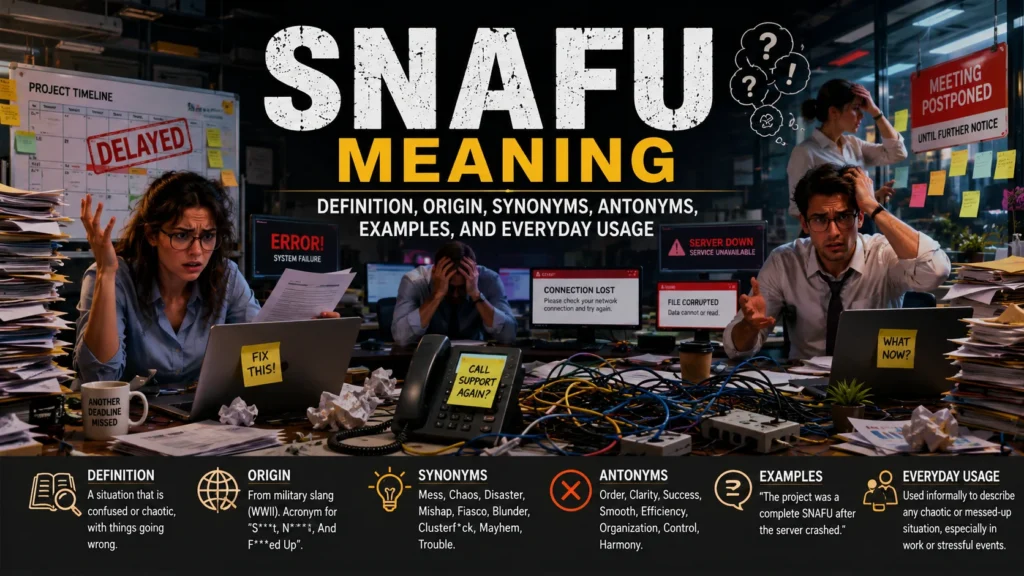
The SNAFU meaning is a situation that has become disorganized, chaotic, or full of problems. It is also a military acronym that originally stood for “Situation Normal: All Fouled Up” (the original military version used a stronger profanity), but today it is commonly used to describe any confusing or messy situation.
The term SNAFU is a well-known acronym that originated in the U.S. military during World War II. Soldiers used it humorously to describe situations where everything seemed to be going wrong despite being considered “normal.” Over time, the expression moved into everyday English and is now widely used in business, politics, news, and casual conversations.
Today, when someone says a project has become a SNAFU, they usually mean it is suffering from confusion, mistakes, poor planning, or unexpected problems. Understanding the SNAFU meaning helps you recognize this popular expression in both historical and modern contexts.
SNAFU Meaning at a Glance
| Term | SNAFU |
|---|---|
| Pronunciation | SNAF-oo |
| Part of Speech | Noun |
| Full Form | Situation Normal: All Fouled Up |
| Original Military Version | Situation Normal: All F***ed Up |
| Primary Meaning | A chaotic, disorganized, or problematic situation. |
| Origin | U.S. military slang during World War II |
| Common Contexts | Business, government, military, news, and everyday conversations |
| Example Sentence | The software update turned into a complete SNAFU. |
What Does SNAFU Mean?
SNAFU refers to a situation filled with confusion, mistakes, delays, or unexpected problems.
Although it began as military slang, it is now commonly used in everyday English.
Examples:
- The airport experienced a SNAFU after the storm.
- A scheduling SNAFU delayed the meeting.
In both examples, SNAFU means something went wrong and created unnecessary confusion.
The Origin of the Word SNAFU
SNAFU originated during World War II among American soldiers.
It originally stood for:
Situation Normal: All F*ed Up**
Because the original phrase contains profanity, a family-friendly version is often written as:
Situation Normal: All Fouled Up
The acronym reflected soldiers’ humor about the challenges and confusion of military life. After the war, the expression spread into civilian language and became a common way to describe any major mix-up.
SNAFU Meaning in Different Contexts
In Business
Companies use SNAFU to describe unexpected problems or operational mistakes.
Example:
The product launch became a SNAFU after shipping delays.
In Government
Officials may use the term when discussing administrative errors.
Example:
The paperwork SNAFU delayed the project.
In Technology
The word describes technical failures or software issues.
Example:
The system outage caused a SNAFU for customers.
In Everyday Conversations
People use SNAFU for any confusing or frustrating situation.
Example:
Our vacation plans turned into a complete SNAFU.
Common Uses of SNAFU
Describing Mistakes
Example:
There was a communication SNAFU.
Talking About Delays
Example:
The delivery SNAFU postponed the event.
Explaining Confusion
Example:
The booking SNAFU left everyone waiting.
Examples of SNAFU in Sentences
- The event became a SNAFU because of poor planning.
- A scheduling SNAFU delayed the meeting.
- The software update caused a major SNAFU.
- Their travel plans ended in a SNAFU.
- The paperwork SNAFU frustrated customers.
- One small mistake created a huge SNAFU.
- The company apologized for the SNAFU.
- Nobody expected the project to become such a SNAFU.
Synonyms of SNAFU
- Mess
- Mix-up
- Chaos
- Confusion
- Blunder
- Mishap
- Fiasco
- Problem
- Disorder
- Debacle
Antonyms of SNAFU
- Order
- Organization
- Success
- Smooth operation
- Efficiency
- Stability
- Coordination
- Harmony
- Control
- Perfection
SNAFU vs FUBAR
These military acronyms are often confused.
| SNAFU | FUBAR |
|---|---|
| Refers to a situation that is chaotic or disorganized. | Refers to something that is completely ruined or beyond repair. |
| Problems may still be fixable. | Usually implies severe or irreversible damage. |
| Common in business and everyday conversations. | More informal and less commonly used in professional settings. |
Why Is SNAFU Still Popular?
Although it originated in the military, SNAFU remains popular because it quickly describes a situation where things have gone wrong.
You’ll commonly hear it in:
- Business meetings
- News reports
- Government discussions
- Technology articles
- Military history
- Workplace conversations
- Everyday English
Its humorous tone makes it a memorable way to describe confusion and mistakes.
FAQs
What does SNAFU mean?
SNAFU means a chaotic, confusing, or problematic situation. It originally stood for Situation Normal: All Fouled Up, with the original military version using stronger language.
Where did SNAFU come from?
It originated as U.S. military slang during World War II.
Is SNAFU an acronym?
Yes. It is an acronym that represents a humorous phrase about disorder and confusion.
Is SNAFU a bad word?
The acronym itself is not offensive, but its original military expansion contains profanity. The family-friendly version uses “Fouled Up.”
Is SNAFU still used today?
Yes. It is commonly used in business, technology, government, and everyday conversations.
How do you pronounce SNAFU?
It is commonly pronounced SNAF-oo.
Conclusion
The SNAFU meaning refers to a situation that has become chaotic, confusing, or full of unexpected problems. Originally created as military slang during World War II, the term has become part of everyday English and is widely used to describe organizational mistakes, technical issues, and frustrating mix-ups. Whether discussing work, travel, or daily life, SNAFU remains a useful and memorable expression for describing situations that don’t go according to plan.