
Definition:
Apt means being suitable, appropriate, accurate, or having a natural ability to learn or do something well.
Have you ever heard someone say, “That’s an apt description” or “She made an apt comparison,” and wondered what apt actually means? Although it’s a short word, apt carries several meanings depending on the context. It can describe something that is appropriate, someone who learns quickly, or even indicate that something is likely to happen.
Understanding the apt meaning can improve both your vocabulary and your confidence in using English naturally. In this guide, you’ll learn the definition of apt, its origin, common uses, examples, synonyms, comparisons, and practical tips for using it correctly in everyday conversations and writing.
Apt Meaning and Definition
What Does Apt Mean?
Apt is an adjective that generally means appropriate, suitable, fitting, or likely to happen. It can also describe someone who is quick to learn or naturally talented in a particular area.
Examples
| Sentence | Meaning |
|---|---|
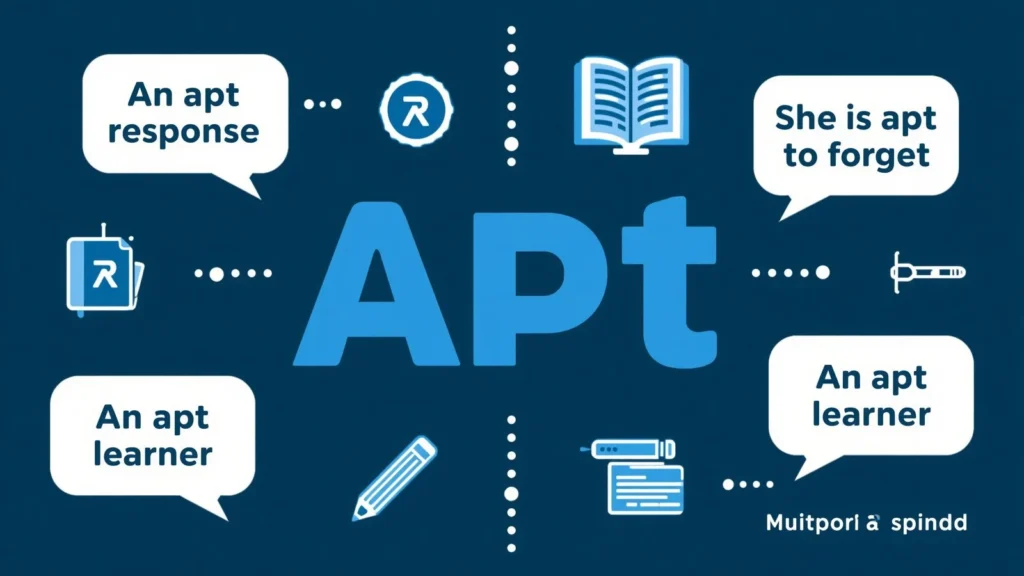
| That was an apt response. | The response was appropriate for the situation. |
| She is apt to forget names. | She is likely to forget names. |
| He is an apt student. | He learns quickly and easily. |
Origin of the Word “Apt”
The word apt comes from the Latin word aptus, meaning fit, suitable, or joined together. It entered the English language through Old French and has been used for centuries to describe people, actions, and situations that are especially appropriate or well suited.
Today, apt is commonly found in books, news articles, business writing, education, and everyday conversations.
Different Meanings of Apt
Depending on the sentence, apt can have several meanings.
1. Suitable or Appropriate
This is the most common meaning.
Examples
- That was an apt choice of words.
- Her comment was apt for the occasion.
- The title is apt for the story.
2. Likely to Happen
Sometimes apt means something is likely or prone to happen.
Examples
- Children are apt to get curious.
- The roads are apt to flood during heavy rain.
- He is apt to arrive late.
3. Quick to Learn
When describing a person, apt can mean intelligent or naturally talented.
Examples
- She is an apt learner.
- He’s apt at solving puzzles.
- The young musician proved to be exceptionally apt.
How Is “Apt” Used in Everyday English?
You’ll often hear apt in conversations, articles, workplaces, and classrooms.
In Conversations
- “That’s an apt observation.”
- “You’re apt to enjoy this movie.”
In Education
Teachers may describe a student as an apt learner if they understand new ideas quickly.
In Business
Professionals often use phrases like:
- Apt solution
- Apt description
- Apt example
- Apt comparison
These expressions make writing sound more polished and professional.
Common Examples of Apt
| Expression | Meaning |
|---|---|
| Apt description | A very accurate description |
| Apt response | A suitable reply |
| Apt comparison | A fitting comparison |
| Apt learner | Someone who learns quickly |
| Apt remark | An appropriate comment |
Apt vs Similar Words
Many words are similar to apt, but each has its own nuance.
| Word | Meaning | Difference |
|---|---|---|
| Apt | Suitable or likely | Broadest meaning |
| Appropriate | Proper for the situation | More formal |
| Suitable | Right for a purpose | Common in everyday English |
| Relevant | Directly connected | Focuses on relation |
| Accurate | Correct | Focuses on correctness |
Synonyms of Apt
Depending on the context, you can use these words instead of apt:
- Appropriate
- Suitable
- Fitting
- Proper
- Relevant
- Accurate
- Likely
- Prone
- Clever
- Quick to learn
Opposites of Apt
Some common antonyms include:
- Inappropriate
- Unsuitable
- Improper
- Unfit
- Irrelevant
- Unlikely
Alternate Meanings of Apt
Besides its dictionary meanings, APT can also appear as an abbreviation in different fields.
Some common examples include:
- Advanced Persistent Threat (Cybersecurity)
- Apartment (Property listings and rental advertisements)
- Automatic Picture Transmission (Weather satellite technology)
When you see APT written in capital letters, the intended meaning usually depends on the context.
Tips for Using “Apt” Correctly
Keep these tips in mind:
- Use apt when something perfectly fits a situation.
- Use apt to when describing something likely to happen.
- Use apt learner for someone who learns quickly.
- In formal writing, apt often sounds more sophisticated than appropriate.
FAQs
1. What does apt mean?
Apt means appropriate, suitable, accurate, or likely to happen. It can also describe someone who learns quickly.
2. Is apt a positive word?
Usually, yes. It often describes something that is fitting or someone with natural ability. However, it can also describe negative tendencies, such as “He is apt to worry.”
3. What does “apt to” mean?
“Apt to” means likely to or prone to do something.
4. Can apt describe a person?
Yes. An apt person is someone who learns quickly or has a natural talent.
5. What is the difference between apt and appropriate?
Both mean suitable, but apt often suggests something is especially accurate or perfectly fitting.
6. Is apt commonly used in English?
Yes. It is common in formal writing, education, journalism, and professional communication.
7. What are some synonyms for apt?
Common synonyms include appropriate, suitable, fitting, proper, relevant, and likely.
8. What does APT mean in cybersecurity?
In cybersecurity, APT stands for Advanced Persistent Threat, referring to a long-term and highly targeted cyberattack.
Conclusion
Understanding the apt meaning helps you communicate more accurately and naturally in English. Whether you’re describing something as appropriate, saying a person is quick to learn, or explaining that something is likely to happen, apt is a versatile word that fits many situations.
By learning its different meanings, synonyms, and real-life examples, you’ll be able to recognize and use this useful word with confidence in both everyday conversations and professional writing.
See Also More :
- 200+ TBH Snapchat Replies That Are Funny, Honest, Cute, and Perfect for Stories in 2026
- 200+ Dry Replies That Turn “Dry Replies” Funny Comebacks In 2026