

Quick Answer:
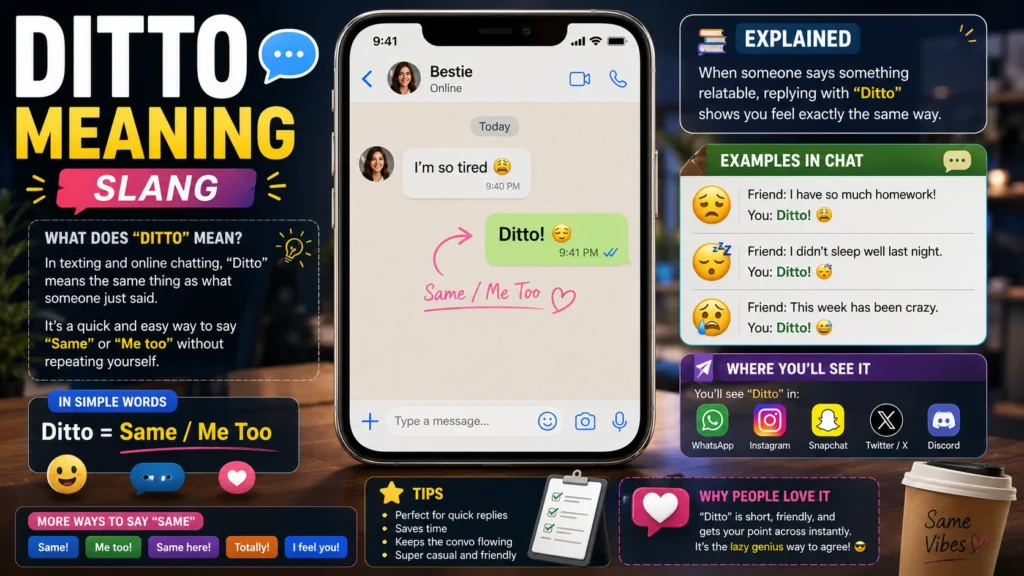
Ditto means “same,” “me too,” or “I agree.” In texting and casual conversation, people use it when they feel the same way as someone else or want to repeat the same response without saying everything again. For example, if someone says, “I’m so tired,” replying “Ditto” means “I’m tired too.”
Have you ever received a one-word reply that made you stop and think, “What does that even mean?” Ditto is one of those words. It looks simple, but its meaning depends on what came before it.
You may see ditto in text messages, Instagram comments, TikTok discussions, group chats, or everyday conversations. It can be a quick way to agree with someone, return a compliment, share the same feeling, or say that the same thing applies to you.
If you are learning modern slang, trying to understand a message, or simply want to know how native English speakers use the word, this guide will make ditto meaning slang easy to understand.
Definition & Meaning
In casual speech and texting, ditto means “the same,” “me too,” “I agree,” or “same here.”
Instead of repeating another person’s statement, you can simply say ditto.
For example:
Friend: “I really need a vacation.”
You: “Ditto.”
Here, ditto means:
“I really need a vacation too.”
It can also be used when someone gives you a positive message.
Friend: “Have a great weekend!”
You: “Ditto!”
This means:
“You have a great weekend too.”
The word is especially useful when your response is exactly the same as what another person has already said.
Ditto Meaning at a Glance
| Term | Meaning | Tone |
|---|---|---|
| Ditto | Same or me too | Casual |
| Ditto | I agree | Friendly |
| Ditto | Same applies to me | Informal |
| Ditto | You too | Context-dependent |
Although people sometimes describe ditto as slang, it is not strictly modern internet slang. It is an established English word that has been used for a long time. Its short, casual use in texts simply makes it feel like slang.
Background & History
The history of ditto is older than texting, smartphones, and social media.
The word comes from the Italian detto, meaning “said.” It entered English centuries ago and was used to indicate that something should be repeated.
For example, in old written records, a person could write a word once and then use ditto to mean that the same word applied again.
This idea of repetition eventually became part of everyday English.
Over time, people started using ditto outside of written records. Instead of physically repeating something, speakers could say “ditto” to mean:
“The same applies to me.”
Modern texting gave the word another useful role. Online conversations move quickly, so people often prefer short replies.
Instead of typing:
“I feel exactly the same way.”
someone can simply type:
“Ditto.”
Today, you can find the word in casual conversations, social media posts, online comments, text messages, and entertainment.
It has remained popular because its meaning is simple and flexible.
Usage in Various Contexts
The meaning of ditto stays close to “same,” but its exact tone depends on the situation.
In Text Messages
This is one of the easiest ways to use it.
Alex: “I’m exhausted today.”
Sam: “Ditto.”
Sam is saying that they are exhausted too.
In Social Media Comments
Someone may use ditto when agreeing with another person’s opinion.
Comment: “This is the best movie I’ve watched this year.”
Reply: “Ditto!”
The person completely agrees.
With Compliments
Ditto can also mean “same to you.”
“You look amazing!”
“Ditto ❤️”
The reply returns the compliment.
In Group Chats
It can save time when several people share the same opinion.
Person 1: “We should order pizza.”
Person 2: “Ditto.”
Person 3: “Same.”
Here, both people agree with the first suggestion.
In Casual Conversation
Ditto is not limited to online communication.
“I could really use some coffee.”
“Ditto.”
The second person means they want coffee too.
Common Misconceptions & Clarifications
One common misunderstanding is that ditto only means “I agree.” That’s not always true.
It can mean agreement, but it can also mean that you share a feeling, experience, preference, or situation.
For example:
“I miss summer.”
“Ditto.”
This isn’t necessarily an opinion that the second person agrees with. It means “I miss summer too.”
Another misconception is that ditto is always romantic. It isn’t.
You can use it with:
- Friends
- Family
- Coworkers in casual settings
- Online communities
- Romantic partners
The context determines the tone.
Can Ditto Sound Rude?
Usually, no.
But a one-word response can sometimes feel lazy or dismissive.
Imagine someone sends you a long emotional message:
“I’ve been having a really difficult week and I feel completely overwhelmed.”
Replying only:
“Ditto.”
may sound cold.
A more caring response would be:
“I understand. I’ve been feeling overwhelmed too.”
So, while ditto is perfectly normal, it isn’t always the best response.
Similar Terms & Alternatives
Several expressions can replace ditto in casual conversations.
| Expression | Meaning | Tone |
|---|---|---|
| Ditto | Same or me too | Casual |
| Same | I feel the same | Very casual |
| Me too | I also feel that way | Natural |
| Same here | I have the same experience | Casual |
| I agree | I share your opinion | Neutral |
| Likewise | The same applies to you | Slightly formal |
| You too | Returning a wish or greeting | Casual |
Ditto vs Same
“Same” is more common in modern internet slang.
“Ditto” can sound a little more playful or old-fashioned.
Ditto vs Me Too
“Me too” is usually clearer.
“Ditto” is shorter and can sound more humorous.
Ditto vs Likewise
“Likewise” is more polished and can work in professional or semi-formal situations.
How to Respond to This Term
If someone says “ditto” to you, your response depends on the conversation.
Casual Response
“Haha, same 😂”
Good for friends and relaxed chats.
Funny Response
“Great minds think alike 😂”
This keeps the conversation playful.
Friendly Response
“Glad I’m not the only one!”
This works when you have shared a feeling or experience.
Romantic Response
“Aww, ditto ❤️”
This works when the conversation is already affectionate.
Professional Response
If someone uses ditto in a casual workplace conversation, you can simply continue normally.
“I agree. Let’s go with that option.”
If You Want More Detail
Sometimes you can ask:
“Ditto what? 😂”
This works when the previous message isn’t clear.
Regional or Cultural Differences
Ditto is widely understood in English-speaking communities, but how often people use it varies.
In casual American English, you may hear:
- Ditto
- Same
- Me too
- Same here
Younger internet users may prefer “same” because it is common across social media.
In other English-speaking communities, ditto may sound slightly more traditional or playful.
The word itself does not have a different basic meaning in different English-speaking regions. The main difference is how frequently people choose to use it.
For non-native English speakers, context is important. If someone says “ditto” after expressing a feeling, they are usually saying that they share that feeling.
Comparison With Similar Terms
| Word or Phrase | Basic Meaning | Example |
|---|---|---|
| Ditto | Same | “I’m tired.” “Ditto.” |
| Same | I feel the same | “I’m hungry.” “Same.” |
| Me too | I also feel this | “I love this song.” “Me too.” |
| Likewise | Same applies to you | “Nice meeting you.” “Likewise.” |
| I agree | I share your opinion | “This plan works.” “I agree.” |
| You too | Same wish toward you | “Have a nice day.” “You too.” |
The biggest difference is tone.
Ditto is casual and slightly playful.
Same is very modern and informal.
Me too is natural and widely understood.
Likewise sounds more polished.
I agree is direct and clear.
Usage in Online Communities & Dating Apps
Ditto can appear in online communities when users strongly agree with another person’s comment.
For example:
User 1: “This game needs a better matchmaking system.”
User 2: “Ditto.”
The second user is saying they have the same opinion.
In dating conversations, the word can have a warmer meaning depending on the message.
Person 1: “I had a great time talking to you.”
Person 2: “Ditto 😊”
This means:
“I had a great time talking to you too.”
However, don’t assume that ditto is automatically flirty. The surrounding conversation matters much more than the word itself.
If someone sends:
“Miss you.”
and you reply:
“Ditto ❤️”
it can sound affectionate.
If someone says:
“I hate waking up early.”
and you reply:
“Ditto.”
there is nothing romantic about it.
Hidden or Offensive Meanings
Ditto does not normally have a hidden offensive meaning in texting or slang.
Its standard meaning remains connected to same, me too, or I agree.
Still, tone can change how it feels.
For example:
“Whatever. Ditto.”
can sound dismissive.
Likewise:
“Yeah, ditto.”
could sound uninterested if the conversation is already tense.
The word itself isn’t offensive. The context, punctuation, and relationship between the people determine how it comes across.
If someone uses ditto sarcastically, it may communicate:
“I feel exactly the same, but I’m not taking this conversation seriously.”
So don’t judge the meaning from the word alone.
Suitability for Professional Communication
Ditto is usually acceptable only in casual professional conversations where the tone is relaxed.
It is not the best choice for:
- Formal emails
- Job applications
- Business proposals
- Official reports
- Client communication
- Important workplace messages
Instead of:
“Ditto.”
you could write:
“I agree.”
or:
“I feel the same way.”
For a more polished response, use:
“I agree with your assessment.”
or:
“I feel the same approach would work well.”
The main reason is clarity. Professional writing should leave little room for interpretation.
FAQs
What does ditto mean in slang?
Ditto means “same,” “me too,” or “I agree.” It is used when someone wants to say that the same feeling, opinion, or situation applies to them.
What does ditto mean in texting?
In texting, ditto is a short way to say that you feel or think the same as the person you’re talking to.
Is ditto a slang word?
Ditto is often used casually like slang, but it is actually an established English word with a much older history.
Is ditto a positive or negative word?
Ditto is normally neutral or positive. Its tone depends on the conversation and how the person uses it.
Does ditto mean me too?
Yes. In many conversations, ditto can be replaced with “me too” or “same here.”
Is ditto romantic?
Not by itself. It can sound romantic when used in an affectionate conversation, but it is also commonly used between friends and family.
Can I use ditto in a professional email?
It’s better to use clearer phrases such as “I agree,” “likewise,” or “I feel the same way” in formal communication.
Conclusion
The ditto meaning slang is simple: same, me too, or I agree. It lets you respond to someone without repeating everything they just said. You can use it when sharing a feeling, agreeing with an opinion, returning a compliment, or showing that the same situation applies to you.
While ditto is common in casual texting and social media, remember that context controls the tone. A quick “Ditto 😂” can sound funny between friends, while “Ditto ❤️” can feel affectionate in a romantic conversation. In formal situations, however, a clearer phrase such as “I agree” is usually the better choice.