
Quick Answer
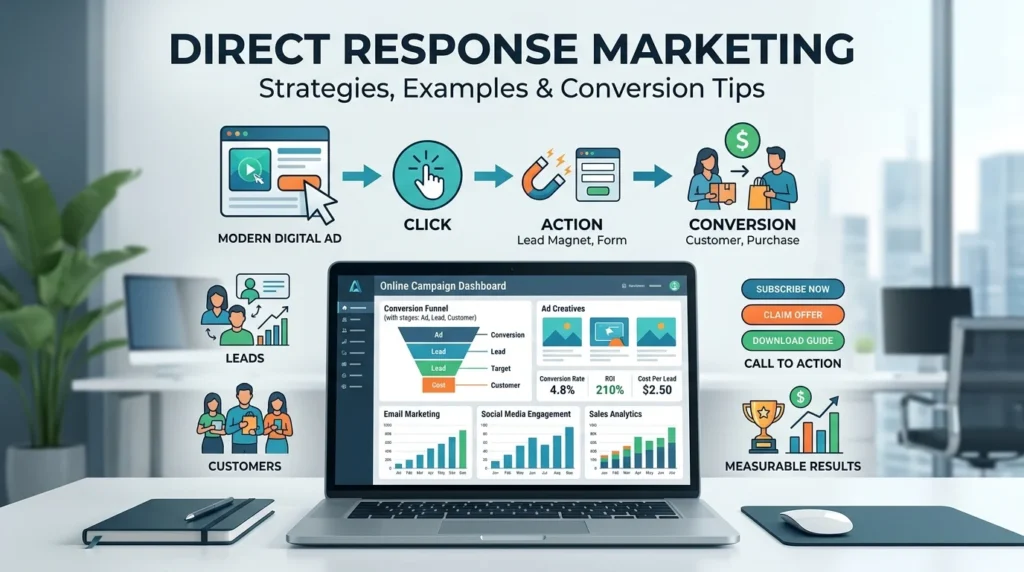
Direct response marketing is a type of marketing designed to make people take an immediate, measurable action, such as buying, signing up, calling, clicking, or requesting information. It combines a clear offer with persuasive messaging and a strong call to action.
Top alternatives: direct response advertising, performance marketing, response marketing, conversion marketing, measurable marketing
Ever see an ad that makes you think, “Okay, where do I click?” That’s direct response marketing doing its job. Unlike traditional advertising that mainly focuses on awareness and brand recognition, direct response marketing asks the audience to do something right now. That could mean purchasing a product, joining an email list, downloading a guide, booking a consultation, or sending a message. You’ll find it everywhere, from Facebook ads and TikTok campaigns to email marketing, landing pages, direct mail, and search ads. The magic is in making the next step obvious. A strong offer, persuasive copy, urgency, and a clear call to action can turn attention into measurable results. In this guide, you’ll learn what direct response marketing means, how it works, which strategies matter, and how businesses can use it effectively in 2026.
What Is Direct Response Marketing?
Direct response marketing is marketing built around an immediate and measurable response from the audience.
Instead of simply saying, “Remember our brand,” the campaign asks people to take a specific action.
That action might be:
- Buy now
- Sign up
- Download a free guide
- Request a quote
- Book a call
- Start a free trial
- Claim an offer
- Send a message
- Visit a landing page
- Subscribe to an email list
The key word is response.
A successful campaign can tell you exactly what happened after someone saw the marketing message.
How Does Direct Response Marketing Work?
Direct response marketing typically follows a simple path:
Attention → Problem → Solution → Offer → Call to Action → Response
For example, imagine a company selling a productivity app.
The advertisement might say:
“Still wasting two hours every morning organizing your tasks? Try our productivity app free for 14 days.”
The ad identifies a problem, presents a solution, gives an offer, and tells the reader what to do next.
That’s direct response marketing in action.
Direct Response Marketing vs Traditional Marketing
| Direct Response Marketing | Traditional Marketing |
|---|---|
| Focuses on immediate action | Often focuses on awareness |
| Highly measurable | Can be harder to measure |
| Uses specific calls to action | May use broader messaging |
| Tracks conversions | Often tracks reach and recognition |
| Usually tests multiple variations | Often relies on larger campaigns |
| Focuses heavily on offers | Focuses heavily on brand perception |
Neither approach is automatically better.
The right choice depends on your business goals.
Key Elements of Direct Response Marketing
Strong Hook
Your first sentence needs to earn attention.
Examples:
- “Stop wasting money on expensive software.”
- “Get your first customers without cold calling.”
- “Your morning routine may be costing you productivity.”
A weak opening gets ignored.
A strong one creates curiosity.
Clear Problem
Good direct response copy shows that you understand the customer’s frustration.
For example:
“Struggling to keep up with customer emails?”
The reader immediately recognizes the problem.
Compelling Solution
Next, explain how your product or service solves that problem.
Keep it simple.
Nobody wants to decode a marketing message like it’s an ancient scroll.
Strong Offer
Your offer gives people a reason to act.
It could include:
- Discounts
- Free trials
- Bonuses
- Free consultations
- Limited-time pricing
- Free shipping
- Exclusive access
- Money-back guarantees
Clear Call to Action
Tell people exactly what to do.
Examples include:
Shop Now
Get Started
Claim Your Discount
Book Your Free Call
Download the Guide
Start Your Free Trial
Best Direct Response Marketing Strategies
Email Marketing
Email remains one of the most useful channels for direct response campaigns.
A strong email usually includes:
- Attention-grabbing subject line
- Relevant problem
- Clear solution
- Specific offer
- Call to action
Paid Search Advertising
Search ads can capture people who are already looking for a solution.
Someone searching for “best accounting software for small business” already has commercial intent.
A well-written ad can turn that intent into a click and potentially a customer.
Social Media Advertising
Platforms such as Facebook, Instagram, TikTok, and YouTube allow businesses to test different audiences and creative concepts.
Effective direct response ads often combine:
- Strong hooks
- Short videos
- Customer pain points
- Social proof
- Clear offers
- Strong CTAs
Landing Pages
A landing page should have one primary objective.
If the page asks visitors to:
- Buy
- Subscribe
- Download
- Book
- Call
- Follow
- Read six other articles
…you may have a focus problem.
Keep the desired action obvious.
Direct Mail
Direct response marketing isn’t limited to digital channels.
Postcards, catalogs, letters, coupons, and promotional packages can all encourage measurable responses.
QR codes, unique URLs, promo codes, and dedicated phone numbers can make direct mail easier to track.
Direct Response Marketing Examples
Example 1: Ecommerce
“Get 25% off your first order. Use code FIRST25 at checkout.”
The customer gets an offer and a clear next step.
Example 2: SaaS
“Try our project management platform free for 14 days. No credit card required.”
The free trial reduces friction.
Example 3: Local Business
“Need a plumber today? Call now for same-day service.”
The message focuses on urgency and immediate action.
Example 4: Coaching
“Book a free 20-minute strategy session and discover your three biggest growth opportunities.”
The free consultation becomes the response mechanism.
Example 5: Lead Generation
“Download the free 2026 small-business marketing checklist.”
The download generates a measurable lead.
Example 6: Fitness
“Start your 7-day workout plan free today.”
The offer gives the audience a reason to act.
Example 7: Real Estate
“See homes available under $300,000 in your area.”
The CTA can send prospects to a property search or lead form.
Example 8: Online Course
“Join thousands of students learning digital marketing. Start your first lesson free.”
The free lesson lowers the barrier to entry.
Direct Response Marketing Copywriting
Copywriting plays a huge role in direct response campaigns.
One popular framework is:
Problem → Agitation → Solution
For example:
“Still spending hours creating social media posts?
Trying to stay consistent while running your business can feel impossible.
Our scheduling tool lets you plan an entire month of content in one afternoon.”
Then comes the CTA:
Start Free Today
The structure works because it connects the customer’s problem to a practical solution.
Direct Response Headlines
A headline can make or break your campaign.
Try formats such as:
- “How to Get More Customers Without Increasing Your Ad Budget”
- “The Simple Way to Save 5 Hours Every Week”
- “Stop Paying More for Marketing”
- “Get Started Free Today”
- “Discover the Strategy Small Businesses Are Using to Grow”
- “Want More Leads? Start Here”
- “Save 30% Before the Offer Ends”
- “Get Your Free Marketing Guide”
Direct Response Calls to Action
A CTA should make the next step obvious.
Popular examples include:
- Buy Now
- Shop Now
- Get Started
- Learn More
- Claim Your Offer
- Download Now
- Book a Call
- Start Free
- Get My Quote
- Try It Free
- Reserve Your Spot
- Subscribe Now
- Request a Demo
- Get Instant Access
- Join Today
Direct Response Marketing for Small Businesses
Small businesses can use direct response marketing without huge advertising budgets.
Start with one specific goal.
For example:
Goal: Generate consultation requests.
Create an ad offering a free consultation.
Send traffic to a simple landing page.
Ask visitors for basic contact information.
Track:
- Ad clicks
- Landing-page visits
- Leads
- Appointments
- Customers
- Revenue
Now you can see whether the campaign actually works.
Direct Response Marketing on Social Media
Social media is ideal for testing direct response campaigns.
A simple post might say:
“Want 10 free content ideas for your business? Comment ‘GUIDE’ and we’ll send them to you.”
This creates an immediate action.
You can also use:
- Instagram Stories
- TikTok videos
- Facebook ads
- YouTube ads
- Pinterest pins
- Messenger campaigns
- Lead forms
The important part is having a measurable response.
Direct Response Marketing Metrics
You can’t improve what you don’t measure.
Important metrics include:
| Metric | What It Measures |
|---|---|
| CTR | Percentage of people who click |
| Conversion Rate | Percentage who complete the desired action |
| CPC | Cost per click |
| CPL | Cost per lead |
| CPA | Cost per acquisition |
| ROAS | Revenue generated compared with ad spend |
| AOV | Average order value |
| LTV | Customer lifetime value |
| ROI | Overall return on investment |
These metrics help you identify where your campaign is losing potential customers.
How to Improve Conversion Rates
If people are clicking but not buying, your problem may not be the advertisement.
Check your landing page.
Ask:
- Is the offer clear?
- Is the CTA easy to find?
- Does the page load quickly?
- Is there enough trust?
- Are testimonials visible?
- Does the page match the ad?
- Is the checkout process simple?
- Are you asking for too much information?
Small changes can sometimes produce significant improvements.
The Importance of Social Proof
People naturally look for evidence before making a decision.
Social proof can include:
- Customer reviews
- Testimonials
- Case studies
- Ratings
- User-generated content
- Before-and-after examples
- Client logos
- Expert endorsements
For example:
“Trusted by more than 10,000 customers”
can provide immediate credibility.
But never fabricate testimonials or claims.
Using Urgency
Urgency can encourage people to act rather than postpone the decision.
Examples include:
- Offer ends tonight
- Limited spots available
- Early-bird pricing ends Friday
- Sale ends Sunday
- Registration closes soon
The urgency should be genuine.
Fake countdown timers may create short-term clicks but can damage trust.
Using Scarcity
Scarcity communicates limited availability.
Examples:
“Only 10 consultation slots available this month.”
“Last 50 products at this price.”
“Registration closes when the class reaches capacity.”
Again, authenticity matters.
If everything is “limited,” nothing feels limited.
Direct Response Marketing Funnels
A direct response funnel might look like this:
Ad → Landing Page → Lead Form → Email Follow-Up → Offer → Purchase
Another example:
TikTok Video → Product Page → Checkout → Upsell
Each stage should move the customer toward the desired action.
Direct Response Email Examples
Promotional Email
Subject: Your 25% discount expires tonight
“Still thinking about it?
Your 25% discount ends tonight.
Use code SAVE25 before midnight.
Shop Now”
Lead Generation Email
Subject: Want the free guide?
“Looking for a simpler way to plan your marketing?
Download our free guide and get practical strategies you can use today.
Get the Free Guide”
Product Launch Email
Subject: It’s finally here
“Our new product is officially available.
Early customers get an exclusive launch bonus.
Get Yours Today”
Direct Response Marketing Mistakes
Weak CTA
“Click here” can work, but a more specific CTA often communicates greater value.
Try:
“Get My Free Guide”
instead.
Too Many Offers
Giving people ten choices can create decision paralysis.
One campaign should usually have one primary action.
Focusing Only on Features
Features explain what a product does.
Benefits explain why the customer should care.
Instead of:
“Includes 50 templates.”
Try:
“Create your next campaign in minutes with 50 ready-to-use templates.”
Ignoring Mobile Users
A huge portion of digital traffic comes from smartphones.
Your ads, landing pages, forms, and checkout experience should work smoothly on smaller screens.
Not Testing
One version isn’t enough.
Test:
- Headlines
- Images
- Videos
- CTAs
- Offers
- Audiences
- Landing pages
- Email subject lines
The data can tell you what your audience actually prefers.
Direct Response Marketing vs Performance Marketing
These terms overlap, but they aren’t identical.
Direct response marketing emphasizes getting a specific measurable response.
Performance marketing is a broader approach centered around measurable marketing outcomes.
A direct response campaign can therefore be part of a larger performance marketing strategy.
Is Direct Response Marketing Still Effective in 2026?
Yes.
Customers are surrounded by advertising, so measurable campaigns remain valuable because businesses can identify what generates clicks, leads, purchases, and revenue.
The biggest challenge is standing out.
People don’t need more noise.
They need a relevant message, a compelling reason to care, and an easy next step.
FAQs
What is direct response marketing?
Direct response marketing encourages people to take a specific, measurable action immediately.
What is an example of direct response marketing?
A Facebook ad offering 20% off and sending customers directly to a checkout page is a simple example.
What is the main goal of direct response marketing?
The goal is to generate an immediate and measurable response, such as a purchase, lead, signup, call, or click.
Is direct response marketing the same as digital marketing?
No. Digital marketing is a broad category, while direct response marketing focuses specifically on measurable actions.
What is direct response copywriting?
It’s persuasive writing designed to encourage readers to take a specific action.
What makes direct response marketing effective?
A strong offer, relevant message, persuasive copy, social proof, urgency, and a clear CTA can improve performance.
Is direct response marketing expensive?
It doesn’t have to be. Businesses can start with organic content, email campaigns, small paid campaigns, or direct outreach.
What are common direct response channels?
Email, paid search, social media ads, landing pages, direct mail, SMS, and other measurable marketing channels.
What is a direct response ad?
It’s an advertisement designed to encourage an immediate action, such as buying a product or submitting a form.
Why is tracking important in direct response marketing?
Tracking helps marketers determine which campaigns generate actual results and revenue.
Conclusion
Direct response marketing turns attention into action. Instead of simply hoping people remember your brand, it gives them a clear reason and an easy opportunity to respond. Whether you’re selling products, collecting leads, booking consultations, or building an email list, the fundamentals stay surprisingly simple: understand the audience, highlight a real problem, present a valuable solution, make the offer compelling, and give people one obvious next step. Test different messages, track the results, and keep improving what works. Great marketing doesn’t need to shout the loudest. It needs to say the right thing to the right person at the right moment. Try these strategies, test your ideas, and turn more attention into measurable results.
See Also More :
- 300+ How to See Replies on X (Twitter): Complete Guide for Mobile, Desktop and Hidden Conversations 2026
- 200+ Happy Mother’s Day Replies: That Are Sweet, Emotional & Perfect to Send