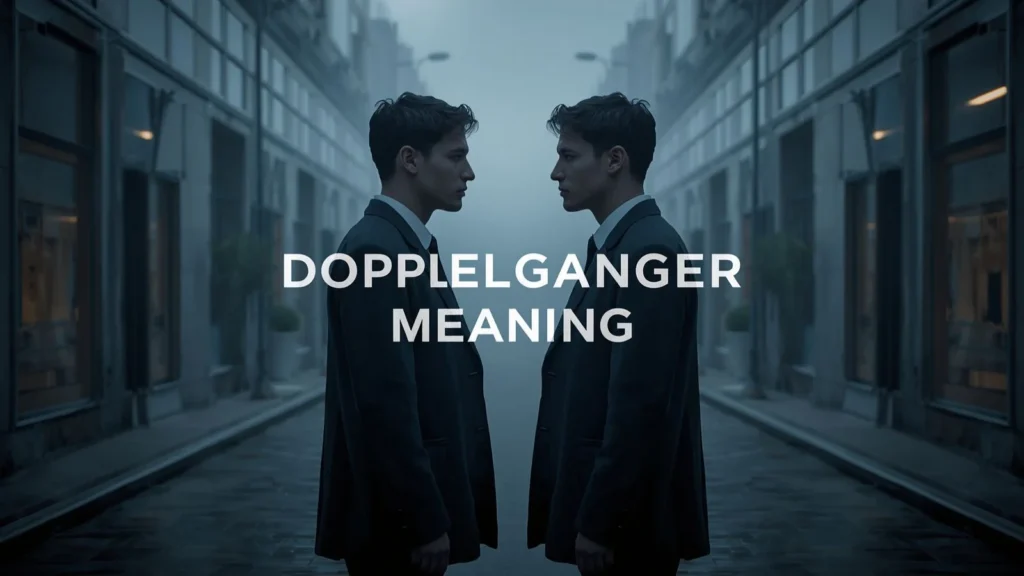

A doppelganger is a person who looks exactly like someone else, or a ghostly double of a living person. The word comes from German and literally means “double walker,” suggesting someone who walks the earth as an exact copy of another.
Have you ever looked at a stranger and felt certain you’ve seen them before, only to realize they look almost exactly like you or someone you know? That strange mix of curiosity and disbelief is what makes the doppelganger meaning so fascinating. A doppelganger is a person who closely resembles another, even though they are not related. The idea has existed for centuries in myths, legends, and literature, but today it has become even more popular through social media, viral photos, and face-matching apps. Many people even wonder, does everyone have a doppelganger, or is finding your lookalike just an incredible coincidence? If you’ve searched apa itu doppelganger, you’re simply asking, “What is a doppelganger?” In this guide, you’ll discover the true doppelganger meaning, its origin, pronunciation, cultural significance, and why this mysterious phenomenon continues to capture people’s imagination around the world.
Doppelganger Meaning Explained

At its simplest, a doppelganger is a lookalike, someone who bears an uncanny resemblance to another person. But the doppelganger meaning runs much deeper than mere similarity. Traditional folklore treats the doppelganger as something supernatural, a shadow self or spirit double that appears to a living person as an omen of death or misfortune. Seeing your own doppelganger was considered one of the most terrifying portents imaginable.
In modern usage, the word has softened somewhat. People now use it casually to describe celebrity lookalikes, identical strangers discovered through internet searches, or even friends who happen to resemble each other. The supernatural terror has faded, but the underlying unease remains. There is something fundamentally disturbing about encountering a copy of yourself or someone you know. It challenges our sense of individuality, the comforting belief that we are unique.
Psychologists have studied this phenomenon through the lens of depersonalization and identity disturbance. Some researchers suggest that the doppelganger experience in folklore may have roots in neurological conditions like heautoscopy, where a person sees a hallucinated double of themselves. Others connect it to the universal human fascination with mirrors, twins, and reflections, all of which play on the boundary between self and other.
In literature and film, the doppelganger serves as a powerful narrative device. It externalizes inner conflict, allowing characters to confront their dark sides, their repressed desires, or their mortality. The double can be evil, innocent, or simply ambiguous, but it always disrupts the normal order of identity. Once a doppelganger appears, nothing can remain the same.
Origin of the Word Doppelganger
The word doppelganger comes directly from German, combining “doppel” meaning double and “ganger” meaning walker or goer. The literal translation is “double walker,” someone who walks alongside you or in your place. The term emerged in German Romantic literature of the late 18th and early 19th centuries, a movement obsessed with the supernatural, the irrational, and the dark corners of the psyche.
Johann Wolfgang von Goethe helped popularize the concept when he claimed to have seen his own doppelganger riding past him on horseback. This experience, whether real or literary invention, fed into the Romantic fascination with doubles and divided selves. Other German writers like Jean Paul and E.T.A. Hoffmann explored doppelganger themes in their fiction, cementing the word’s association with horror and psychological disturbance.
The concept itself predates the German word by millennia. Ancient Egyptian mythology featured the “ka,” a spiritual double that accompanied each person through life and into death. Norse legends told of “vardoger,” ghostly precursors who performed a person’s actions before they arrived. Celtic folklore warned about “fetch,” spectral doubles whose appearance foretold death. Every culture seems to have some version of the double, suggesting that the fear and fascination are deeply human.
The word entered English in the mid-19th century, brought by translations of German literature and by the growing Victorian interest in the supernatural. By the early 20th century, “doppelganger” was established in English as both a technical literary term and a popular concept. Sigmund Freud’s essay on “The Uncanny” gave it psychological respectability, analyzing why doubles produce such profound unease.
Today, the internet has created a new kind of doppelganger culture. Websites and apps allow people to upload photos and find their celebrity lookalikes or even identical strangers around the world. Social media occasionally erupts when someone discovers their double in a historical painting or an old photograph. The supernatural has become searchable, but the essential mystery remains.
How People Use and Reference Doppelganger
People reference doppelganger in tones that range from playful amusement to genuine unease to literary analysis. The tone depends heavily on whether the speaker believes in the supernatural aspect or treats the concept as pure metaphor.
Playful and Casual Tone
In everyday conversation, doppelganger is often used lightheartedly. Friends might point out a stranger and say, “That is your doppelganger over there.” Celebrity lookalike contests and social media posts use the word casually. The tone is fun and observational, stripped of any ominous weight.
A typical casual use might sound like: “I found my doppelganger on this app. She lives in Brazil and we could be twins.” This usage treats the double as a delightful curiosity, a fun fact to share rather than a threat to identity.
Uneasy and Superstitious Tone
Some people still use doppelganger with genuine apprehension. They might describe seeing someone who looks exactly like a deceased relative, or encountering their own double in a dream. The tone here is hushed and serious. Even if the speaker does not fully believe in omens, the experience feels wrong in a way that resists rational explanation.
Someone might say, “I swear I saw my brother’s doppelganger the day before his accident. I know it sounds chaotic, but I cannot shake the feeling.” These references invite belief or at least respectful listening rather than skeptical dismissal.
Literary and Analytical Tone
Writers, critics, and academics use doppelganger as a technical term for a specific narrative device. They analyze how Edgar Allan Poe, Fyodor Dostoevsky, or Jordan Peele use doubles to explore identity, morality, and social anxiety. The tone is intellectual and precise, treating the doppelganger as a tool rather than a phenomenon.
A literary discussion might note: “The doppelganger in Dostoevsky’s The Double represents the protagonist’s alienation in bureaucratic society.” Here the word serves analysis, not storytelling or personal experience.
Examples of Doppelganger in Context
Table
| Example | Situation | Meaning | Tone |
|---|---|---|---|
| “My coworker is literally my doppelganger. Same hair, same glasses, everything.” | Office observation | Uncanny physical resemblance | Playful and amazed |
| “In the movie, the doppelganger represents the character’s repressed anger.” | Film analysis discussion | Literary or symbolic double | Analytical and interpretive |
| Grandma said seeing your doppelganger means death is coming. | Family folklore sharing | Supernatural omen | Serious and traditional |
| “This app found my doppelganger in another country.” | Social media post about lookalike | Identical stranger discovered online | Casual and entertained |
| “The politician’s doppelganger showed up at the rally as a prank.” | News about impersonator | Physical double used for deception | Humorous or critical |
| “I had a dream where my doppelganger tried to replace me.” | Sharing a disturbing dream | Threat to identity and selfhood | Uneasy and vulnerable |
| “The novel uses the doppelganger device to explore guilt.” | Book review or class discussion | Narrative technique in fiction | Academic and evaluative |
| “Scientists study doppelganger cases to understand facial recognition.” | Science journalism | Identical strangers as research subjects | Informative and curious |
Comparison With Similar Terms
Table
| Term | What It Means | How It Differs From Doppelganger |
|---|---|---|
| Twin | Sibling born from the same pregnancy | Biological relationship, not supernatural or coincidental |
| Lookalike | Someone who resembles another person | Lacks the ominous or identity-challenging connotations |
| Clone | Genetically identical copy | Scientific rather than supernatural, implies deliberate creation |
| Impersonator | Someone who intentionally mimics another | Active deception rather than accidental resemblance |
| Alter ego | A second self or different personality | Internal rather than external, psychological rather than physical |
| Shadow self | Jungian concept of repressed aspects | Metaphorical and internal, not a visible double |
| Eidolon | Greek term for phantom or idealized image | More abstract and philosophical, less about exact physical copying |
| Fetch | Celtic spectral double | Specifically foretells death, narrower than doppelganger |
The doppelganger stands apart because it combines physical exactness with existential threat. A twin is expected. A lookalike is amusing. An alter ego is internal. Only the doppelganger confronts you with a visible, external copy that challenges your fundamental uniqueness.
Alternate Meanings and Related Uses
In most contexts, doppelganger refers to a human double. However, the concept has extended into several related areas.
In technology, “doppelganger” sometimes describes a digital twin or AI copy of a person. Virtual influencers and deepfake technology create artificial doubles that blur the line between real and simulated identity. These technological doppelgangers raise new ethical questions about consent, authenticity, and the ownership of one’s own likeness.
In marketing and branding, companies occasionally use “doppelganger” to describe counterfeit products or copycat brands that mimic their appearance. A luxury handbag maker might warn customers about “doppelganger bags” that look identical but lack quality and authenticity.
In medicine, the Capgras delusion causes patients to believe that loved ones have been replaced by identical impostors. While not called doppelganger syndrome, this condition represents a terrifying psychological inversion of the double concept. The patient sees the original but believes them to be a copy.
Some spiritual traditions use doppelganger concepts in teachings about astral projection or out-of-body experiences. The idea that consciousness can separate from the body and appear elsewhere resembles traditional doppelganger beliefs, though framed as voluntary rather than ominous.
Professional or Polite Alternatives
Depending on your context, you might use these alternatives to doppelganger.
- Double. Shorter and less Germanic, suitable for casual conversation without the supernatural baggage.
- Lookalike. Neutral and descriptive, ideal for celebrity comparisons or casual observations.
- Dead ringer. Colloquial and emphatic, suggests extremely close resemblance without the eerie connotation.
- Spitting image. Informal and friendly, implies family resemblance or strong similarity.
- Mirror image. Emphasizes exact visual copying, useful for descriptions rather than identity threats.
- Counterpart. Suggests a matching equivalent rather than a copy, useful in professional or diplomatic contexts.
- Evil twin. Playful and specific, implies a malevolent double, often used jokingly.
- Body double. Professional term for someone hired to stand in for an actor or public figure.
Common Mistakes to Avoid
One frequent mistake is using doppelganger to describe any similarity. If two people merely share a hair color or fashion sense, they are not doppelgangers. The word requires striking, almost uncanny resemblance. Overusing it weakens its impact.
Another error is assuming doppelganger always implies evil. While many fictional doubles are malevolent, the concept itself is neutral. A doppelganger might be harmless, helpful, or simply mysterious. Do not impose narrative expectations on real-world lookalikes.
Some people mistakenly believe that finding your doppelganger is extremely rare. In reality, with billions of people on Earth, statistical models suggest that most people have at least one near-identical stranger somewhere. Facial recognition research supports this. The rarity is not in existence but in encounter.
In writing, avoid confusing doppelganger with alter ego. An alter ego is a different aspect of the same person, like Clark Kent and Superman. A doppelganger is a separate physical entity. These are distinct literary devices with different functions.
Finally, do not dismiss people’s doppelganger experiences as mere superstition. Even if you do not believe in omens, the psychological impact of encountering one’s double is real and well-documented. Respect the discomfort and confusion it can cause.
Tips for Using Doppelganger Naturally
If you want to use this word effectively, keep these guidelines in mind.
First, reserve it for truly striking resemblances. Calling every similarity a doppelganger makes the word meaningless. Save it for moments that genuinely startle or unsettle.
Second, consider your audience’s beliefs. In some cultures, the double is still taken seriously as a supernatural sign. In others, it is purely literary or scientific. Match your tone to avoid giving unintended offense or seeming frivolous.
Third, explore the concept in creative work carefully. The doppelganger is a powerful device but also a familiar one. Find fresh angles rather than repeating well-worn tropes. What does the double mean in the age of social media and facial recognition?
Fourth, use it precisely in academic or analytical writing. Distinguish between the folkloric double, the literary device, and the psychological phenomenon. Precision strengthens your argument.
Fifth, enjoy the mystery. Whether you encounter your double in a dream, an app, or a crowded street, the experience touches something primal about human identity. The doppelganger reminds us that uniqueness is fragile and that selfhood is more complex than we like to admit.
FAQs
What does doppelganger mean exactly?
A doppelganger is a person who looks exactly like someone else, or in traditional folklore, a ghostly double of a living person. The word comes from German and means “double walker.” Modern usage ranges from casual descriptions of lookalikes to supernatural beliefs about ominous doubles.
Is it bad luck to see your doppelganger?
According to European folklore, seeing your own doppelganger was considered a terrible omen, often foretelling death or disaster. However, this is purely superstitious and not supported by any evidence. In modern times, most people treat doppelganger encounters as interesting coincidences rather than warnings.
Does everyone have a doppelganger?
Statistically, it is likely that most people have at least one near-identical stranger somewhere in the world given the billions of humans and the limited number of facial feature combinations. However, actually meeting your doppelganger is extremely rare. The internet has made such discoveries more common through facial recognition tools and social media.
What is the difference between a doppelganger and a twin?
A twin is a sibling born from the same pregnancy, sharing genetic material and family history. A doppelganger is someone unrelated who happens to look strikingly similar. Twins are expected and biologically explained. Doppelgangers are surprising and coincidental, which gives them their unsettling power.
Conclusion
The doppelganger meaning has traveled a remarkable path from German folklore to global popular culture. It began as a terrifying omen, evolved into a literary device, and now lives in our pockets through apps that promise to find our double somewhere on Earth.
Through all these transformations, the core idea remains potent. There is something about encountering a copy of yourself or someone you love that shakes the foundations of identity.