

Quick Answer
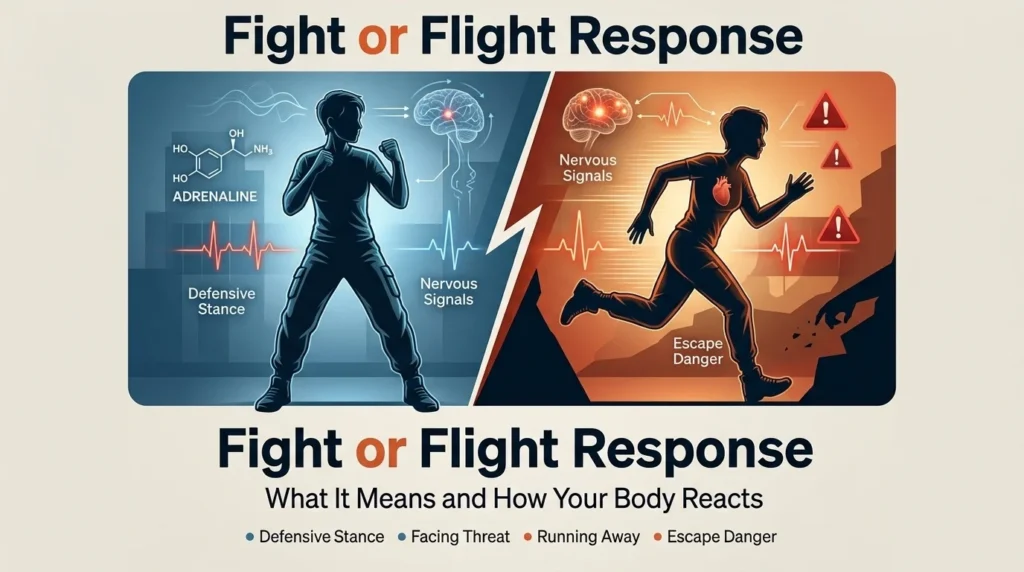
The fight or flight response is the body’s automatic reaction to a perceived threat or stressful situation. It prepares you to confront the danger or get away from it by increasing alertness, heart rate, breathing, and muscle readiness.
Imagine you’re walking down a quiet street when you suddenly hear a loud noise behind you. Your heart starts pounding. Your breathing gets faster. Your muscles tighten, and your attention instantly locks onto the sound.
You didn’t consciously tell your body to react. It reacted automatically.
That’s the fight or flight response, a built-in survival mechanism that prepares your body to deal with a perceived threat. It can help you confront danger, escape from it, or react quickly enough to protect yourself.
The response doesn’t only happen during obvious emergencies. A stressful presentation, heated argument, frightening thought, sudden noise, or difficult situation can trigger similar physical reactions.
Understanding what the fight or flight response is, what causes it, and why it creates such strong physical sensations can make those reactions much easier to understand.
The sympathetic nervous system plays a major role in this process. Stress hormones such as adrenaline also contribute to many of the rapid physical changes you experience.
Fight or Flight Response at a Glance
| What happens | Why it happens |
|---|---|
| Heart rate increases | Helps move blood and oxygen quickly |
| Breathing speeds up | Supports increased oxygen demand |
| Muscles tense | Prepares the body for action |
| Alertness increases | Helps detect and respond to danger |
| Sweating increases | Helps regulate body temperature |
| Digestion slows | Conserves resources during immediate stress |
| Pupils may dilate | Supports heightened visual awareness |
What Does Fight or Flight Mean?
The phrase fight or flight describes two basic ways the body may prepare to respond to danger.
Fight means confronting or defending against a perceived threat.
Flight means escaping or moving away from the threat.
However, the response isn’t limited to physically fighting or running. Your body can activate the same system when you face psychological or emotional stress.
For example, imagine you’re about to give an important presentation. There’s no physical danger in the room, yet your heart may race and your palms may sweat.
Your nervous system has interpreted the situation as threatening or highly stressful.
In simple terms, your body’s alarm system has switched on.
“Something might be wrong. Get ready.”
That’s essentially what the fight or flight response is designed to do.
How Does the Fight or Flight Response Work?
The fight or flight response happens quickly because your body needs to react before you have time to carefully analyze every detail.
When your brain detects a potential threat, the sympathetic nervous system becomes active. This causes several changes throughout the body.
Your heart can beat faster. Your breathing can change. Your muscles become more prepared for movement, and your attention becomes more focused on the potential threat.
The adrenal glands also release hormones such as epinephrine, commonly known as adrenaline. These chemicals help create many of the immediate sensations associated with stress.
The basic process looks like this:
Potential threat → brain detects danger → sympathetic nervous system activates → stress hormones increase → body prepares for action → you respond → threat passes → body begins returning toward normal
Once the stressful situation ends, the body’s calming systems help reduce the heightened state.
The parasympathetic nervous system plays an important role in helping the body return toward its resting state.
What Happens to Your Body During Fight or Flight?
The physical changes during fight or flight can feel surprisingly intense.
That’s because the body is temporarily prioritizing systems that could help you respond quickly.
Your Heart Rate Increases
Your heart may suddenly start beating faster or harder.
This helps circulate blood and oxygen throughout the body while you’re preparing for action.
You may notice:
- A racing heart
- Pounding heartbeat
- Stronger heartbeat
- Awareness of your pulse
A stressful situation can make these sensations noticeable even when you’re sitting still.
Your Breathing Changes
Your breathing may become faster or deeper.
The body does this to support increased oxygen needs during a stressful situation.
However, rapid breathing can also make you more aware of physical sensations such as lightheadedness or a racing heart.
Your Muscles Become Tense
Your muscles prepare for movement.
You might unconsciously:
- Clench your jaw
- Tighten your shoulders
- Make fists
- Tremble
- Shake
- Feel restless
Your body is essentially getting ready to move.
Your Alertness Increases
Your attention can become sharply focused.
You may suddenly notice sounds, movements, facial expressions, or other details that you would normally ignore.
This heightened alertness can be useful when you’re actually facing danger.
Your Digestion Slows
During an immediate stress response, digestion becomes less important than rapid action.
The body temporarily shifts resources toward systems that can help you respond to the perceived threat.
That’s one reason stress can affect your stomach.
You May Sweat More
Sweating can increase during stressful situations.
Your palms might become damp or clammy even if you’re not physically active.
It’s another automatic change associated with the body’s heightened state.
Fight or Flight Response Symptoms
The fight or flight response symptoms can affect your body, emotions, and behavior at the same time.
Physical Symptoms
Common physical symptoms can include:
- Rapid heartbeat
- Faster breathing
- Sweating
- Muscle tension
- Trembling
- Shaking
- Cold or clammy hands
- Feeling hot
- Stomach discomfort
- Increased alertness
- Dilated pupils
These changes occur because your body is preparing for rapid action.
Emotional Symptoms
You may also experience:
- Fear
- Nervousness
- Anxiety
- Irritability
- Restlessness
- Panic
- A strong urge to escape
- Difficulty concentrating
The emotional experience isn’t identical for everyone.
One person might become angry and defensive. Another might become frightened and want to leave.
Behavioral Symptoms
The response can also influence your behavior.
You may:
- Avoid the situation
- Leave suddenly
- Become defensive
- Argue
- Speak quickly
- Scan your surroundings
- Become unusually quiet
- Have difficulty sitting still
These reactions don’t automatically indicate a mental health disorder. They’re possible responses to perceived stress or danger.
What Causes the Fight or Flight Response?
A fight or flight response trigger doesn’t have to involve physical danger.
Your body can respond to many types of stress.
Common triggers include:
- Sudden loud noises
- Dangerous situations
- Car accidents
- Aggressive behavior
- Frightening animals
- Public speaking
- Job interviews
- Important exams
- Relationship conflicts
- Financial concerns
- Work deadlines
- Traumatic memories
- Phobias
- Unexpected bad news
This explains why you can experience a strong physical reaction even when you’re technically safe.
The nervous system responds to perceived threats, not only situations that involve immediate physical danger. Psychological stress can also activate the body’s stress systems.
Fight or Flight Response Examples in Real Life
Real examples make the concept much easier to understand.
Example 1: A Car Nearly Hits You
You’re crossing the street when a vehicle suddenly approaches too quickly.
Your heart races. Your muscles tense. You jump backward.
That’s a straightforward fight-or-flight reaction to immediate danger.
Example 2: Giving a Presentation
You walk toward the front of a room to give a presentation.
There’s no physical attack happening, yet your palms become sweaty and your heart starts racing.
Your brain has interpreted the situation as highly stressful.
Example 3: Hearing a Strange Noise
You’re home alone at night when you hear a loud crash downstairs.
Suddenly, you’re completely alert.
Your body is preparing you to determine whether you need to confront the situation or get away from it.
Example 4: A Heated Argument
Someone unexpectedly confronts you.
Your face feels hot. Your heart starts pounding. You feel an urge to argue or walk away.
The physical response can occur because your brain perceives the confrontation as threatening.
Fight vs. Flight: What’s the Difference?
The fight response and flight response are different behavioral reactions to perceived danger.
| Fight Response | Flight Response |
|---|---|
| Confronts the perceived threat | Moves away from the threat |
| May involve anger | May involve fear |
| Can involve defensive behavior | Can involve avoidance |
| Focuses on dealing with the threat | Focuses on creating distance |
| Prepares the body for action | Also prepares the body for rapid action |
Neither response is automatically better.
If you’re facing a physical threat, getting away may be safer than confronting it.
In another situation, calmly addressing the problem may be more helpful than avoiding it.
The appropriate response depends on the circumstances and how your brain interprets the situation.
Fight, Flight, Freeze, and Fawn Responses
You may have heard the terms fight, flight, freeze, and fawn.
These describe different ways people may respond when they perceive danger or become overwhelmed by stress.
Fight
You confront the threat.
Example: Someone becomes defensive or confrontational during an intense argument.
Flight
You try to escape or create distance.
Example: You leave a stressful situation because you feel unable to deal with it.
Freeze
You feel temporarily stuck or unable to respond.
Example: Someone asks you an unexpected question during a frightening confrontation, and you can’t think of what to say.
Fawn
You try to reduce conflict by appeasing the other person.
Example: You immediately agree with someone because you’re trying to prevent the situation from becoming more intense.
These aren’t rigid categories. A person may experience different reactions in different situations, and responses can overlap.
Why Does Fight or Flight Happen When You’re Not in Danger?
This is one of the most confusing parts of the stress response.
Your body doesn’t always make a perfect distinction between physical danger and intense psychological stress.
A job interview isn’t a predator.
An angry email isn’t a physical attack.
A difficult presentation isn’t a car accident.
Yet your body can still react strongly.
Stressful thoughts, social situations, deadlines, conflicts, and worries can activate the body’s stress systems. Occasional stress is normal, but ongoing stress can become more difficult to manage.
That’s why you might think:
“I know I’m safe, so why does my body feel like something terrible is happening?”
Your conscious mind may recognize that you’re safe while your nervous system is still responding to the perceived threat.
What Is a Chronic Fight or Flight Response?
The fight or flight response is designed to be temporary.
Your body activates it when it believes you need to respond quickly. After the stressful situation passes, your systems should gradually move toward a calmer state.
Problems can arise when someone repeatedly feels stuck in a high-alert state.
This can involve:
- Constantly feeling on edge
- Being easily startled
- Difficulty relaxing
- Sleep problems
- Irritability
- Racing thoughts
- Muscle tension
- Persistent worry
- Heightened awareness of surroundings
A prolonged state of high arousal is sometimes described as hyperarousal. It can occur with conditions including PTSD and sleep problems.
Long-term stress can also affect sleep, digestion, mood, and overall well-being.
How Long Does the Fight or Flight Response Last?
The initial fight-or-flight reaction can happen very quickly.
How long it takes to fully settle depends on the person and situation.
After the immediate threat ends, the body begins moving toward its normal resting state. Cleveland Clinic notes that recovery from the acute response can often take around 20 to 30 minutes.
However, feeling physically calmer doesn’t always mean your mind immediately feels normal.
For example, after a frightening near-miss while driving, your heart may settle while your thoughts continue replaying the incident.
That’s because the emotional impact of a stressful event can outlast the initial physical reaction.
How to Calm the Fight or Flight Response
You can’t always stop the initial response from happening.
You can, however, use strategies that help your body shift toward a calmer state.
Practice Slow, Comfortable Breathing
Slow, controlled breathing can help you focus on the present and encourage relaxation.
Don’t force extremely deep breaths. Aim for comfortable, steady breathing instead.
Try Grounding Techniques
Grounding can help bring your attention back to your immediate surroundings.
For example, you can identify:
- Five things you can see
- Four things you can touch
- Three things you can hear
- Two things you can smell
- One thing you can taste
The point isn’t to perform the exercise perfectly.
It’s simply a way to redirect attention from overwhelming thoughts toward the present moment.
Relax Your Muscles
Stress often causes unconscious muscle tension.
Try noticing your:
- Jaw
- Shoulders
- Hands
- Neck
- Stomach
Relaxing these areas can make you more aware that the immediate threat has passed.
Move Your Body
Gentle physical activity can help release some of the physical tension that accompanies stress.
A walk, light stretching, or another comfortable form of movement can be useful.
Practice Relaxation Regularly
Relaxation techniques can include:
- Deep breathing
- Meditation
- Progressive muscle relaxation
- Guided imagery
- Biofeedback
The National Center for Complementary and Integrative Health notes that relaxation techniques can help produce a relaxation response involving changes such as slower breathing and a calmer physical state.
The goal isn’t to force stress away.
It’s to give your nervous system a chance to slow down.
Fight or Flight vs. Stress Response
The terms fight or flight response and stress response are closely related, but they aren’t always used in exactly the same way.
The stress response is the broader term for how your body reacts to challenging or threatening situations.
Fight or flight describes a major pattern within that response, especially the body’s preparation to confront or escape a perceived threat.
The sympathetic nervous system plays a central role in the classic fight-or-flight reaction.
In everyday conversation, however, people often use the terms interchangeably.
Fight or Flight vs. Anxiety
The fight or flight response isn’t the same thing as anxiety.
Fight or flight is a normal biological response that can happen during stressful situations.
Anxiety is a broader emotional experience that can involve worry, fear, nervousness, and anticipation of possible problems.
For example, your heart racing before an important presentation doesn’t automatically mean you have an anxiety disorder.
You can experience a completely normal stress response without having a mental health condition.
If anxiety becomes persistent, severe, or disruptive to daily life, talking with a qualified healthcare professional can help determine what’s causing it.
Is the Fight or Flight Response Bad for You?
No. The fight or flight response itself is not bad.
In fact, it’s an important protective mechanism.
When you’re facing genuine danger, increased alertness, faster heart activity, muscle readiness, and other changes can help you react quickly.
The concern is more about frequent or prolonged activation without enough recovery.
Occasional stress is part of normal life.
Long-term stress, however, can affect sleep, mood, digestion, and other aspects of health.
Think of the fight-or-flight response as an alarm system.
An alarm is useful when there’s a fire.
You just don’t want it screaming every time someone burns toast.
When Should You Talk to a Healthcare Professional?
An occasional stress reaction is normal.
However, consider seeking professional guidance if your symptoms are frequent, severe, persistent, or interfering with everyday life.
It may be worth talking with a healthcare professional if you regularly experience:
- Severe anxiety
- Persistent sleep problems
- Frequent panic-like episodes
- Constant hypervigilance
- Flashbacks after trauma
- Major problems at work or school
- Avoidance that limits your daily activities
- Stress symptoms without an obvious trigger
After trauma, persistent symptoms such as being constantly on edge, avoiding reminders, having flashbacks, or experiencing significant sleep problems may require professional evaluation. NIH notes that trauma-related symptoms that persist and interfere with everyday life can be associated with PTSD.
Also, don’t automatically assume that every episode of chest discomfort, severe shortness of breath, fainting, or unusual heart symptoms is caused by stress.
New, severe, or concerning physical symptoms should receive appropriate medical attention.
FAQs
What is the fight or flight response?
The fight or flight response is an automatic reaction to perceived danger or intense stress. It prepares the body to respond by changing heart rate, breathing, blood flow, alertness, and muscle activity.
What are the most common fight or flight response symptoms?
Common symptoms include a racing heart, faster breathing, sweating, muscle tension, trembling, increased alertness, and feelings of fear or anxiety. Not everyone experiences the same symptoms.
What triggers the fight or flight response?
Triggers can include physical danger, sudden fear, stressful conversations, public speaking, work pressure, deadlines, traumatic experiences, phobias, and other psychological stressors. The body can react to perceived threats even when there isn’t immediate physical danger.
How do you calm a fight or flight response?
You can try slow breathing, grounding exercises, muscle relaxation, gentle movement, meditation, or other relaxation techniques. If the response happens frequently or interferes with everyday life, professional support may be helpful.
Is fight or flight the same as anxiety?
No. Fight or flight is a normal biological stress response, while anxiety is a broader emotional state involving fear, worry, or anticipation. A person can experience a fight-or-flight reaction during an ordinary stressful situation without having an anxiety disorder.
Conclusion
The fight or flight response is one of the body’s most important automatic survival mechanisms. When your brain detects a potential threat, your nervous system can rapidly increase alertness, heart rate, breathing, and muscle readiness so you can respond.
Although the sensations can feel intense, they’re not necessarily a sign that something is wrong. Your body is trying to protect you.
The key is understanding the difference between an occasional stress response and a pattern that keeps happening without enough recovery. Learning your triggers, practicing healthy relaxation techniques, and recognizing your body’s signals can make stressful reactions easier to manage.
If stress or high-alert symptoms become persistent, severe, or disruptive, professional support can help you understand what’s happening and find appropriate ways to manage it.
See Also More :
- Can Someone Else Read Your Instagram Story Reply In 2026
- 200+ Reply to “Have a Good Day Reply” That Sound Polite, Friendly & Memorable In 2026