
Quick Answer
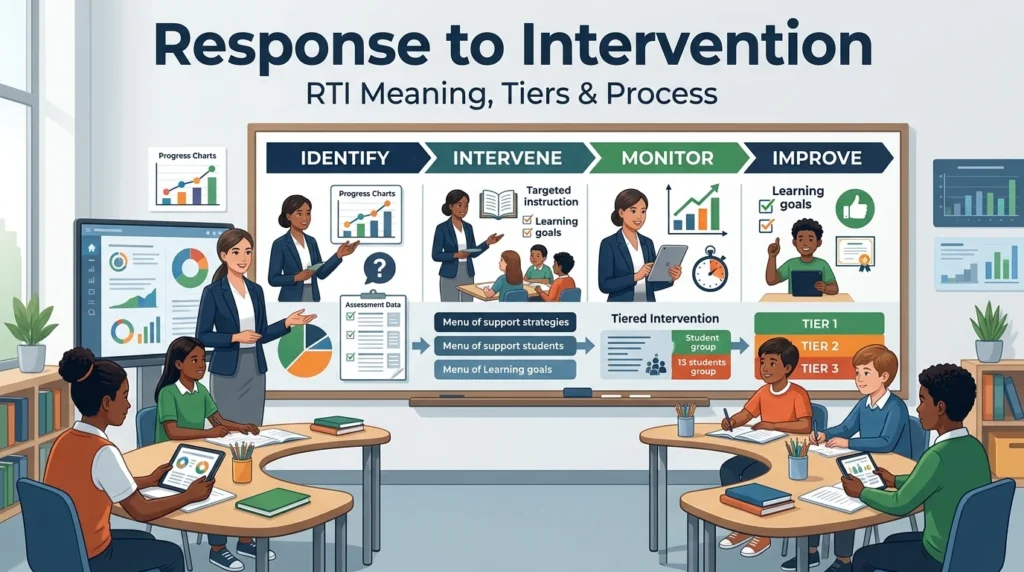
Response to Intervention (RTI) is a school-based framework used to identify students who need additional academic or behavioral support and provide increasingly targeted interventions based on their progress. It typically uses screening, evidence-based instruction, progress monitoring, and data to guide decisions.
Top elements: Tier 1, Tier 2, Tier 3, progress monitoring, targeted intervention
Every student learns differently, and sometimes a student needs more support than regular classroom instruction provides. Response to Intervention, often called RTI, gives schools a structured way to notice those needs early and respond with appropriate support. Instead of waiting until a student falls significantly behind, teachers can monitor progress, introduce targeted interventions, and adjust instruction based on what the data shows. RTI can be used for areas such as reading, writing, mathematics, behavior, and other academic skills. The framework is built around a simple idea: provide the right level of support, monitor whether it works, and increase or adjust that support when necessary. For teachers and families, understanding RTI can make the process much less confusing and help explain why a student may receive additional instruction.
What Is Response to Intervention?
Response to Intervention is a framework schools use to identify students who may need additional support and provide interventions while monitoring their progress.
The goal is to determine whether a student responds positively to increasingly targeted instruction.
Example: A student struggles with reading despite receiving regular classroom instruction.
Meaning: The school may provide additional reading support and monitor the student’s progress.
What Does Response to Intervention Mean?
Response to Intervention literally focuses on how a student responds to intervention.
Teachers use information about a student’s performance to decide whether current instruction is sufficient or whether additional support is needed.
Example: A student receives extra reading instruction for several weeks and their progress is monitored.
Meaning: The student’s response to the intervention helps guide future instructional decisions.
What Are The Tiers Of Response To Intervention?
RTI is commonly organized into three levels, or tiers, of support.
| Tier | Level of Support | Typical Approach |
|---|---|---|
| Tier 1 | Universal | High-quality instruction for all students |
| Tier 2 | Targeted | Additional support for students who need it |
| Tier 3 | Intensive | More individualized and intensive intervention |
The exact structure can vary between schools and districts.
What Is Tier 1 In RTI?
Tier 1 is the foundation of RTI.
All students receive high-quality classroom instruction and are screened or monitored to identify students who may need additional support.
Example: A teacher provides evidence-based reading instruction to the entire class.
Meaning: Every student receives the core instruction before more targeted interventions are considered.
What Is Tier 2 In RTI?
Tier 2 provides additional targeted support to students who aren’t making enough progress with Tier 1 instruction alone.
This support is often delivered in small groups.
Example: A group of students receives additional phonics instruction several times a week.
Meaning: The students receive extra instruction targeting a specific skill.
What Is Tier 3 In RTI?
Tier 3 provides more intensive and individualized support.
Students receiving Tier 3 intervention typically need a more focused approach because they haven’t made adequate progress with less intensive support.
Example: A student receives individualized reading intervention based on specific skill gaps.
Meaning: Instruction becomes more intensive and closely matched to the student’s needs.
How Does Response to Intervention Work?
A typical RTI process may include:
- Universal screening
- Identifying students who may need support
- Selecting an appropriate intervention
- Providing the intervention
- Monitoring progress
- Reviewing the data
- Adjusting support when needed
Example: A student scores below expectations on a reading screening.
Meaning: The school may provide targeted intervention and track the student’s progress.
What Is Universal Screening In RTI?
Universal screening involves assessing students to identify those who may be at risk for academic difficulties.
It helps schools notice potential concerns early.
Example: A school administers a reading assessment to all students at the beginning of the school year.
Meaning: Teachers can identify students who may benefit from additional support.
What Is Progress Monitoring?
Progress monitoring means regularly checking a student’s performance to determine whether an intervention is working.
Example: A student receiving math intervention completes a short skills assessment regularly.
Meaning: The teacher can use the results to determine whether the student’s performance is improving.
Why Is Progress Monitoring Important In RTI?
Progress monitoring helps prevent interventions from becoming a guessing game.
Instead of simply assuming that an intervention works, educators can examine the student’s actual progress.
Example: A student receives additional reading support but shows little improvement over time.
Meaning: The intervention may need to be changed, intensified, or reconsidered.
What Are RTI Interventions?
An RTI intervention is targeted instruction or support designed to address a specific student need.
Examples can include:
- Reading intervention
- Phonics instruction
- Vocabulary support
- Reading fluency practice
- Math intervention
- Writing support
- Behavioral interventions
- Organizational skills support
Example: A student struggles with multiplication facts and receives focused practice.
Meaning: The intervention targets a specific academic skill rather than providing general extra work.
Response to Intervention For Reading
RTI is commonly used to provide additional reading support.
Interventions may address:
- Phonemic awareness
- Phonics
- Fluency
- Vocabulary
- Reading comprehension
Example: Students who struggle with decoding receive targeted phonics instruction.
Meaning: The intervention focuses on the specific reading skill causing difficulty.
Response to Intervention For Math
RTI can also support students who struggle with mathematics.
Interventions may focus on:
- Number sense
- Computation
- Problem-solving
- Mathematical reasoning
- Basic facts
Example: A student struggles to understand place value.
Meaning: The intervention can focus specifically on place-value concepts rather than repeating the entire math curriculum.
Response to Intervention For Writing
Writing interventions can address areas such as:
- Spelling
- Sentence construction
- Grammar
- Organization
- Written expression
Example: A student struggles to organize paragraphs.
Meaning: The intervention can teach planning and organization strategies directly.
Response to Intervention For Behavior
Some schools use RTI-style frameworks to provide increasingly targeted behavioral support.
Support may include:
- Classroom expectations
- Positive reinforcement
- Social skills instruction
- Behavior monitoring
- Individualized behavior strategies
Example: A student repeatedly struggles with classroom routines.
Meaning: The teacher may introduce targeted behavioral support and monitor whether the student’s behavior improves.
RTI And Special Education
RTI can be part of a school’s process for identifying students who may need additional services, but RTI isn’t automatically the same thing as special education.
A student receiving RTI support isn’t necessarily receiving special education services.
Example: A student receives Tier 2 reading intervention.
Meaning: That student may simply need additional instructional support and isn’t automatically identified as having a disability.
Can RTI Identify Learning Disabilities?
RTI data can contribute important information when educators evaluate a student’s learning needs.
However, RTI should not simply be treated as a single test that determines whether a student has a learning disability.
Example: A student continues to struggle despite receiving appropriate, documented interventions.
Meaning: The school may use the student’s progress data as part of a broader evaluation process.
RTI vs MTSS
RTI and MTSS, or Multi-Tiered System of Supports, are closely related frameworks.
MTSS is generally broader and can address academic, behavioral, social, and emotional needs, while RTI has historically been strongly associated with academic intervention.
| RTI | MTSS |
|---|---|
| Often focused on academic intervention | Broader support framework |
| Uses tiers of support | Uses tiers of support |
| Includes progress monitoring | Includes progress monitoring |
| Identifies students needing additional help | Addresses multiple areas of student need |
The terminology and implementation can vary by school or district.
Benefits Of Response to Intervention
RTI can provide several benefits.
Early Identification
Students who are struggling can be identified earlier.
Targeted Support
Interventions can focus on specific skill gaps.
Data-Based Decisions
Teachers can use progress data to guide instructional decisions.
Flexible Support
Support can increase or decrease based on student response.
Collaboration
RTI can encourage teachers, specialists, administrators, and families to work together.
Example: A teacher notices that a student isn’t responding to regular instruction and begins targeted intervention.
Meaning: The student receives additional help before the difficulty becomes even more significant.
Challenges Of Response to Intervention
RTI can also present challenges.
Common concerns include:
- Limited staffing
- Insufficient intervention time
- Inconsistent implementation
- Poor progress monitoring
- Lack of resources
- Communication problems
- Large student groups
- Difficulty maintaining intervention schedules
Example: A school schedules intervention but doesn’t have enough staff to provide consistent support.
Meaning: Even a strong framework can struggle without adequate resources.
How Long Does RTI Take?
There isn’t one universal timeline for every RTI intervention.
The length can depend on:
- Student needs
- Intervention type
- Progress-monitoring data
- School procedures
- Intervention intensity
Example: A school reviews progress regularly during an intervention period.
Meaning: Decisions should be based on meaningful progress data rather than an arbitrary timeline alone.
What Happens If A Student Doesn’t Respond To RTI?
If a student isn’t making adequate progress, educators may review the intervention and determine whether changes are needed.
Possible actions include:
- Increasing intervention intensity
- Changing the instructional approach
- Providing more individualized support
- Collecting additional information
- Considering a broader evaluation when appropriate
Example: A student makes minimal progress during a targeted reading intervention.
Meaning: The team may examine whether the intervention is appropriate and whether additional evaluation or support is needed.
How Parents Can Participate In RTI
Parents can ask questions and stay informed about their child’s progress.
Useful questions include:
- What skill is my child struggling with?
- What intervention is being provided?
- How often is it provided?
- How is progress measured?
- What does the progress data show?
- What happens if the intervention doesn’t work?
- How can we support the skill at home?
Example: A parent asks for progress-monitoring information after several weeks of intervention.
Meaning: The parent is participating in understanding and supporting the intervention process.
Response to Intervention Checklist
- Identify student needs
- Review screening data
- Select an appropriate intervention
- Define measurable goals
- Provide targeted instruction
- Monitor progress
- Review data regularly
- Adjust intervention when needed
- Communicate with families
- Document interventions
- Consider additional evaluation when appropriate
Response to Intervention Example
Imagine a second-grade student struggling with reading.
The teacher notices that the student has difficulty decoding basic words.
The school may:
- Provide strong Tier 1 reading instruction.
- Monitor the student’s performance.
- Provide additional Tier 2 phonics intervention.
- Track reading progress.
- Review the results.
- Adjust the intervention if progress remains limited.
Example: The student begins reading words more accurately after targeted phonics instruction.
Meaning: The student’s positive response suggests that the intervention is helping.
FAQs
What does response to intervention mean?
Response to Intervention is a framework for providing increasingly targeted support based on a student’s academic or behavioral needs and progress.
What are the three tiers of RTI?
They are commonly described as Tier 1 universal support, Tier 2 targeted intervention, and Tier 3 intensive intervention.
What is the main purpose of RTI?
The main purpose is to identify students who need additional support and provide appropriate interventions while monitoring their progress.
Is RTI the same as special education?
No. RTI is an intervention framework and does not automatically mean a student receives special education services.
What is Tier 1 in RTI?
Tier 1 is high-quality core instruction provided to all students.
What is Tier 2 in RTI?
Tier 2 provides additional targeted support, often in a small-group setting.
What is Tier 3 in RTI?
Tier 3 provides more intensive and individualized intervention for students who need additional support.
What is progress monitoring in RTI?
Progress monitoring is the regular collection of information about a student’s performance to determine whether an intervention is working.
Can RTI be used for reading?
Yes. RTI is commonly used to provide targeted reading interventions.
Can RTI be used for math?
Yes. Schools can use targeted interventions to support students struggling with specific math skills.
How does RTI help teachers?
RTI gives teachers a structured way to identify needs, provide targeted instruction, monitor progress, and adjust support.
Can parents participate in RTI?
Yes. Parents can ask about interventions, progress data, goals, and ways to support learning at home.
Conclusion
Response to Intervention gives schools a structured way to identify students who need extra support and respond with targeted instruction. Instead of waiting for a student to fall further behind, educators can use screening, intervention, and progress monitoring to understand what is working and what needs to change. The three-tier model makes it easier to match the intensity of support with student needs, from strong classroom instruction to more individualized intervention. RTI isn’t a magic fix, and its success depends heavily on consistent implementation, good data, appropriate interventions, and collaboration. When those pieces come together, the framework can help students receive timely support while giving teachers clearer information for making instructional decisions.
See Also More :
- 300+ How to See Replies on X (Twitter): Complete Guide for Mobile, Desktop and Hidden Conversations 2026
- 200+ Happy Mother’s Day Replies: That Are Sweet, Emotional & Perfect to Send