
Quick Answer
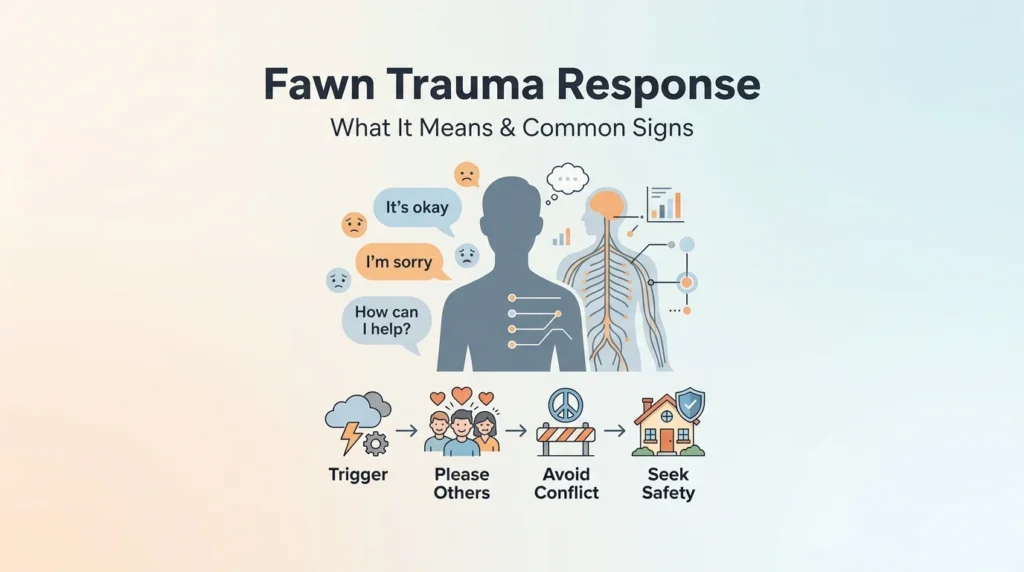
A fawn trauma response is a stress response where someone tries to keep themselves safe by excessively pleasing, appeasing, agreeing with, or accommodating another person. It can look like constantly saying yes, avoiding conflict, apologizing too much, or ignoring your own needs to keep the peace.
Top signs: people pleasing, conflict avoidance, excessive apologizing, difficulty saying no, ignoring personal needs
Sometimes saying “yes” isn’t really about wanting to help. It can be about avoiding conflict, rejection, anger, or another uncomfortable reaction. That’s where the idea of a fawn trauma response comes in. Someone experiencing this pattern may automatically focus on keeping other people happy, even when they’re uncomfortable themselves. They might apologize when they haven’t done anything wrong, agree with someone just to avoid an argument, or constantly monitor another person’s mood. The response can feel automatic rather than deliberate. Understanding it can help explain why setting boundaries feels unusually difficult. It can also make everyday situations, from friendships and family interactions to romantic relationships and work, feel exhausting. Recognizing the pattern is a useful first step toward responding to stress in healthier ways.
What Is A Fawn Trauma Response?
A fawn trauma response describes a pattern of responding to perceived danger or conflict by trying to please, appease, or accommodate another person.
It is often discussed alongside the commonly known fight, flight, and freeze responses.
Example: Someone immediately agrees with an angry person even though they privately disagree.
Meaning: Their priority may be reducing perceived danger or conflict rather than expressing what they genuinely think.
What Does Fawn Response Mean?
The word “fawn” is used to describe appeasing behavior during stressful or threatening situations.
Someone may attempt to become agreeable, helpful, quiet, or accommodating because they believe it will make the situation safer.
Example: A person notices someone becoming irritated and immediately starts apologizing.
Meaning: They may be trying to calm the situation and prevent further conflict.
What Are The Signs Of A Fawn Trauma Response?
Common patterns can include:
- Constant people pleasing
- Difficulty saying no
- Excessive apologizing
- Avoiding confrontation
- Automatically agreeing
- Feeling responsible for others’ emotions
- Suppressing personal opinions
- Overexplaining decisions
- Fear of disappointing people
- Ignoring personal boundaries
- Quickly trying to fix conflict
- Seeking approval
- Putting others’ needs first
- Feeling guilty about self-care
- Changing behavior to avoid upsetting someone
Example: Someone repeatedly agrees to plans they don’t want because they’re afraid of disappointing a friend.
Meaning: Their behavior prioritizes the other person’s comfort over their own preference.
Fawn Response vs People Pleasing
Fawn responses and people pleasing can look very similar, but they’re not automatically the same thing.
People pleasing can happen for many reasons, including wanting approval or avoiding disappointment.
A fawn response is generally discussed in relation to perceived threat, stress, or trauma-related patterns.
Example: Someone says yes because they genuinely enjoy helping.
Meaning: That isn’t necessarily a fawn response.
Example: Someone says yes because they feel unsafe saying no.
Meaning: The behavior may be more consistent with an appeasing stress response.
Fawn Response vs Fight, Flight, And Freeze
The four terms are often discussed as different ways people respond to perceived danger.
| Response | Common Pattern |
|---|---|
| Fight | Confronting or resisting |
| Flight | Escaping or avoiding |
| Freeze | Becoming unable to act or respond |
| Fawn | Appeasing or accommodating |
These descriptions are useful ways to understand stress behavior, although human reactions can be more complicated than four simple categories.
Example: One person argues, another leaves, another becomes silent, while someone else tries to calm everyone down.
Meaning: People can react to stressful situations in very different ways.
Why Does A Fawn Response Happen?
A person may learn that keeping others happy feels safer than disagreeing with them.
This pattern can develop in environments where conflict, rejection, criticism, or unpredictable reactions felt especially threatening.
Example: Someone learns to carefully monitor another person’s mood before expressing an opinion.
Meaning: They may have learned that anticipating other people’s reactions helps them feel safer.
Is Fawn A Trauma Response?
The term fawn response is commonly used in trauma and mental health discussions to describe appeasing behavior in response to perceived danger or conflict.
However, not every instance of people pleasing means someone has experienced trauma.
Example: A person occasionally avoids an argument because they don’t want unnecessary drama.
Meaning: A single behavior doesn’t automatically indicate a trauma response.
Fawn Response In Relationships
A fawn pattern can affect romantic relationships and close friendships.
Someone may:
- Avoid expressing disagreement
- Say yes when they mean no
- Apologize constantly
- Take responsibility for every argument
- Ignore their own preferences
- Try to prevent their partner from becoming upset
- Feel guilty about having boundaries
Example: Someone agrees to everything their partner wants even when they are uncomfortable.
Meaning: They may be prioritizing emotional safety over their own needs.
Fawn Response In Friendships
Fawning can also appear in friendships.
Example: A person always changes their plans to accommodate friends and feels guilty when they can’t.
Meaning: They may believe keeping everyone happy is their responsibility.
Example: Someone avoids telling a friend that a comment hurt them.
Meaning: They may fear that expressing their feelings will create conflict.
Fawn Response At Work
Workplace situations can trigger similar patterns.
Someone may automatically accept extra tasks, avoid disagreeing with coworkers, or apologize excessively after receiving ordinary feedback.
Example: An employee says yes to every request even when their workload is already full.
Meaning: They may be prioritizing approval or conflict avoidance over their own limits.
Fawn Response And Boundaries
Boundary-setting can feel especially uncomfortable when someone is accustomed to appeasing others.
A simple boundary might be:
“I can’t take that on right now.”
Example: Someone declines an extra responsibility without giving a long explanation.
Meaning: They’re communicating a limit while respecting both themselves and the other person.
Why Is Saying No So Difficult?
For someone with a strong fawn pattern, “no” may feel much bigger than a simple word.
They might worry about:
- Anger
- Rejection
- Disappointment
- Abandonment
- Conflict
- Being seen as selfish
- Making someone upset
Example: Someone spends an hour explaining why they can’t attend an event.
Meaning: They may feel that a simple no isn’t acceptable without extensive justification.
Fawn Response And Excessive Apologizing
Apologizing can become automatic.
Someone may say sorry for asking a question, expressing a preference, or taking up normal space in a conversation.
Example: “Sorry for bothering you” when simply asking for information.
Meaning: The apology may reflect fear of being perceived as inconvenient.
Fawn Response And Guilt
Guilt can become a major part of the pattern.
Someone may feel guilty even when they’ve done nothing wrong.
Example: A person feels terrible after declining a request they genuinely couldn’t fulfill.
Meaning: Their emotional reaction may be stronger than the situation itself requires.
Fawn Response And Overexplaining
Overexplaining can happen when someone feels they must convince another person that their boundary is acceptable.
Example: “I can’t come because I have to do this, then this happened, and I really wanted to…”
Meaning: The person may be trying to prevent the other person from becoming disappointed or angry.
Fawn Response And Conflict Avoidance
Conflict avoidance is one of the most recognizable patterns.
Someone might:
- Change the subject
- Agree immediately
- Apologize
- Take blame
- Stay silent
- Try to make everyone happy
Example: Two friends argue and one person immediately takes responsibility despite not causing the problem.
Meaning: They may be trying to end the conflict as quickly as possible.
Fawn Response And Self-Neglect
Constantly prioritizing other people can make personal needs easy to overlook.
Example: Someone repeatedly skips rest, meals, hobbies, or personal plans to help others.
Meaning: Their own needs may consistently be treated as less important.
Fawn Response And Emotional Responsibility
A person may believe it’s their job to keep everyone around them happy.
Example: Someone constantly monitors a partner’s mood and changes their behavior whenever the partner seems unhappy.
Meaning: They may feel responsible for emotions they cannot actually control.
How To Recognize A Fawn Response
Ask yourself:
- Am I agreeing because I genuinely want to?
- Am I afraid of what will happen if I say no?
- Do I apologize automatically?
- Do I feel responsible for everyone’s feelings?
- Do I hide disagreement to keep the peace?
- Do I struggle to identify what I actually want?
- Do boundaries make me feel guilty?
These questions aren’t a diagnosis.
Example: You notice that saying no consistently creates intense anxiety.
Meaning: That pattern may be worth exploring rather than simply labeling yourself as “too nice.”
How To Stop A Fawn Response
Changing an automatic stress pattern usually takes practice.
Start small.
Pause Before Saying Yes
Instead of answering immediately, try:
“Let me think about it first.”
This creates space between the request and your automatic reaction.
Practice Small No’s
Start with low-stakes situations.
Example: Declining a plan you genuinely don’t want to attend.
Meaning: Small boundaries can help you practice tolerating the discomfort of saying no.
Notice Your Body
Pay attention to tension, racing thoughts, or an urge to immediately make someone happy.
Meaning: Physical reactions can sometimes alert you that you’re responding automatically.
Use Simple Boundaries
You don’t always need a detailed explanation.
Example: “I can’t do that today.”
Meaning: A clear boundary can be respectful without being lengthy.
Healthy Alternatives To Fawning
Instead of automatically pleasing someone, try:
- Pausing
- Checking what you actually want
- Saying no when necessary
- Expressing disagreement respectfully
- Asking for time
- Setting boundaries
- Allowing others to feel disappointed
- Taking care of your own needs
Example: “I understand you’re disappointed, but I still can’t change my decision.”
Meaning: You’re acknowledging another person’s feelings without taking responsibility for controlling them.
When Should You Seek Professional Support?
If these patterns are causing significant distress or interfering with relationships, work, or daily life, talking with a qualified mental health professional can be helpful.
A professional can help you explore the underlying patterns without forcing you into a label.
Example: Someone feels unable to establish boundaries in multiple areas of life despite repeatedly wanting to change.
Meaning: Professional support may provide a structured place to understand and work on the pattern.
Fawn Trauma Response Examples
Here are some everyday examples:
| Situation | Possible Fawn Pattern |
|---|---|
| Someone is angry | Immediately apologizing |
| A friend asks for help | Saying yes despite exhaustion |
| A partner disagrees | Quickly changing your opinion |
| A coworker asks for more work | Accepting without checking your capacity |
| Someone criticizes you | Taking all the blame |
| A family member is upset | Trying immediately to fix their emotions |
These behaviors don’t automatically mean someone has a trauma response.
Fawn Response Checklist
- I struggle to say no.
- I apologize frequently.
- I avoid disagreements.
- I worry about disappointing people.
- I feel responsible for others’ emotions.
- I hide my opinions to keep peace.
- I overexplain my decisions.
- I ignore my own needs.
- I automatically agree.
- I feel guilty when setting boundaries.
- I constantly monitor people’s moods.
- I try to fix conflict immediately.
A checklist can help you notice patterns, but it isn’t a diagnosis.
FAQs
What is a fawn trauma response?
A fawn trauma response describes an appeasing or people-pleasing reaction to perceived danger, conflict, or stress.
What are the four trauma responses?
They are commonly described as fight, flight, freeze, and fawn.
Is fawning the same as people pleasing?
Not necessarily. People pleasing can have many causes, while fawning is specifically discussed as an appeasing response to perceived threat or stress.
What does fawning look like?
It can include excessive apologizing, automatic agreement, conflict avoidance, difficulty saying no, and prioritizing another person’s needs over your own.
Why do I automatically say yes to everyone?
Automatic agreement can have several causes. For some people, it may be connected to learned conflict avoidance or an appeasing stress pattern.
Can fawning happen in romantic relationships?
Yes. Someone may avoid disagreement, constantly accommodate their partner, or feel responsible for keeping their partner happy.
Can fawning happen at work?
Yes. It can appear as constantly accepting extra work, avoiding disagreement, or apologizing excessively.
How do I stop fawning?
Start by noticing automatic reactions, pausing before agreeing, practicing small boundaries, and learning to communicate your needs more directly.
Is fawning always caused by trauma?
No. People pleasing or conflict avoidance can have many different causes, so the behavior alone doesn’t prove that someone has experienced trauma.
Can therapy help with fawning?
A qualified mental health professional can help someone explore persistent people-pleasing, boundary difficulties, and stress patterns in a personalized way.
Is saying no selfish?
No. Saying no can be a healthy way to communicate your limits and protect your time, energy, and well-being.
Why do I feel guilty after setting a boundary?
If you’re accustomed to prioritizing other people’s needs, setting a boundary may initially feel uncomfortable or selfish even when the boundary is reasonable.
Conclusion
A fawn trauma response can make people pleasing feel less like a choice and more like an automatic survival strategy. Constantly saying yes, apologizing, avoiding conflict, and putting everyone else’s needs first can become exhausting over time.
Recognizing these patterns doesn’t mean you need to blame yourself. It simply gives you more information about how you respond under stress. Small steps can make a difference, such as pausing before answering, practicing simple boundaries, and learning that another person’s disappointment doesn’t automatically mean you’ve done something wrong. If these patterns are deeply rooted or causing significant distress, professional support can help you explore them safely. You don’t have to keep choosing peace at the expense of yourself.
See Also More :
- 300+ How to See Replies on X (Twitter): Complete Guide for Mobile, Desktop and Hidden Conversations 2026
- 200+ Happy Mother’s Day Replies: That Are Sweet, Emotional & Perfect to