
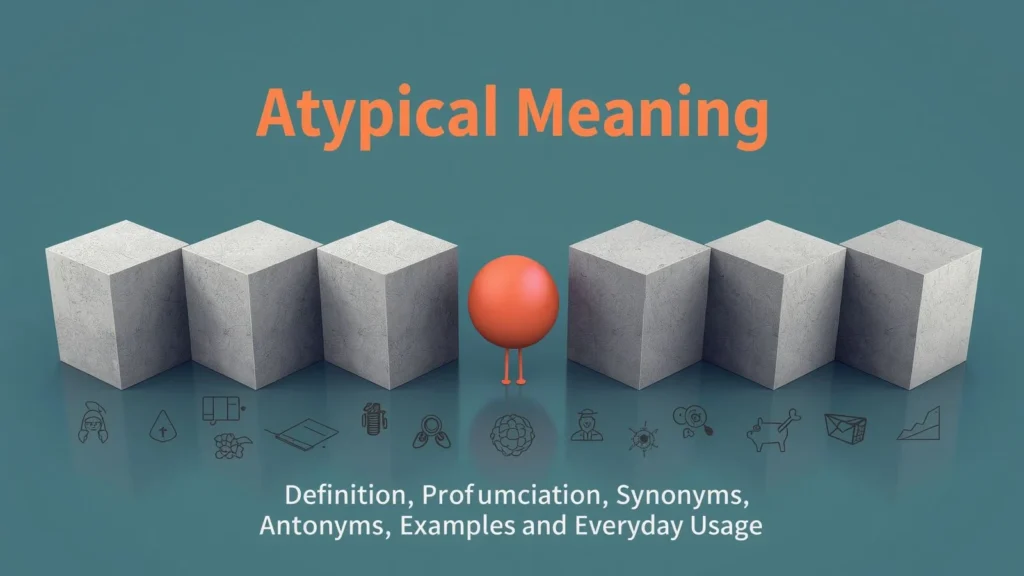

Quick Answer
The atypical meaning is not typical, unusual, or different from what is normally expected. It describes a person, object, behavior, or situation that does not follow the usual pattern or standard.
The word atypical is commonly used to describe something that stands out because it is different from what is considered normal or expected. You might hear it in conversations about medicine, psychology, education, business, science, or even everyday life. For example, an atypical weather pattern may bring unexpected temperatures, while an atypical student may have a unique learning style that differs from most classmates. Atypical pronunciation.
Although people sometimes confuse atypical with abnormal, the two words are not always the same. Atypical simply means something is uncommon or doesn’t fit the usual pattern. Learning the atypical meaning will help you understand news articles, academic writing, medical information, and everyday conversations more confidently.
Atypical Definition
Atypical means not typical, usual, or expected. It describes something that is unusual, different from what is normally seen, or does not fit the usual pattern. For example, “Her atypical behavior surprised everyone” means her behavior was different from what people normally expected.
Atypical Meaning at a Glance
| Word | Atypical |
|---|---|
| Pronunciation | ay-TIP-ih-kuhl |
| Part of Speech | Adjective |
| Primary Meaning | Not typical or not following the usual pattern. |
| Language of Origin | Greek and Latin roots |
| Common Contexts | Medicine, psychology, education, science, business, and everyday English |
| Synonyms | Unusual, uncommon, irregular, unconventional, distinctive |
| Antonyms | Typical, normal, standard, ordinary, conventional |
| Example Sentence | The patient’s symptoms were atypical for that illness. |
What Does Atypical Mean?

Atypical means not typical or different from what is normally expected.
It is used when someone or something does not match the usual characteristics, behavior, or appearance of a particular group or situation.
Example:
His solution to the problem was atypical but highly effective.
The Origin of the Word Atypical
The word atypical combines the prefix “a-“, meaning “not,” with the word “typical,” which means representing the usual or expected characteristics.
Together, the word literally means “not typical.”
Over time, atypical became widely used in medicine, psychology, education, science, and everyday English to describe anything that differs from the norm.
Atypical Meaning in Different Contexts
In Medicine
Doctors often use atypical to describe symptoms or conditions that are different from the common presentation of a disease.
Example:
The patient experienced atypical chest pain.
In Psychology
Psychologists may describe behaviors or developmental patterns as atypical when they differ from what is commonly observed.
Example:
The child showed atypical communication patterns.
In Education
Teachers may use the word when discussing unique learning styles or classroom behavior.
Example:
She has an atypical approach to solving math problems.
In Business
Companies sometimes succeed by using atypical strategies that differ from traditional methods.
Example:
The startup followed an atypical marketing strategy.
In Everyday Conversations
People use atypical to describe anything unusual or unexpected.
Example:
It was an atypical winter with very little snowfall.
Common Uses of Atypical

Describing Unusual Behavior
Used for actions that differ from the norm.
Example:
His response was atypical.
Discussing Medical Symptoms
Used for uncommon signs of an illness.
Example:
Doctors identified atypical symptoms.
Explaining Unique Ideas
Used for creative or unconventional approaches.
Example:
She proposed an atypical solution.
Examples of Atypical in Sentences
- The patient’s symptoms were atypical.
- His leadership style is atypical.
- The weather has been atypical this year.
- She chose an atypical career path.
- Their marketing campaign was atypical.
- The scientist observed atypical behavior in the experiment.
- His answer was completely atypical.
- The company adopted an atypical business model.
Synonyms of Atypical
Depending on the context, similar words include:
- Unusual
- Uncommon
- Irregular
- Unconventional
- Different
- Distinctive
- Rare
- Exceptional
- Extraordinary
- Nontraditional
Antonyms of Atypical
Words with opposite meanings include:
- Typical
- Normal
- Ordinary
- Standard
- Conventional
- Common
- Regular
- Expected
- Familiar
- Routine
Atypical vs Typical
Although these words are opposites, they are often compared.
| Atypical | Typical |
|---|---|
| Different from the usual pattern. | Matches the usual or expected pattern. |
| Describes something uncommon or unique. | Describes something common or ordinary. |
| Often stands out because it is different. | Represents what is generally expected. |
Why Is Atypical a Useful Word?

The word atypical helps describe situations, people, or events that don’t fit the usual pattern without automatically suggesting something is good or bad.
You’ll commonly encounter it in:
- Medicine
- Psychology
- Education
- Science
- Business
- News articles
- Books
- Everyday conversations
Its neutral meaning makes it valuable for describing differences accurately.
FAQs
What does atypical mean?
Atypical means not typical or different from what is normally expected.
Is atypical the same as abnormal?
No. Atypical simply means uncommon or different, while abnormal often suggests something outside the normal or healthy range.
Can a person be described as atypical?
Yes. A person may be described as atypical if their behavior, personality, or experiences differ from what is commonly expected.
Is atypical a positive or negative word?
Neither. It is generally a neutral word that simply means something is different from the usual pattern.
Where is atypical commonly used?
It is frequently used in medicine, psychology, education, science, business, and everyday English.
How do you pronounce atypical?
It is commonly pronounced ay-TIP-ih-kuhl.
Conclusion
The atypical meaning refers to anything that is unusual, uncommon, or different from what is normally expected. Whether describing medical symptoms, learning styles, business strategies, or everyday situations, the word simply highlights that something does not follow the usual pattern.
Understanding atypical can help you communicate more clearly and recognize that being different often leads to creativity, innovation, and fresh perspectives. Atypical meaning medical.
See Also More:
- Understanding GVWR Meaning: A Complete Guide for Vehicle Owners For 2026
- Prodigy Meaning | Origin, Definition, and Examples In 2026
- The Semicolon Tattoo Meaning: A Symbol of Survival, Hope, and New Beginnings For 2026