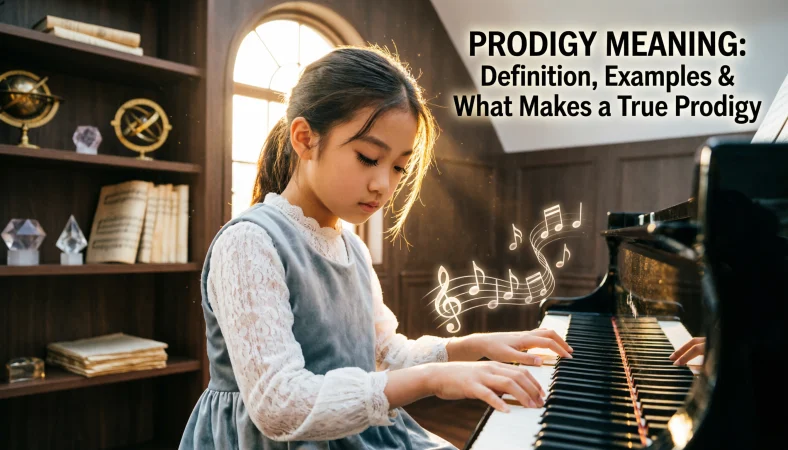

A prodigy is a person, usually a child or young individual, who demonstrates exceptional talent, intelligence, or skill in a particular field far beyond what is expected for their age. The term is commonly used for gifted musicians, mathematicians, artists, athletes, and other individuals who achieve remarkable success early in life.
Have you ever heard someone described as a prodigy and wondered what makes them so extraordinary? The word is often used to describe children who display incredible abilities at a very young age, but its meaning goes beyond simply being talented. A prodigy stands out because their skills or knowledge are far ahead of their peers, often attracting widespread recognition in fields such as music, mathematics, sports, science, or art.
In this guide, you’ll learn the meaning of prodigy, where the word comes from, how it’s used in everyday English, and what qualities define a prodigy. We’ll also explore prodigy meaning in English, prodigy meaning in Urdu, examples of prodigies, synonyms, and answer the most common questions people search online so you can fully understand this widely used term.
Where Did the Word “Prodigy” Come From?
Understanding the prodigy meaning requires exploring its linguistic journey through history. The word “prodigy” traces its roots back to the Latin word prodigium, which meant “omen” or “portent”—something that foretold future events, particularly of a supernatural nature. In ancient Rome, unusual occurrences like strange weather patterns or extraordinary births were considered prodigia: signs from the gods that demanded interpretation.
This original meaning is fascinating because it reveals how ancient cultures viewed exceptional talent with a mixture of awe and unease. A child displaying extraordinary abilities wasn’t just considered gifted—they were seen as messengers bearing important omens.
Over time, the prodigy meaning shifted from the supernatural to the exceptional. By the 17th century, the term began to describe “an amazing or extraordinary thing,” and eventually narrowed to focus specifically on “a person endowed with exceptional qualities or abilities.” Today, when we ask about prodigy definition, we’re discussing talent that seems almost otherworldly in its intensity and early manifestation.
The modern usage gained widespread popularity during the 18th and 19th centuries, when child prodigies like Wolfgang Amadeus Mozart and William James Sidis captured the public imagination. These figures cemented the association between youth and extraordinary talent, making the prodigy meaning almost inseparable from childhood genius.
What Makes a Prodigy? The Defining Characteristics
When exploring the prodigy meaning, it’s essential to understand exactly what distinguishes a prodigy from other exceptional individuals. Here are the defining characteristics:
Extreme Early Talent
Prodigies typically demonstrate their abilities before the age of 12. A young child composing symphonies, solving complex calculus problems, or creating museum-worthy art is a clear sign of prodigious ability.
Domain-Specific Excellence
Unlike polymaths who excel across multiple fields, prodigies usually show extraordinary talent in a single domain. This prodigy definition emphasizes laser-focused genius.
Intuitive Learning
Prodigies often learn without explicit instruction. They seem to absorb information related to their talent area effortlessly, making connections that others miss.
Intense Passion and Drive
Beyond raw talent, prodigies typically display an obsessive focus on their area of interest. This isn’t just skill it’s a calling.
Rapid Advancement
Their learning curve is vertical. What takes others years to master, they achieve in months or even weeks.
Unconventional Thinking
Prodigies often approach problems from unique angles, challenging established conventions in their fields.
Emotional Intensity
Many prodigies experience emotions with greater intensity, both positive and negative, which can affect their social development.
Real-World Examples of Prodigies Throughout History
To truly grasp the prodigy meaning, we should look at the individuals who have defined this concept through their extraordinary achievements.
Musical Prodigies
Wolfgang Amadeus Mozart (1756–1791) remains the quintessential example of a musical prodigy. He began composing at age five, performed before European royalty at age six, and wrote his first symphony at eight. The prodigy meaning in the musical world is often measured against Mozart’s remarkable example.
In modern times, Yo-Yo Ma began cello lessons at age four and performed for President John F. Kennedy at age seven. His intuitive understanding of music has made him one of the most celebrated musicians of our era.
Mathematical and Scientific Prodigies
Srinivasa Ramanujan (1887–1920) was largely self-taught yet developed revolutionary mathematical formulas that baffled professional mathematicians. His innate genius demonstrates that the prodigy meaning extends beyond formal education.
Terence Tao, who earned his PhD at age 21 and received the Fields Medal at 31, showed mathematical abilities at age two and was solving university-level algebra by age seven.
Chess Prodigies
Bobby Fischer became a chess grandmaster at age 15, while Magnus Carlsen achieved the same feat at just 13. These chess prodigies demonstrate that the prodigy definition encompasses strategic and cognitive abilities as well as artistic or scientific talents.
Artistic Prodigies
Pablo Picasso had his first exhibition at age 13 and displayed extraordinary drawing skills from early childhood. His formal academic training was minimal compared to his natural visual intuition.
Contemporary Prodigies
Tanishq Mathew Abraham graduated high school at age 10, earned a bachelor’s degree at 14, and is currently pursuing medical research. His story shows that prodigy meaning continues to evolve in our modern world.
How Prodigy Meaning Differs Across Contexts
The prodigy meaning varies slightly depending on the context in which it’s used. Understanding these nuances helps us appreciate the full scope of the term.
In Psychology
Psychological prodigy definition emphasizes exceptional talent emerging in childhood, often associated with high IQs and specific cognitive strengths. Psychologists study prodigies to understand the nature of intelligence, talent development, and the interaction between genetics and environment.
In Education
Educational contexts focus on providing appropriate learning environments for prodigies. The prodigy meaning here involves accelerated curricula, mentorship programs, and specialized support to nurture their unique talents.
In Popular Culture
The prodigy meaning in media often romanticizes exceptional talent, portraying prodigies as mysterious, socially awkward, or burdened by their gifts. Popular culture frequently explores the question: Is being a prodigy a blessing or a curse?
In Religious and Spiritual Contexts
Historically, the prodigy meaning connected to divine favor. Many prodigies throughout history were seen as divinely chosen, their abilities interpreted as divine gifts.
In Business and Technology
Today’s tech industry embraces the prodigy meaning through “prodigy entrepreneurs” like Mark Zuckerberg and Elon Musk, who demonstrated extraordinary vision and capability at very young ages.
Understanding the Difference: Prodigy vs. Gifted vs. Talented
When exploring prodigy meaning, it’s helpful to distinguish it from related terms that people often confuse.
| Term | Key Characteristics | Age of Emergence | Scope |
|---|---|---|---|
| Prodigy | Extraordinary ability approaching adult mastery; often revolutionary | Before age 12 | Narrow, specific domain |
| Gifted | High intelligence (typically IQ 130+); strong cognitive abilities | Throughout childhood | Broad; across multiple academic areas |
| Talented | Above-average skill in specific areas; strong potential | Any age | Moderate; focused but not exclusive |
| Genius | Exceptional intellectual or creative power; innovative contributions | Any age | Broad; often creates new knowledge |
| Savant | Extraordinary ability alongside significant cognitive limitations | Often appears suddenly after injury or from early childhood | Extremely specific; often memory-based |
Prodigy Meaning vs. Gifted Meaning
The prodigy meaning implies more than being gifted. While a gifted child might score high on IQ tests and excel academically, a prodigy demonstrates the kind of skill that impresses experts in their field. The gifted child is exceptional among peers; the prodigy is exceptional among adults.
Prodigy Definition vs. Talented Definition
Talent suggests high potential with proper cultivation, while the prodigy definition indicates a level of performance that emerges with minimal training. Think of talent as a fertile seed and prodigy as a fully developed plant seemingly appearing overnight.
Prodigy Meaning vs. Genius Meaning
The prodigy meaning often focuses on childhood achievement, while genius encompasses adults who make revolutionary contributions. However, many prodigies grow into geniuses, as exemplified by Mozart’s transition from child prodigy to adult master.
The Science Behind the Prodigy Meaning
Modern neuroscience has begun to unravel what lies behind the prodigy meaning. Understanding the science helps demystify these exceptional individuals.
Brain Structure and Development
Studies using neuroimaging suggest that prodigies often have enhanced connectivity in specific brain regions. Mathematical prodigies, for example, show increased gray matter in areas associated with number processing. Musicians display enlarged corpus callosum—the bridge between brain hemispheres—which facilitates communication between creative and analytical regions.
Genetics vs. Environment
Research on the prodigy meaning has moved beyond the nature-versus-nurture debate. Studies show that many prodigies are born with genetic predispositions that are then activated and amplified by supportive environments. The interplay between innate ability and dedicated practice is crucial.
Deliberate Practice vs. Innate Talent
While the prodigy meaning emphasizes natural ability, research by psychologist Anders Ericsson suggests that even prodigies require substantial practice to reach extraordinary levels. The difference lies in their accelerated learning curve and the quality of their practice.
Working Memory Advantages
Prodigies typically possess exceptional working memory capacity in their domain. This allows them to process and manipulate complex information rapidly, contributing to their remarkable performance.
The Challenges of Being a Prodigy
Understanding the prodigy meaning isn’t complete without acknowledging the challenges these exceptional individuals face. The extraordinary abilities that define the prodigy definition often come with significant struggles.
Social and Emotional Difficulties
Prodigies frequently struggle with:
- Social isolation: Difficulty relating to peers of the same age
- Uneven development: Physical, emotional, and intellectual growth at different rates
- High expectations: Constant pressure from parents, teachers, and society
- Identity issues: Feeling defined solely by their talent
- Perfectionism: Setting impossibly high standards for themselves
The Burnout Risk
Many prodigies experience intense pressure that can lead to burnout. The prodigy meaning carries expectations of continued success, which can become overwhelming. The metaphor of the “burned-out prodigy” is sadly common, with many individuals leaving their fields as young adults.
Parental Pressures and Exploitation
A darker aspect of the prodigy meaning involves parents who may exploit their child’s talent for personal gain. Stories of “stage parents” pushing their children relentlessly highlight the ethical concerns surrounding prodigy-raising.
Educational Challenges
Standard educational systems often fail prodigies. The prodigy definition requires specialized education that acknowledges their unique needs, but such programs are rare and often inadequate.
Transitioning to Adulthood
Perhaps the greatest challenge is transitioning from child prodigy to adult success. Many fail to achieve the same level of recognition in adulthood, leading to what psychologists call the “prodigy burden.”
The Prodigy Meaning in Pop Culture and Media
Popular culture has shaped our understanding of the prodigy meaning significantly. From films to books, prodigies occupy a special place in our collective imagination.
Movies and Television
Films like Little Man Tate, Searching for Bobby Fischer, and The Pianist explore the complexities behind the prodigy meaning. These portrayals often highlight the emotional toll and sacrifice involved.
Literature
From Sherlock Holmes’s “consulting detective” to Ender Wiggin’s strategic genius, literature is filled with prodigies who reflect our fascination with exceptional talent and its consequences.
The “Prodigy” in Music and Gaming
The term “prodigy” has also become associated with:
- The Prodigy: The British electronic music group, which adopted the name to reflect their innovative and boundary-pushing approach.
- Prodigy Game: An educational platform that gamifies learning, connecting the prodigy meaning with accessible education.
Social Media Prodigies
The digital age has created new categories of prodigies: viral video geniuses, coding prodigies, and social media entrepreneurs who demonstrate extraordinary aptitude online.
How to Identify Prodigy Potential
For parents and educators interested in the prodigy meaning, recognizing potential early is crucial. Here are key indicators:
Early Signs of Prodigy Potential
- Extreme curiosity: An insatiable desire to know and understand
- Rapid skill acquisition: Learning new concepts with minimal instruction
- Intense focus: Ability to concentrate on their area of interest for extended periods
- Exceptional memory: Recalling information with remarkable accuracy
- Creative problem-solving: Finding unconventional solutions to complex problems
- Critical thinking: Ability to evaluate and analyze information at an advanced level
- Advanced vocabulary: Using language beyond age expectations
Professional Assessment
If you suspect someone might fit the prodigy definition, consider:
- Psychological testing: Comprehensive IQ assessments
- Domain-specific evaluation: Testing in their particular area of talent
- Educational assessment: Evaluation by specialized education professionals
- Behavioral observation: Monitoring social, emotional, and cognitive development
The Fine Line Between Talent and Prodigy
Remember that the prodigy meaning is reserved for truly extraordinary talent. Many gifted children are very talented prodigies are exceptional even among the gifted.
Famous Child Prodigies: Success Stories and Warnings
The prodigy meaning is best illustrated through the real-life journeys of child prodigies. Let’s explore their triumphs and challenges.
Success Stories
Maria Agnesi (1718–1799): An Italian mathematician and philosopher who could speak five languages by age nine. She later became a respected scholar and the first woman appointed as a mathematics professor at a university.
John Stuart Mill (1806–1873): The British philosopher began Greek at age three and Latin at age eight. His intellectual journey shows how the prodigy meaning can translate to lifelong achievement.
Stephen Hawking (1942–2018): While not a child prodigy in the traditional sense, his early displayed exceptional curiosity and intelligence that would later revolutionize physics.
Cautions and Warnings
William James Sidis (1898–1944) was perhaps the most prodigious child in American history, with an estimated IQ of 250–300. Yet his adult life was marked by isolation, hiding from public attention, and eventual poverty.
Sufiah Yusof was a math prodigy who entered Oxford at age 13 but later dropped out, becoming involved in controversial circumstances. Her story highlights the dangers of intense pressure.
The Prodigy Meaning in Education
Understanding the prodigy meaning is essential for educators who may encounter prodigious students. Here’s how education accommodates extraordinary talent:
Acceleration Options
- Grade skipping: Moving ahead one or more grades
- Early college admission: Enrolling in university while young
- Independent study: Self-paced learning guided by mentors
- Compacted curriculum: Condensing multiple years into fewer
- Specialized programs: Designed specifically for prodigies
Enrichment Opportunities
- Mentorship: Working with experts in their field
- Competitions: Advanced challenges like Olympiads
- Research opportunities: Participating in real research projects
- Summer programs: Specialized enrichment during breaks
Challenges in Education
The prodigy definition presents unique challenges in schools:
- Social integration: How to keep a prodigy socially connected
- Emotional support: Helping them cope with being different
- Curriculum fit: Finding materials challenging enough
- Teacher training: Helping educators understand prodigy needs
Is Prodigy Meaning Different from Savant?
Many people confuse the prodigy meaning with savant syndrome, but these concepts are distinct.
Key Differences
| Aspect | Prodigy | Savant |
|---|---|---|
| Cognitive ability | Generally high or normal overall intelligence | Often accompanied by cognitive disability |
| Skill scope | Usually one domain of excellence | Extremely narrow, often memory-based |
| Development | Gradual emergence over childhood | Often appears suddenly or emerges with brain injury |
| Social skills | Typically normal or slightly below average | Frequently limited social abilities |
| Independence | Can function independently | Often requires support for daily living |
The Savant-Prodigy Connection
Some individuals qualify as both, but the prodigy meaning generally refers to those with typical cognitive development in other areas. Savants may display prodigious abilities in specific areas despite significant cognitive challenges elsewhere.
How to Support a Child Prodigy
For parents navigating the prodigy meaning, supporting a prodigious child requires special care:
Do’s
- Follow their interests: Let them pursue their passion joyfully
- Provide appropriate resources: Books, tools, mentors, and experiences
- Encourage social connections: Help them find peers, including older ones
- Emphasize balance: Nurture all aspects of development
- Celebrate process over outcome: Value learning, not just achievement
- Seek professional guidance: Work with psychologists and educators
Don’ts
- Don’t pressure them: Allow natural development without pushing too hard
- Don’t ignore other needs: Physical, emotional, and social growth matter
- Don’t isolate them: Help them connect with diverse people
- Don’t define them by their talent: Support their full identity
- Don’t skip important social experiences: Childhood is precious
Communication Strategies
- Open dialogue: Encourage them to share concerns
- Validate feelings: Acknowledge the weight of their gifts
- Set realistic expectations: Help them manage pressure
- Focus on happiness: Ensure they’re actually enjoying their passion
Prodigy Meaning and the Role of Passion
The prodigy meaning would be incomplete without understanding the critical role of passion. Extraordinary talent without corresponding passion often fails to develop into prodigious achievement.
The Passion-Talent Connection
Prodigies don’t just have innate ability—they have an almost obsessive love for their field. This passion fuels the thousands of hours of practice that refine their natural gifts.
How Passion Manifests
- Intense curiosity: Eagerly seeking more knowledge
- Joy in process: Finding happiness in the work itself
- Resilience: Persisting through difficulties
- Creativity: Seeing beyond established boundaries
Nurturing Passion in Young Prodigies
- Exposure: Early introduction to their talent area
- Freedom: Allowing self-directed exploration
- Encouragement: Positive reinforcement
- Community: Connecting with others who share their passion
The Prodigy Meaning in the Modern World
The digital age has transformed how we understand the prodigy meaning. Today’s prodigies have unprecedented opportunities and challenges.
Technology and Prodigies
- Online learning: Access to virtually unlimited resources
- Global community: Connecting with mentors and peers worldwide
- Platforms for display: YouTube, social media, and online competitions
- New domains: Coding, digital art, and other tech-based talents
New Categories of Prodigy
- Coding prodigies: Young programmers creating innovative software
- Robotics whizzes: Building advanced machines
- Social media experts: Understanding digital culture
- Environmental activists: Young leaders like Greta Thunberg
Challenges in the Modern Context
- Information overload: Too many options and distractions
- Pressure to monetize: Turning talent into profit quickly
- Privacy concerns: Public exposure at a young age
- Mental health issues: Anxiety and depression from constant comparison
How Prodigy Meaning Varies Across Cultures
The prodigy meaning varies across cultures, reflecting different values and expectations.
Western Perspectives
Western cultures often celebrate prodigies as signs of individual achievement and societal progress. The prodigy definition here emphasizes personal fulfillment and innovation.
Eastern Perspectives
In many Eastern cultures, prodigies are seen as reflecting family honor and cultural traditions. Children are prodigies not just for themselves but for their communities.
Indigenous and Traditional Cultures
Some traditional cultures interpret prodigy status differently, often connecting it to spiritual gifts or community roles rather than purely individual achievement.
Cross-Cultural Insights
Understanding the prodigy meaning across cultures reveals common elements—exceptional talent, early emergence, and special role—but also culturally specific interpretations.
How to Pronounce Prodigy and Use It Correctly
Before closing, let’s ensure clarity about the prodigy meaning and its pronunciation.
Pronunciation Guide
Prodigy is pronounced: PROD-uh-jee (IPA: /ˈprɒd.ɪ.dʒi/)
- Stress: First syllable (PROD)
- Sound: “PROD” as in product, “uh” as in about, “jee” as in gee
- Common errors: Not “pro-DIJ-ee” or “PROD-i-gee”
Synonyms and Variations
- Wunderkind (German origin): A child prodigy
- Child genius: Often used interchangeably with prodigy
- Phenom: Short for phenomenon, used informally
- Prodigious: The adjective form meaning extraordinary
Common Phrases
- “She was a prodigy at the piano”
- “The young prodigy stunned the chess world”
- “His prodigious talent was evident from an early age”
- “A prodigy in the making”
Comparison: Prodigy vs. Prodigal Son
The prodigy meaning is sometimes confused with the “Prodigal Son.” They share a root (prodigere meaning “to drive away”) but have different modern meanings. The prodigal son is wasteful and extravagant; the prodigy is extraordinarily talented.
FAQs
1. What is the exact meaning of prodigy?
A prodigy is a person, typically young, who demonstrates extraordinary natural abilities in a specific field—far beyond what’s normal for their age often with minimal formal training.
2. What makes someone a prodigy?
Extraordinary talent in one domain before age 12, plus intuitive learning, rapid skill acquisition, intense passion, and performance that impresses experts.
3. Is a prodigy born or made?
Both. Natural genetic predisposition combines with supportive environments, intense practice, and early exposure to produce prodigious achievement.
4. What age is considered a prodigy?
Typically before age 12, with signs sometimes appearing as early as 2 or 3 years old.
5. What’s the difference between a prodigy and a genius?
Prodigy = exceptional ability in childhood. Genius = revolutionary contributions, usually as an adult. Prodigies may or may not become geniuses.
6. Can prodigy be used as an adjective?
No use “prodigious” instead (e.g., “prodigious talent”). “Prodigy” works as an attributive noun (e.g., “prodigy violinist”).
7. Is every gifted child a prodigy?
No. Prodigy is more restrictive. Gifted children excel academically, but prodigies perform at professional levels in specific domains.
8. What happens to prodigies when they grow up?
Outcomes vary. Some achieve continued success, others burn out or change paths. Many struggle with high expectations and the transition to adulthood.
Conclusion:
In short, the prodigy meaning reveals that extraordinary talent is a rare and beautiful gift but true greatness isn’t just about being born exceptional. It’s about passion, perseverance, and the right support system that allows any spark of curiosity to flourish into something remarkable. While prodigies inspire us with their achievements, the real takeaway is that every person has unique potential worth nurturing, and the journey of growth matters far more than the label itself. 🌟