
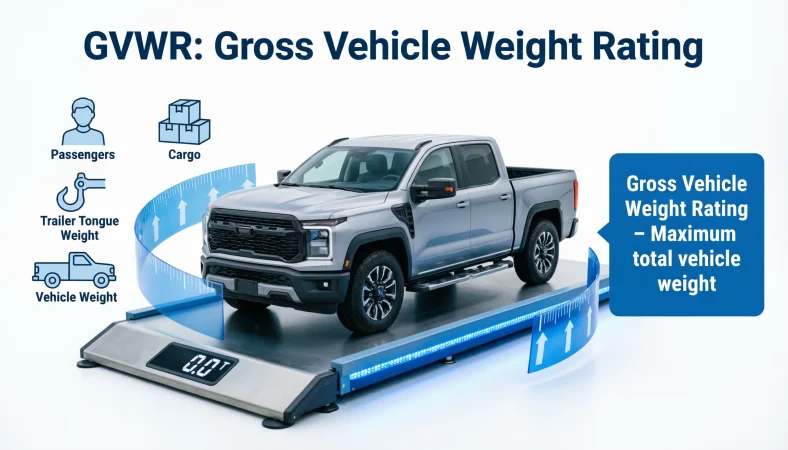

GVWR stands for Gross Vehicle Weight Rating. It is the maximum safe operating weight of a vehicle, including the vehicle itself, passengers, cargo, fuel, and any additional equipment. The manufacturer sets the GVWR to ensure the vehicle can be operated safely without overloading its suspension, brakes, tires, or frame.
Have you ever noticed the term GVWR on your vehicle’s door sticker or in the owner’s manual and wondered what it actually means? Whether you’re buying a truck, towing a trailer, or simply checking your vehicle’s specifications, understanding GVWR (Gross Vehicle Weight Rating) is essential for safe and legal driving. Many drivers confuse GVWR with towing capacity or curb weight, but they are not the same.
In this guide, you’ll learn what GVWR means, how it is calculated, why it matters, where to find your vehicle’s GVWR, and how it affects payload, towing, and overall vehicle safety. We’ll also answer the most common questions to help you confidently understand this important vehicle rating.
Where Did GVWR Come From and Why Does It Matter?
The concept of GVWR emerged alongside the commercial vehicle industry’s need for standardized safety regulations. As trucks became more powerful and vehicles more complex, manufacturers needed a clear, consistent way to communicate safe operating limits to drivers and regulatory bodies.
The History Behind the Term
The Federal Motor Carrier Safety Administration (FMCSA) and the National Highway Traffic Safety Administration (NHTSA) established GVWR standards to:
- Improve road safety: Preventing overloaded vehicles that could cause accidents
- Standardize classification: Creating clear categories for vehicles (Class 1–8 trucks)
- Protect infrastructure: Limiting weight on roads and bridges
- Enable enforcement: Giving authorities measurable criteria for inspection
Today, GVWR appears on every vehicle manufactured for sale in the United States, from the smallest passenger car to the largest commercial semi‑truck.
Why This Number Should Matter to You
Understanding your GVWR isn’t just for fleet managers or truck enthusiasts. Here’s why everyday drivers need to pay attention:
- Safety first: An overloaded vehicle takes longer to stop, handles poorly in emergencies, and puts extra stress on brakes and suspension
- Legal compliance: Exceeding your GVWR can result in fines, especially in commercial applications
- Warranty protection: Overloading may void manufacturer warranties
- Insurance implications: Accidents involving overloaded vehicles might not be fully covered
- Vehicle longevity: Operating within GVWR extends the life of your vehicle’s components
How to Find Your Vehicle’s GVWR
Locating your GVWR is straightforward. Here’s where to look:
Primary Locations
- Driver’s side doorjamb sticker (most common)
- Inside the glove box
- Fuel filler door area
- Owner’s manual
- Vehicle registration documents (sometimes included)
What You’ll See
The sticker typically displays:
- GVWR in pounds (e.g., 7,000 lbs)
- Tire pressure recommendations
- Cargo carrying capacity
- VIN (Vehicle Identification Number)
💡 Pro Tip: The GVWR on the door sticker is legally binding. Even if your vehicle could physically carry more weight, the manufacturer’s rating is what matters for legal and safety purposes.
Breaking Down the Components of GVWR
To truly understand GVWR meaning, you need to know what contributes to your vehicle’s total weight. Let’s break it down:
Curb Weight (Empty Vehicle Weight)
This is what your vehicle weighs when it rolls off the assembly line:
- Full fuel tank
- All necessary fluids (oil, coolant, brake fluid)
- Standard equipment (spare tire, jack, basic tools)
Payload Capacity
Payload is everything you add to your vehicle:
- Passengers (including the driver)
- Cargo in the bed or trunk
- Aftermarket accessories
- Hitches and trailer tongue weight
- Roof cargo and cargo boxes
The GVWR Formula
text
Curb Weight + Payload = Maximum GVWR
Example: A half‑ton pickup might have:
- Curb Weight: 5,500 lbs
- GVWR: 7,000 lbs
- Available Payload: 1,500 lbs
If you add four passengers (600 lbs), a camper shell (200 lbs), and equipment (700 lbs), you’re at exactly 1,500 lbs of payload right at the limit.
Real‑World Examples of GVWR in Action
Let’s look at how GVWR plays out in different scenarios:
Scenario 1: The Weekend Warrior (Neutral Tone)
Sarah’s 2022 Ford F‑150 has a GVWR of 7,050 lbs. The truck weighs 5,200 lbs empty, leaving 1,850 lbs for payload. She loads her camping gear (300 lbs), three passengers (450 lbs), and a fishing boat trailer with 400 lbs of tongue weight. Total payload: 1,150 lbs well within the GVWR. ✅
Scenario 2: The Overloaded Mover (Negative/Dismissive Tone)
Dave’s Ford F‑150 (GVWR 7,050 lbs) is packed to the brim with furniture. He’s got 2,500 lbs of cargo plus three passengers. The truck is sagging, the brakes feel spongy, and he’s ignoring that 850‑lb overload. 🙈 “It’ll be fine,” he thinks, ignoring physics, safety, and that angry‑looking state trooper he’s about to meet.
Reality check: Dave is now a rolling hazard with no legal protection and a rapidly deteriorating transmission.
Scenario 3: The Smart Fleet Manager (Friendly/Professional)
Maria runs a landscaping business with three F‑250s rated at 10,000 lbs GVWR each. She’s calculated her average load (trailer + equipment + crew) at 8,500 lbs, giving her a comfortable 1,500‑lb safety margin. Smart scheduling means she never exceeds capacity, her fleet stays reliable, and her drivers stay safe. 🌟
GVWR vs. Other Weight Ratings (Comparison)
Understanding GVWR meaning is easier when you know how it relates to other important terms:
| Term | What It Measures | Example Value | How It Relates |
| GVWR | Maximum total vehicle weight | 8,500 lbs | The “big picture” number |
| GCWR (Gross Combined Weight Rating) | Maximum weight of vehicle + towed trailer | 18,500 lbs | Always higher than GVWR |
| Curb Weight | Empty vehicle weight | 6,000 lbs | What you start with |
| Payload Capacity | Maximum weight of cargo + passengers | 2,500 lbs | GVWR – Curb Weight |
| Towing Capacity | Maximum weight you can tow | 10,000 lbs | Limited by GCWR and other factors |
| GAWR (Gross Axle Weight Rating) | Maximum weight per axle | 4,500 lbs (front), 5,000 lbs (rear) | Must be respected individually |
The Key Distinction
GVWR is about the whole vehicle, while GAWR considers individual axles. A vehicle could be under GVWR but overweight on one axle a common mistake when loads are improperly distributed.
🛑 Watch Out: Your GCWR is typically higher than your GVWR because it includes the trailer weight, but exceeding either rating is dangerous and illegal.
Common Misconceptions About GVWR
Let’s clear up some frequent misunderstandings:
Myth #1: “GVWR includes the trailer”
Fact: GVWR is only the vehicle itself, not what it tows. Towed weight is accounted for in GCWR and tongue weight affects payload.
Myth #2: “GVWR is the maximum legal driving weight”
Fact: It’s the manufacturer’s rating, but many states have their own weight regulations that may be lower.
Myth #3: “I can exceed GVWR if I’m careful”
Fact: No amount of “careful driving” compensates for mechanical stresses. Exceeding GVWR is always risky and often illegal.
Myth #4: “GVWR only matters for commercial vehicles”
Fact: Every vehicle has a GVWR, and exceeding it affects safety, legal compliance, and warranty coverage.
Alternate Meanings of GVWR
While “Gross Vehicle Weight Rating” is by far the most common meaning, you might encounter:
- Gross Vehicle Weight Ratio (rare, but appears occasionally)
- Green Vehicle Waste Reduction (not relevant for vehicles)
- Global Vehicle Weight Registry (fleet management systems)
In 99.9% of cases, GVWR means Gross Vehicle Weight Rating. Stick with that and you’ll be fine.
Professional Alternatives and Polite Ways to Discuss GVWR
When discussing GVWR professionally, here are some alternatives and context‑specific phrases:
For Customers/Clients
- “Your vehicle’s maximum safe carrying capacity”
- “The manufacturer’s recommended maximum weight”
- “Your vehicle’s weight limit rating”
For Technical Settings
- “Vehicle design weight capacity”
- “Manufacturer’s rated gross weight”
- “GVW limit” (Gross Vehicle Weight limit)
In Documentation
- “Vehicle weight rating”
- “Maximum allowable vehicle weight”
- “Rated load capacity”
Formal Alternative
“The manufacturer‑specified maximum operating weight for this vehicle, inclusive of all occupants, cargo, and equipment.”
Tips for Staying Within Your GVWR
Want to avoid overloading? Here’s a practical guide:
1. Know Your Numbers
- Find your GVWR sticker
- Calculate your curb weight (from manufacturer specs)
- Determine your available payload
2. Weigh Your Vehicle
- Visit a public scale (truck stops, recycling centers)
- Weigh empty first, then fully loaded
- Compare to GVWR
3. Plan Your Loads
- Distribute weight evenly
- Keep heavy items low and centered
- Secure all cargo properly
4. Consider Upgrades
- Air bags (help with leveling, not legal capacity)
- Heavy‑duty springs (improve ride, not GVWR)
- Remember: Upgrades don’t change the legal GVWR
5. Watch the Trailer Tongue Weight
- Typically 10‑15% of trailer weight
- Counts toward payload (not GCWR)
Conclusion:
Q1: What does GVWR mean on a truck?
It’s the maximum total weight your truck can safely carry – truck + passengers + cargo + accessories. Example: F‑250 with 10,000 lbs GVWR means you cannot exceed that loaded weight.
Q2: Is GVWR the weight of the vehicle?
No. GVWR is the weight limit (ceiling). The actual empty weight is called curb weight.
Q3: What’s the difference between GVWR and payload?
Payload = GVWR – Curb Weight. So if GVWR is 8,000 lbs and curb weight is 6,000 lbs, your payload capacity is 2,000 lbs for people and stuff.
Q4: Can I exceed GVWR by a little?
Physically yes, but don’t. Even a small overload voids warranties, invites fines, ruins braking/handling, and speeds up wear on suspension and drivetrain.
Q5: Where is the GVWR sticker?
Most common spot: driver’s side doorjamb. Also check the glove box, fuel filler door, or owner’s manual.
Q6: Does GVWR include tongue weight?
Yes. The downward force from your trailer hitch counts toward your truck’s payload, which adds to GVWR.
Q7: What happens if I exceed GVWR?
You risk: poor braking/blowouts (safety), part failures (transmission/suspension), heavy fines, denied insurance claims, and voided warranties.
Q8: Does GVWR change with mods (airbags/heavier springs)?
No. Aftermarket upgrades may improve ride quality but do not legally raise the manufacturer’s GVWR. The sticker number stays binding.
Conclusion:
Understanding GVWR meaning isn’t just a technical exercise, it’s a matter of safety, legality, and practicality. By knowing your vehicle’s limits, you can:
- Protect yourself from accidents and mechanical failures
- Save money by avoiding fines and repair bills
- Extend vehicle life by reducing wear and tear
- Stay legal in all jurisdictions
- Load smarter with confidence
Your Action Plan:
- Find your vehicle’s GVWR sticker today
- Calculate your available payload
- Weigh your vehicle for peace of mind
- Plan future loads with capacity in mind
- Remember: Staying within GVWR is always the smart choice
Whether you’re hauling for work, planning a family vacation, or just want to be an informed owner, knowing your GVWR is step one toward safer, smarter driving. Your vehicle and everyone else on the road will thank you.