

Quick Answer:
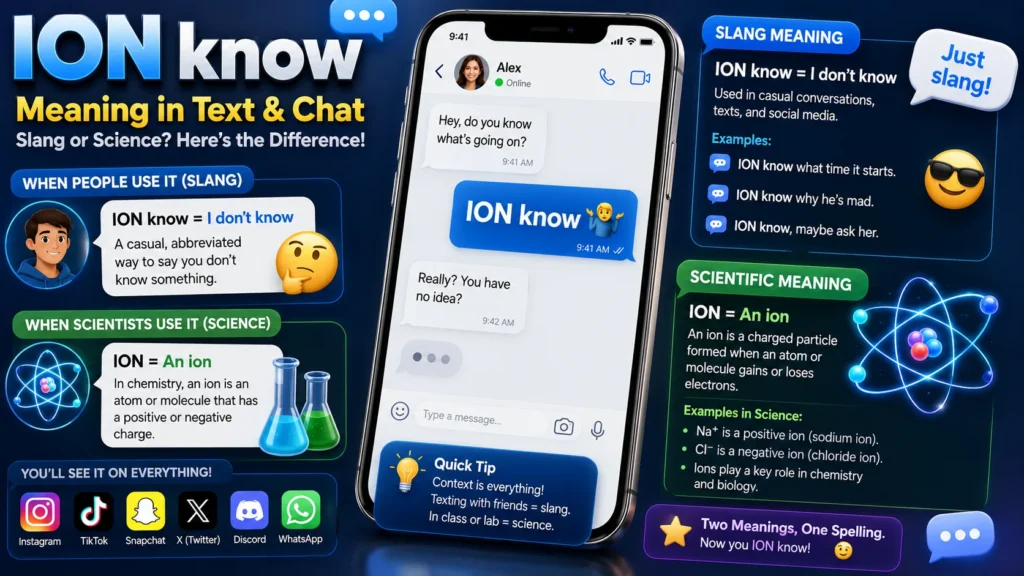
ION most commonly means “I Don’t” in text messages, chats, and social media. It is a popular slang abbreviation used in casual online conversations, especially in African American Vernacular English (AAVE). In science, however, ion has a completely different meaning, referring to an electrically charged atom or molecule.
Have you ever received a message saying “ION know” or seen someone write “ION” on TikTok, Snapchat, or Instagram? At first glance, it may look like the scientific word ion, but in internet slang, it has an entirely different meaning. Depending on the conversation, ION can refer to casual speech in texting or to a scientific term in chemistry. This guide explains the ION meaning, its origin, examples, alternate meanings, and how it’s used in everyday conversations.
ION Meaning
In texting and online chats, ION most commonly means “I Don’t.” It reflects the way some people naturally pronounce the phrase “I don’t” in casual speech, making it popular in text messages and social media posts.
For example:
- “ION know.” → I don’t know.
- “ION like that.” → I don’t like that.
- “ION think so.” → I don’t think so.
Pronunciation
In texting, ION is usually read as “I don’t.”
In science, ion is pronounced:
EYE-on
Meaning at a Glance
| Term | Meaning |
|---|---|
| ION | I Don’t (chat slang) |
| Type | Internet slang |
| Common Usage | Texting, social media, online chats |
| Tone | Casual and informal |
| Formality | Not suitable for professional writing |
The Origin of ION
The slang meaning of ION comes from African American Vernacular English (AAVE), where the phrase “I don’t” is often pronounced in a way that sounds similar to “ion.” As texting and social media became more popular, users began spelling it exactly as it sounded.
Today, the abbreviation is widely used on platforms like TikTok, X (formerly Twitter), Instagram, Snapchat, and Discord.
The scientific word ion, on the other hand, comes from the Greek word meaning “to go” and has been used in chemistry since the 19th century.
Why Is ION So Popular?
ION became popular because it saves time while making conversations sound natural and conversational.
You’ll commonly see it on:
- TikTok
- Snapchat
- X (formerly Twitter)
- Discord
- Messenger
- YouTube comments
It is especially common among younger users and in informal online conversations.
How Is ION Used in Chat?
People use ION as a replacement for “I don’t.”
Examples
- “ION know.”
- “ION care.”
- “ION think that’s true.”
- “ION want to go.”
- “ION remember.”
Each sentence can be understood by replacing ION with “I don’t.”
Examples of ION in Conversations
| Message | Meaning | Tone |
|---|---|---|
| “ION know.” | I don’t know | Casual |
| “ION like pizza.” | I don’t like pizza | Informal |
| “ION think so.” | I don’t think so | Neutral |
| “ION care 😂” | I don’t care | Playful |
| “ION remember.” | I don’t remember | Casual |
Tone Explained
The meaning of ION depends on the conversation but is almost always informal.
Casual Tone
Used between friends in everyday chats.
Example:
“ION know what happened.”
Friendly Tone
Often paired with emojis to keep the conversation relaxed.
Example:
“ION remember 😂”
Dismissive Tone
Depending on the wording, ION can sound blunt.
Example:
“ION care.”
Adding polite language makes the message sound friendlier.
ION vs Similar Chat Abbreviations
| Abbreviation | Meaning | Difference |
|---|---|---|
| ION | I Don’t | Informal slang |
| IDK | I Don’t Know | Specific phrase |
| IDC | I Don’t Care | Shows indifference |
| IMO | In My Opinion | Gives an opinion |
| TBH | To Be Honest | Introduces honesty |
Alternate Meanings of ION
Besides internet slang, ion has several other meanings.
Chemistry
An ion is an atom or molecule with a positive or negative electrical charge.
Example:
“Sodium forms a positive ion.”
Technology
ION may appear as part of product names, software, or company names.
Names and Acronyms
In certain industries or organizations, ION may be used as an abbreviation for specific projects or businesses, depending on the context.
When Should You Use ION?
ION is appropriate for:
- Casual text messages
- Social media comments
- Online chats
- Conversations with friends
- Informal messaging
Avoid using it in:
- Business emails
- School assignments
- Professional reports
- Formal presentations
Common Mistakes
Confusing ION With the Scientific Word
The slang ION means “I don’t,” while the scientific ion refers to a charged atom or molecule.
Using ION in Professional Writing
Internet slang is best reserved for casual conversations. Use “I don’t” in formal communication.
Assuming Everyone Understands It
Although ION is popular online, not everyone recognizes the abbreviation, especially outside social media.
FAQs
What does ION mean in texting?
ION most commonly means “I Don’t.” It is a casual slang abbreviation used in text messages and social media conversations.
What does ION mean on TikTok?
On TikTok, ION usually means “I Don’t.” Users often write phrases like “ION know” or “ION think so.”
Is ION the same as IDK?
No. ION means “I Don’t,” while IDK means “I Don’t Know.” They are related but not identical.
Can ION mean something in science?
Yes. In chemistry, an ion is an atom or molecule that has gained or lost electrons, giving it an electrical charge.
Where is ION commonly used?
ION is popular on TikTok, Snapchat, Instagram, X, Discord, WhatsApp, and other social media platforms.
Is ION formal or informal?
ION is informal internet slang. It’s best used in casual conversations rather than professional or academic writing.
Why do people say ION instead of “I don’t”?
People use ION because it reflects casual spoken pronunciation and makes texting quicker and more conversational.
Should I use ION in business emails?
No. Writing “I don’t” in full is more professional and appropriate for formal communication.
Conclusion
The ION meaning depends on the context. In texting and social media, it most commonly means “I Don’t,” making it a popular slang abbreviation in casual conversations. In science, however, ion refers to an electrically charged atom or molecule. Understanding the difference between these meanings helps you avoid confusion and communicate more effectively, whether you’re chatting online or studying chemistry.