
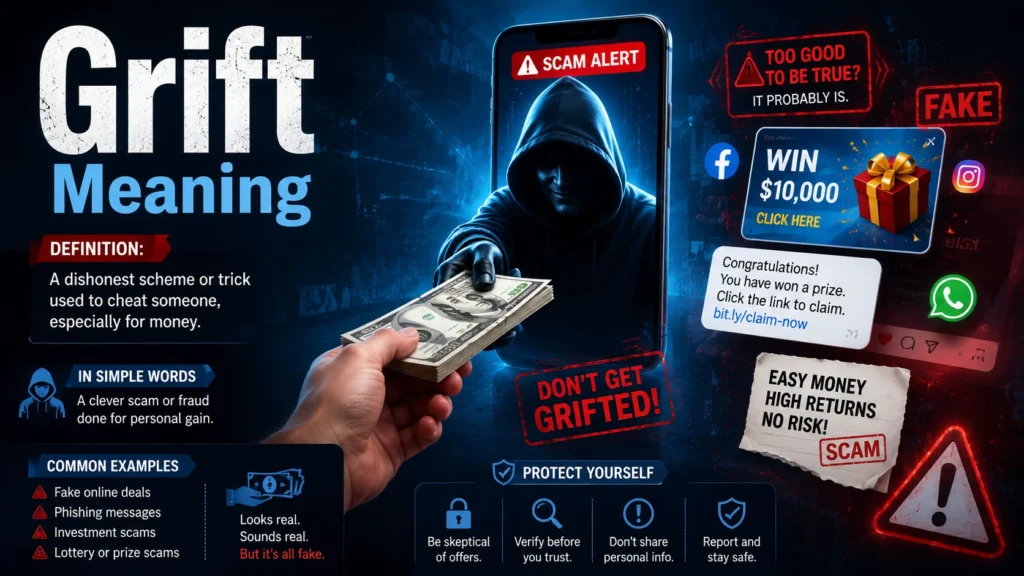

Grift is a noun or verb that refers to a dishonest way of getting money, benefits, or personal advantage by deceiving or manipulating other people. A person who carries out a grift is called a grifter. Today, the word is also commonly used to describe someone who profits by exaggerating, misleading, or taking advantage of public attention, even when their actions aren’t technically illegal.
Have you ever heard someone say, “That online course is just a grift,” or “He’s running a grift to make easy money” and wondered what grift meaning actually is?
The word grift has become increasingly popular in everyday conversations, news articles, podcasts, and social media. It’s often used to describe scams, dishonest schemes, or people who profit by misleading others. But the meaning isn’t always as straightforward as “fraud.” In many cases, people use grift to criticize someone they believe is exploiting others for personal gain, even if what they’re doing isn’t technically illegal.
You’re reading headlines, watching documentaries, or scrolling through X, Reddit, or TikTok, understanding the meaning of grift can help you better interpret modern conversations and avoid misunderstandings.
In this guide, you’ll learn exactly what grift means, where the word came from, how it’s used today, and how to recognize it in different situations.
Grift Meaning
Quick Definition Table
| Term | Meaning |
|---|---|
| Grift (noun) | A scam, swindle, or dishonest scheme used for personal gain. |
| Grift (verb) | To obtain money or benefits through deception or manipulation. |
| Grifter | A person who carries out a grift or scam. |
| Tone | Usually negative, critical, or accusing. |
Simple Meaning
In simple English, grift means making money or gaining benefits by tricking, manipulating, or misleading other people.
Think of it as:
- Pretending to be an expert just to sell expensive advice.
- Running a fake charity to collect donations.
- Promoting products you secretly know don’t work.
- Creating exaggerated stories simply to attract money or followers.
Not every grift is an illegal crime, but the word almost always suggests dishonesty or bad faith.
Origin of the Word “Grift”
The word grift has an interesting history that goes back to American slang.
Language experts believe it became popular during the early 20th century in the United States. It was closely connected to criminals, confidence tricks, gambling, and organized scams.
Many researchers think grift evolved from the older slang word graft, which originally referred to dishonest earning or political corruption. Over time, pronunciation and usage changed, leading to the modern form grift.
During the 1900s, newspapers and crime novels frequently used the word when describing professional con artists who traveled from town to town looking for victims.
Today, the meaning has expanded beyond classic scams.
Now, people often use grift to criticize influencers, politicians, online personalities, fake mentors, and businesses they believe are making money through misleading tactics rather than genuine value.
Why Has “Grift” Become So Popular?
Over the past few years, the word has exploded in popularity online.
Several reasons explain why:
- Social media exposes questionable money-making schemes quickly.
- Online scams have become more common.
- Influencer culture has made people more skeptical.
- Fake investment opportunities spread rapidly online.
- Podcasts and YouTube creators frequently discuss “internet grifters.”
- Political discussions often use the term to criticize fundraising or public campaigns.
Instead of saying:
“That’s a scam.”
Many people now say:
“That’s a grift.”
The newer term often implies that the scheme is clever, manipulative, or designed to appear legitimate.
How Is “Grift” Used Today?
Modern English uses grift in several different ways.
1. Financial Scams
The most common meaning involves dishonest methods of making money.
Example:
“The fake investment program turned out to be a complete grift.”
Here, the speaker believes the investment was intentionally deceptive.
2. Online Influencers
People sometimes accuse influencers of running a grift when they constantly sell questionable products or courses.
Example:
“Many viewers believe the expensive coaching program is just another grift.”
Notice that this expresses an opinion rather than proving fraud.
3. Politics
Political commentators often use grift when they think public figures are exploiting supporters for money.
Example:
“Critics called the fundraising campaign a grift.”
Again, this reflects criticism rather than a legal judgment.
4. Fake Expertise
Someone pretending to know more than they actually do can also be described as running a grift.
Example:
“He marketed himself as a millionaire mentor, but many people later called it a grift.”
5. Everyday Conversations
Friends sometimes use the word jokingly.
Example:
“Selling my old textbooks online feels like a grift. 😂”
Here, the speaker is exaggerating humorously rather than admitting dishonesty.
Common Examples of “Grift” in Context
Understanding context makes the meaning much easier.
| Sentence | Meaning | Tone |
|---|---|---|
| “The charity turned out to be a grift.” | Fake charity | Negative |
| “People think that course is a grift.” | Possibly misleading business | Critical |
| “He spent years perfecting his grift.” | Professional con artist | Strongly negative |
| “She’s grifting people online.” | Misleading others for profit | Accusing |
| “That sounds like a grift to me.” | Suspicious scheme | Skeptical |
| “Don’t fall for that grift!” | Warning someone | Protective |
Is “Grift” Always About Illegal Activity?
Not necessarily.
One reason the word is interesting is that it doesn’t always mean someone has broken the law.
Instead, grift often suggests:
- Manipulation
- Dishonesty
- Exaggeration
- Exploiting trust
- Taking advantage of people’s emotions
- Profiting from misleading claims
For example:
A motivational speaker may legally sell expensive seminars.
Some people may still call it a grift if they believe the promises are unrealistic or intentionally misleading.
So the word often reflects public opinion rather than a legal conclusion.
The Difference Between “Grift” and a Scam
Although they’re closely related, they aren’t exactly the same.
A scam usually describes a specific act of fraud.
A grift often describes an ongoing system, strategy, or lifestyle built around misleading people for personal benefit.
For example:
Scam:
Someone sends fake emails pretending to be your bank.
Grift:
Someone builds an online brand based on exaggerated success stories while constantly selling overpriced products.
Many grifts include scams, but not every grift involves criminal fraud.
Who Is a Grifter?
A grifter is the person behind the grift.
A grifter may:
- Pretend to have special knowledge.
- Promise unrealistic results.
- Manipulate emotions.
- Create fake urgency.
- Build trust before asking for money.
- Continuously invent new ways to attract victims.
Classic examples include:
- Con artists
- Fake investment advisors
- Fraudulent charity organizers
- Fake relationship scammers
- Internet “mentors” selling impossible success
Today, the word is also used more loosely to describe anyone seen as exploiting public attention for profit.
Signs That Something Might Be a Grift
While not every suspicious offer is a grift, many share similar warning signs.
Common red flags include:
- Promises of guaranteed success.
- Pressure to act immediately.
- Claims that sound too good to be true.
- Hidden fees or unclear pricing.
- Constant requests for money.
- Lack of transparency.
- Fake testimonials.
- Refusal to answer reasonable questions.
- Emotional manipulation instead of evidence.
- Grand claims without proof.
Seeing one sign doesn’t automatically mean something is a grift, but several together should encourage extra caution.
Different Tones When Using the Word “Grift”
The tone changes depending on the conversation.
| Tone | Example | Meaning |
|---|---|---|
| Negative | “That’s a grift.” | Strong criticism |
| Skeptical | “It feels like a grift.” | Doubtful opinion |
| Humorous | “My side hustle is a grift 😂.” | Self-deprecating joke |
| Political | “Critics called it a grift.” | Public criticism |
| Journalistic | “Investigators examined the alleged grift.” | Neutral reporting |
Using the word carefully is important because calling someone a grifter can be a serious accusation if presented as fact rather than opinion.
Grift vs Similar Words
Many people use grift interchangeably with words like scam or fraud, but each has its own meaning. Knowing the difference helps you use the word more accurately.
| Word | Meaning | Is It Always Illegal? | Common Usage |
|---|---|---|---|
| Grift | A dishonest or manipulative way of gaining money or influence | Not always | Internet culture, politics, media, everyday conversations |
| Scam | A deliberate trick to steal money or personal information | Usually | Fraud alerts, online safety, news |
| Fraud | A legal term for intentional deception for financial gain | Yes | Law, business, courts |
| Con | A confidence trick that earns someone’s trust before deceiving them | Often | Crime stories, movies |
| Scheme | A plan or strategy, which can be good or bad depending on context | Not necessarily | Business, politics, everyday English |
| Swindle | To cheat someone out of money | Yes | Formal writing, news reports |
Which Word Should You Use?
Use grift when you want to emphasize that someone is profiting through manipulation, exaggeration, or questionable behavior.
Use scam when there is clear deception.
Use fraud when referring to illegal conduct or legal cases.
Alternate Meanings of Grift
Although grift almost always relates to dishonesty today, there are a few variations worth knowing.
1. As a Verb
Sometimes people use grift as an action.
Examples:
- “He spent years grifting wealthy investors.”
- “They’re grifting people through fake giveaways.”
Here, grifting means deceiving people for personal benefit.
2. Internet Slang
Online communities often use the word more loosely.
Someone might call an overpriced product, a misleading subscription, or an exaggerated social media trend a grift, even if there is no proof of illegal activity.
Example:
“Selling a $1,000 productivity course with recycled advice feels like a grift.”
This expresses an opinion rather than a verified fact.
3. Political Discussions
Political commentators frequently use grift to criticize fundraising campaigns, organizations, or public figures they believe are exploiting supporters for money or influence.
Again, the word often reflects criticism rather than a legal conclusion.
Professional or Polite Alternatives to “Grift”
Because grift has a strong negative meaning, it may not always be appropriate in professional writing or workplace conversations.
Here are some alternatives depending on the situation.
| Instead of “Grift” | You Can Say |
|---|---|
| Grift | Questionable business practice |
| Grift | Misleading marketing |
| Grift | Unethical behavior |
| Grift | Dubious scheme |
| Grift | Deceptive practice |
| Grift | Suspicious operation |
| Grift | Lack of transparency |
| Grift | Potentially misleading offer |
Example
Instead of:
“That company is running a grift.”
A more professional version would be:
“Some customers believe the company’s marketing practices are misleading.”
This wording is more balanced and suitable for formal communication.
Common Phrases That Include “Grift”
You may come across these expressions in articles, videos, or social media posts.
- Running a grift
- Internet grift
- Political grift
- Celebrity grift
- Charity grift
- Crypto grift
- Online grifter
- Professional grifter
- Grift economy
- Grift culture
Example Sentences
- “The podcast investigates famous internet grifts.”
- “Some critics described the campaign as a political grift.”
- “She warned her followers about a cryptocurrency grift.”
- “People accused the influencer of running a wellness grift.”
How to Use “Grift” Correctly
If you’re learning English or improving your vocabulary, these tips can help.
Use It When:
- Referring to dishonest money-making tactics.
- Describing manipulation or exploitation.
- Discussing criticism found in media or online culture.
- Talking about alleged scams in a general sense.
Avoid Using It When:
- You have no evidence to support a serious accusation.
- You’re writing formal legal documents.
- You simply mean a legitimate business you dislike.
Remember that grift is often subjective. Different people may disagree on a particular activity deserves that label.
Common Mistakes People Make
Confusing Grift With Every Business
Not every expensive product or service is a grift. High prices alone don’t make something dishonest.
Assuming It Always Means Crime
Many people use the word for behavior they believe is unethical, even when no law has been broken.
Using It Casually About Individuals
Calling someone a grifter can damage their reputation if presented as fact. It’s better to frame it as an opinion unless there is verified evidence.
For example:
✔ “Some critics described it as a grift.”
Instead of:
✘ “He is definitely a grifter.”
Why the Word Matters Today
The rise of social media, online businesses, and digital influencers has made grift more relevant than ever.
People are constantly exposed to:
- Investment opportunities
- Online coaching programs
- Subscription services
- Cryptocurrency projects
- Charity campaigns
- Affiliate marketing
- Viral trends
While many of these are genuine, others may rely on exaggerated promises or emotional persuasion. As a result, the word grift has become a quick way for people to describe behavior they see as exploitative or misleading.
Understanding the meaning helps you interpret online discussions more accurately and encourages you to think critically before trusting bold claims.
FAQs
1. What does grift mean in simple words?
Grift means getting money, influence, or other benefits by misleading, manipulating, or deceiving people. It usually has a negative meaning.
2. Is grift the same as a scam?
Not exactly. A scam is usually a specific act of fraud, while a grift often refers to a broader pattern of dishonest or manipulative behavior for personal gain.
3. What is a grifter?
A grifter is someone who carries out a grift. They often use persuasion, false promises, or manipulation to profit from others.
4. Is grift always illegal?
No. Many people use the word to criticize behavior they consider unethical or misleading, even if it doesn’t break the law.
5. Where did the word grift come from?
The word became popular in early American slang and is widely believed to have evolved from graft, a term associated with dishonest gain and corruption.
6. Why is the word grift so popular now?
It has gained popularity because of social media, influencer culture, online scams, political commentary, and discussions about misleading marketing practices.
7. Can grift be used as a verb?
Yes. For example:
“They were accused of grifting vulnerable customers.”
In this sentence, grifting means deceiving people for personal benefit.
8. Is calling someone a grifter offensive?
Yes, it can be. Since the term suggests dishonesty or manipulation, it should be used carefully and, where appropriate, framed as an opinion rather than a proven fact.
Conclusion
Understanding grift meaning goes beyond simply knowing that it refers to a scam. The word describes a broader idea of gaining money, influence, or personal advantage through manipulation, deception, or misleading behavior. While it originated in American slang connected to con artists, it has evolved into a widely used term in discussions about social media, politics, business, and internet culture.
You’re reading the news, watching a documentary, or scrolling through social media, recognizing how grift is used can help you better understand modern conversations. Just remember that it’s a strong, often subjective term. Using it thoughtfully and understanding its context will make your communication clearer, more accurate, and more informed.