
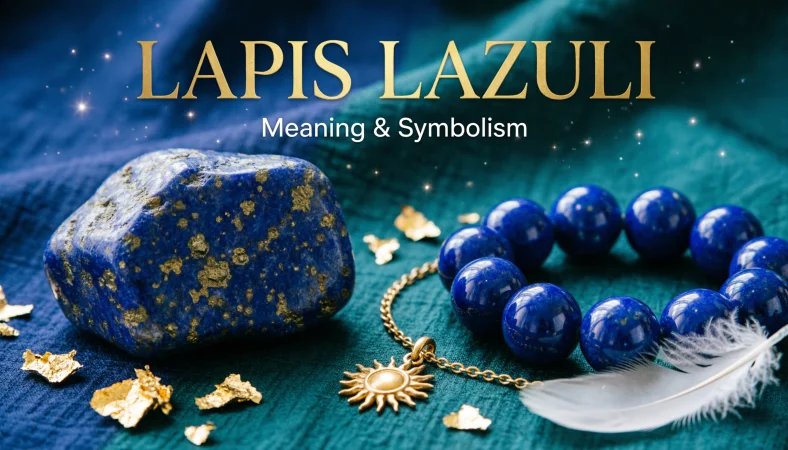

Lapis lazuli is a deep blue metamorphic gemstone prized for its rich color, natural beauty, and historical significance. It has been used for thousands of years in jewelry, art, and decorative objects and is often associated with wisdom, truth, inner peace, and spiritual awareness. The stone is primarily composed of the mineral lazurite, with golden flecks of pyrite and white calcite often adding to its distinctive appearance.
For thousands of years, lapis lazuli has fascinated civilizations with its brilliant royal-blue color and powerful symbolism. From ancient Egyptian pharaohs and Renaissance artists to modern crystal enthusiasts, this remarkable gemstone has been admired as a symbol of wisdom, truth, creativity, and self-expression. Whether you’re curious about lapis lazuli meaning, its spiritual significance, healing properties, symbolism, or why it remains one of the world’s most treasured blue gemstones, understanding its history and cultural importance can help you appreciate its lasting appeal.
In this guide, you’ll discover the meaning of lapis lazuli, its origin, historical uses, metaphysical associations, common colors, benefits, and how people use it today in jewelry, meditation, and personal collections. You’ll also learn fascinating facts, practical examples, and answers to the most frequently asked questions, making this a complete and reliable resource for anyone interested in this iconic gemstone.
The Origin and Ancient History of Lapis Lazuli
The Birthplace: The Mountains of Afghanistan
To understand the lapis lazuli meaning, we must start at its source. The finest and most historically significant lapis lazuli comes from the mines of the Sar-e-Sang district in the Badakhshan province of northeastern Afghanistan. These mines, located in the remote Hindu Kush mountains, have been actively mined for over 6,000 yearsmaking them one of the oldest continually operated mining sites in the world.
Trade routes from these mines spread lapis across the ancient world. It was so highly valued that it was often traded for gold and other precious commodities.
Lapis in Ancient Egypt: The Stone of the Heavens
For the ancient Egyptians, the lapis lazuli meaning was divine. It was associated with the heavens, the night sky, and the gods. The stone was closely linked to Maat, the goddess of truth, and Ra, the sun god.
The most famous example of Egyptian lapis is the death mask of Tutankhamun, which features extensive inlays of the stone. It was also ground down to create eyeshadow for royalty and was placed in tombs to guide the deceased through the afterlife. The Egyptians believed lapis could protect against evil and provide safe passage into the next world.
Mesopotamia and the Epic of Gilgamesh
In ancient Mesopotamia, lapis lazuli was equally revered. The Epic of Gilgamesh, the oldest surviving great work of literature, mentions the stone multiple times. In the story, the goddess Inanna (Ishtar) is described as wearing a lapis lazuli necklace, and the hero Gilgamesh uses the stone to ward off evil spirits. The Sumerians believed lapis had the power to attract divine favor and protection.
The Renaissance: More Precious Than Gold
Fast forward to 14th-century Europe, and the lapis lazuli meaning shifted slightlybut its value skyrocketed. The stone was ground into a fine powder to create ultramarine, the most brilliant and expensive blue pigment of the Renaissance. It was so costly that artists like Michelangelo and Vermeer reserved it exclusively for painting the robes of the Virgin Mary and other holy figures.
Ultramarine was literally worth more than gold by weight. To use it was a sign of immense wealth and spiritual devotion. This historical connection firmly cemented lapis lazuli’s association with divinity and high status.
Physical and Chemical Composition: What Is It Really?
To appreciate the lapis lazuli meaning, it helps to know what the stone is made of. It isn’t a single mineral, but a metamorphic rocka complex aggregate of several minerals.
| Primary Component | Percentage | Characteristics |
| Lazurite | 25% – 40% | The key ingredient responsible for the deep blue color. It is a feldspathoid mineral containing sulfur, which gives it that brilliant azure hue. |
| Calcite | Variable | A white, chalky mineral that creates streaks or spots. High-quality lapis has minimal calcite. |
| Pyrite | Variable | Golden or brassy flecks that look like specks of gold or stars. Often called “fool’s gold,” it adds to the stone’s visual appeal. |
| Sodalite | Variable | A blue mineral similar to lazurite but generally paler and lacking the sulfur-rich intense color. |
| Diopside / Mica | Trace | Minor components that can affect the stone’s texture and luster. |
Color Range: Lapis lazuli ranges from pale, greenish-blue to a deep, vivid indigo. The most prized color is a rich, uniform “ultramarine” blue with minimal calcite veining and well-distributed pyrite flecks.
The Spiritual and Metaphysical Meaning of Lapis Lazuli
This is perhaps the most popular modern search regarding the lapis lazuli meaning. While science explains its composition, spirituality explains its soul.
The Stone of Wisdom and Truth
Lapis lazuli is universally regarded as a stone of intellectual clarity and objective truth. It is believed to:
- Stimulate the mind: Enhance memory, logic, and problem-solving skills.
- Encourage self-expression: Help you articulate your thoughts and feelings clearly and honestly.
- Reveal inner truth: Cut through illusion and self-deception, helping you see yourself and others clearly.
The Third Eye and Throat Chakra Connection
In crystal healing, lapis lazuli is one of the most powerful stones for activating the Third Eye Chakra (Ajna) and the Throat Chakra (Vishuddha).
- Third Eye (Forehead): It is said to open psychic abilities, enhance intuition, and facilitate deep meditation. It connects the physical mind with the spiritual realm.
- Throat (Neck): It empowers honest communication, helping you speak your truth with confidence and compassion.
Protection and Ancient Magic
Historically, lapis was carried as a talisman to ward off negative energies. Modern practitioners still use it to protect against psychic attacks and to bring a sense of peace and tranquility to chaotic environments.
Emotional Healing
Emotionally, the lapis lazuli meaning is tied to inner peace. It is often recommended for people struggling with:
- Depression or anxiety
- Suppressed emotions
- Difficulty expressing oneself
- Self-esteem issues
By promoting self-awareness, it helps you release stored anger and embrace your authentic self.
Modern Uses and Applications
Beyond its historical and spiritual significance, lapis lazuli has numerous practical and decorative applications today.
Jewelry and Adornment
Lapis lazuli is a popular gemstone in necklaces, rings, earrings, and bracelets. Its deep blue complements both gold and silver settings. It is often carved into beads, cabochons, and cameos.
Art and Pigment (Ultramarine)
While synthetic ultramarine was invented in the 19th century (making the pigment affordable), high-end artists and restoration experts still use natural ultramarine derived from real lapis for historical accuracy and its incomparable, luminous depth.
Decorative Objects and Sculpture
The stone is also carved into vases, bowls, chess pieces, and ornamental boxes. Its relative softness (5–6 on the Mohs scale) makes it amenable to carving, yet it is durable enough for everyday display.
Meditation and Spiritual Practices
Crystals and gemstones remain hugely popular in holistic wellness. Many practitioners keep a piece of lapis lazuli in their meditation space, place it on their altars, or wear it to maintain a balanced energy field throughout the day.
Comparison with Similar Stones (How to Tell the Difference)
A common challenge for buyers is distinguishing genuine, high-quality lapis lazuli from similar-looking minerals or fakes. Here is how the lapis lazuli meaning and appearance stack up against its common lookalikes.
| Stone | Key Features | Distinction from Lapis Lazuli |
| Lapis Lazuli (Genuine) | Deep ultramarine blue with golden pyrite flecks. May have subtle white calcite veining. | Contains lazurite and pyrite. Rich, complex color with visible metallic pyrite. |
| Sodalite | Royal blue to dark blue, often with white veins. | No pyrite flecks. Usually lighter and more uniform. Often lacks the “depth” of lapis. |
| Azurite | Deep, almost midnight-blue with greenish undertones. | Higher density and hardness. Often has a greener, more “copper-ish” tint when broken down. Rarely has pyrite. |
| Dyed Howlite | Bright, unnaturally uniform blue. | Completely fake. Howlite is a white porous mineral. A cotton swab dipped in acetone rubbed on a dyed stone will remove the color. |
| Synthetic Ultramarine | Bright, consistent blue (pigment or glass). | Man-made. Does not have natural internal fractures, calcite, or pyrite inclusions. Looks “too perfect.” |
| Lapis “Reconstituted” | Small fragments of lapis glued together with resin. | Often has a plastic-like sheen. May not have natural pyrite distribution. Acetone or heat can reveal resin. |
How to Identify and Care for Your Lapis Lazuli
Spotting Real vs. Fake Lapis
- Check for Pyrite: Real lapis almost always has tiny golden specks of pyrite. If it’s perfectly uniform with no flecks, it may be sodalite or synthetic.
- The Acetone Test: Dip a Q-tip in nail polish remover and rub it on an inconspicuous spot. If blue pigment comes off, the stone is dyed (likely howlite).
- Look for Calcite Veins: Natural lapis often has subtle white or grey streaks. If the color is absolutely uniform and cartoonishly blue, it is probably dyed.
- Weight and Feel: Lapis is relatively dense and should feel cool to the touch. Resin-based fakes or reconstituted stones will feel warmer and lighter.
Care Tips to Preserve Its Beauty
Lapis lazuli is porous and sensitive to chemicals, heat, and sudden temperature changes.
- Clean with Warm Soapy Water: Use a soft cloth and mild dish soap. Avoid ultrasonic or steam cleaners.
- Avoid Acids: Lemon juice, vinegar, or any acidic cleaners can damage the calcite and fade the color.
- Keep Away from Sunlight: Prolonged direct sunlight can fade the vibrant blue over time.
- Store Separately: It can scratch easily. Store it in a soft cloth pouch or separated from harder stones like diamonds or sapphires.
Comparison Table: Lapis Lazuli Quality Grades
When shopping for lapis lazuli, you will encounter different grades that significantly affect the price and aesthetic.
| Grade | Color | Pyrite Content | Calcite Content | Price Range |
| AAA / Gem Grade | Uniform, deep ultra-marine blue | Sparse, fine, evenly distributed | Almost none | Very High |
| AA / Premium | Rich blue, slight variation | Moderate, clearly visible | Minimal (<5%) | High |
| A / Commercial Grade | Lighter blue or greenish-blue | Present but uneven | Noticeable (5-15%) | Moderate to Low |
| Dye-Enhanced | Oversaturated, uniform, unnatural blue | Often absent or painted on | Heavy; used as base for dye | Low |
| Reconstituted | Muddy blue, resinous sheen | Often artificially added | Mixed with resin | Very Low |
Practical Tips: Bringing Lapis Lazuli Into Your Life
If you are drawn to the lapis lazuli meaning, here is how to integrate it into your daily routine:
- Wear it as Jewelry: A pendant worn close to the throat is excellent for public speaking or interviews. Bracelets keep its energy on your pulse point.
- Meditate with It: Hold a piece in your left hand (the receiving hand) during meditation. Focus on the spot between your eyebrows to activate your Third Eye.
- Place it on Your Desk: Keep a polished sphere or cube on your work desk. It is said to improve focus, reduce stress, and encourage clear, honest communication in professional environments.
- Use it for Journaling: Place a stone on your journal before you write. It is believed to help you access your inner truth and write with more honesty.
- Gift it: Given its associations with friendship and honesty, lapis makes a meaningful gift for a friend, colleague, or graduate.
FAQs
1. What does lapis lazuli symbolize spiritually?
Lapis lazuli symbolizes wisdom, truth, intuition, and spiritual enlightenment.
2. Is lapis lazuli expensive?
High-quality lapis lazuli can be expensive, while lower-grade stones are more affordable.
3. What are the golden flecks in lapis lazuli?
The golden flecks are pyrite, a natural mineral that gives the stone its distinctive sparkle.
4. How can you tell if lapis lazuli is real?
Real lapis lazuli has a deep blue color with natural pyrite flecks and may contain small white calcite veins.
5. Which chakra is lapis lazuli associated with?
It is primarily linked to the Third Eye Chakra and the Throat Chakra.
6. Can lapis lazuli go in water?
No. It’s best to keep lapis lazuli away from water, as prolonged exposure can damage the stone.
7. What does lapis lazuli mean in different cultures?
Across cultures, it represents wisdom, protection, truth, royalty, and spiritual power.
8. Where does the best lapis lazuli come from?
The highest-quality lapis lazuli is traditionally sourced from Badakhshan, Afghanistan.
Conclusion
The lapis lazuli meaning goes far beyond its striking deep-blue color. For thousands of years, this gemstone has symbolized wisdom, truth, spiritual awareness, and inner strength across many cultures. Whether you appreciate it for its rich history, symbolic value, or natural beauty, lapis lazuli remains one of the world’s most meaningful gemstones. Understanding its significance can help you appreciate why it continues to be cherished in jewelry, art, and spiritual practices today.
Prompt