
Quick Answer
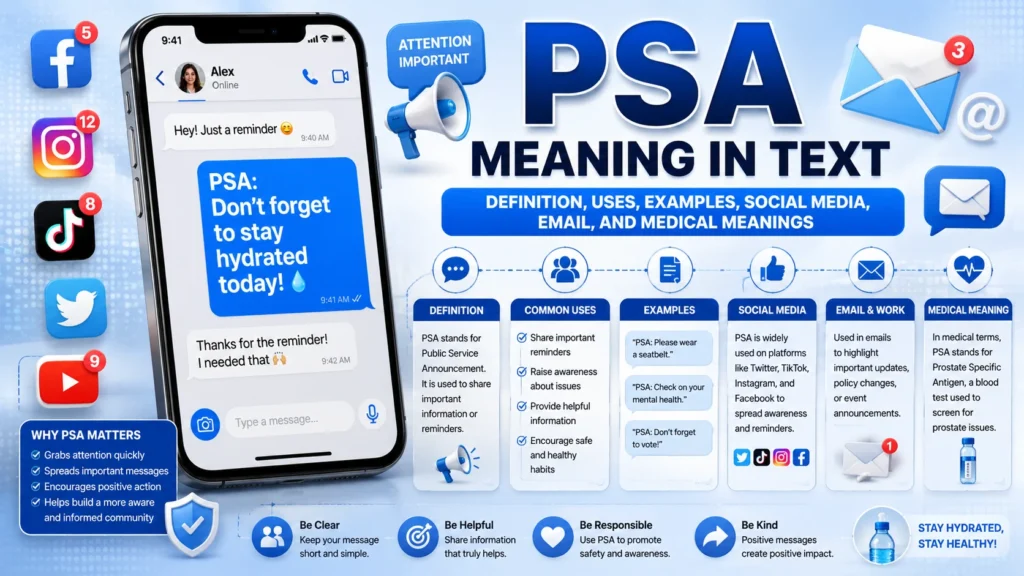
PSA in text most commonly stands for “Public Service Announcement.” However, depending on the conversation, it can also mean “Please See Attached,” “Prostate-Specific Antigen,” or other industry-specific terms. The correct meaning depends entirely on the context.
If you’ve ever received a message that starts with “PSA:”, you may have wondered what it actually means. The abbreviation PSA appears everywhere, from social media posts and text messages to emails and healthcare discussions. While many people immediately think of Public Service Announcement, the term has several meanings depending on where it’s used.
Understanding PSA meaning in text helps you avoid confusion and communicate more effectively. You’re scrolling through Instagram, chatting with friends, reading workplace emails, or seeing medical information online, knowing the different meanings of PSA makes conversations much easier to understand.
This guide explains every major meaning of PSA, when to use it, examples, differences between contexts, common mistakes, FAQs, and much more.
What Does PSA Mean in Text?
In texting and social media, PSA usually stands for Public Service Announcement.
People use it before sharing helpful advice, important reminders, warnings, or useful information that others should know.
Examples
- PSA: Drink plenty of water during the heatwave.
- PSA: The store closes early today.
- PSA: Always back up your files before updating your computer.
- PSA: Don’t forget Mother’s Day is this Sunday.
Although these aren’t official announcements, people use “PSA” humorously or seriously to grab attention.
Table: Primary Meaning of PSA
| Abbreviation | Full Form | Common Usage | Formal or Informal |
|---|---|---|---|
| PSA | Public Service Announcement | Text messages, social media, online posts | Both |
| PSA | Please See Attached | Business emails | Formal |
| PSA | Prostate-Specific Antigen | Medical discussions | Formal |
| PSA | Professional Sports Authenticator | Sports card collecting | Formal |
Why Do People Use PSA in Messages?
Adding PSA at the beginning of a message signals that the information is important.
People use it to:
- Share reminders
- Give warnings
- Offer useful advice
- Spread awareness
- Share life hacks
- Make funny observations
- Highlight important news
Instead of writing a long introduction, simply writing “PSA:” immediately tells readers to pay attention.
PSA Meaning on Social Media
On platforms like Instagram, TikTok, Facebook, X, Reddit, and Threads, PSA almost always means Public Service Announcement.
Sometimes it’s serious.
Example:
PSA: Never share your passwords with anyone.
Sometimes it’s humorous.
Example:
PSA: Fries taste better when someone else pays.
Creators also use PSA in captions to increase engagement because it makes readers curious.
Table: PSA Examples on Different Platforms
| Platform | Example |
|---|---|
| PSA: Sunscreen isn’t just for summer. | |
| TikTok | PSA: Stop believing every viral life hack. |
| PSA: School will remain closed tomorrow. | |
| X | PSA: Coffee is not a substitute for sleep. |
| PSA: Read the rules before posting. |
PSA Meaning in Emails
In business communication, PSA can also mean Please See Attached.
Example:
PSA: The updated sales report is attached.
However, many professionals prefer writing the full phrase because not everyone recognizes the abbreviation.
Example Email
Hello Team,
PSA: The revised presentation has been attached for your review.
Please share your feedback before Friday.
Thank you.
PSA Meaning in Medical Terms
Healthcare professionals use PSA differently.
Here, PSA means Prostate-Specific Antigen, a protein measured during blood tests.
Doctors use PSA testing to help monitor prostate health.
Important Note
When discussing medicine, PSA has nothing to do with texting or social media.
Always consider the context.
Table: PSA in Different Fields
| Industry | Meaning |
|---|---|
| Social Media | Public Service Announcement |
| Texting | Public Service Announcement |
| Healthcare | Prostate-Specific Antigen |
| Business | Please See Attached |
| Sports Cards | Professional Sports Authenticator |
| Aviation | Passenger Service Agent |
Examples of PSA in Everyday Conversations
Here are some realistic examples.
Friends
PSA: Bring snacks tonight because we’ll be gaming for hours.
Family
PSA: Grandma’s birthday dinner starts at 6 PM.
School
PSA: Homework is due tomorrow.
Office
PSA: Meeting has been moved to 3 PM.
Online Community
PSA: Read the community guidelines before posting.
Funny PSA Examples
Many people use PSA to make jokes.
Examples include:
- PSA: Adulting is harder than expected.
- PSA: Pizza counts as self-care.
- PSA: Monday should be optional.
- PSA: Your plants can’t survive on good intentions.
- PSA: Charge your phone before leaving home.
- PSA: Coffee first, conversations later.
- PSA: Don’t text your ex after midnight.
- PSA: Ice cream solves most problems.
- PSA: Wi-Fi is a basic human need.
- PSA: Always save your work.
How to Use PSA Correctly
Using PSA is simple.
Start your message with:
PSA:
Then write your important reminder or announcement.
Example:
PSA: Remember to lock your doors before leaving.
This format is recognized almost everywhere online.
When You Should Avoid Using PSA
Although PSA is common, avoid using it when:
- Writing academic papers
- Creating legal documents
- Communicating with people unfamiliar with internet slang
- Discussing medical topics unless referring to the blood test
- Writing formal reports
In professional writing, spelling out the complete phrase is often clearer.
Common Mistakes About PSA
Many people misunderstand PSA because it has multiple meanings.
Common mistakes include:
Assuming Only One Meaning
PSA changes based on context.
Using It in Medical Conversations Incorrectly
Healthcare discussions usually refer to the blood test.
Forgetting the Audience
Older readers may not recognize internet slang.
Using PSA Without Context
Always make the announcement clear.
Bad:
PSA.
Good:
PSA: The event begins at 5 PM.
Similar Internet Abbreviations
Many texting abbreviations appear alongside PSA.
| Abbreviation | Meaning |
|---|---|
| FYI | For Your Information |
| IMO | In My Opinion |
| TBH | To Be Honest |
| BRB | Be Right Back |
| BTW | By The Way |
| IDK | I Don’t Know |
| ASAP | As Soon As Possible |
| TMI | Too Much Information |
| ICYMI | In Case You Missed It |
| FWIW | For What It’s Worth |
Is PSA Formal or Informal?
It depends.
Informal
- Text messages
- Social media
- Online communities
- Group chats
Formal
- Workplace emails
- Government announcements
- Healthcare communication
- Public awareness campaigns
Understanding your audience helps determine PSA is appropriate.
FAQs
What does PSA mean in texting?
It usually means Public Service Announcement, used before sharing important information or reminders.
What does PSA mean on Instagram?
It generally means Public Service Announcement, often introducing advice, awareness, or humorous observations.
Does PSA always mean Public Service Announcement?
No. It can also mean Please See Attached, Prostate-Specific Antigen, or other terms depending on the situation.
Can PSA be used in business emails?
Yes. Some people use it for Please See Attached, although writing the full phrase is often clearer.
Is PSA internet slang?
It is both an abbreviation and internet slang because social media users frequently use it informally.
How do I know which meaning is correct?
Always look at the context of the conversation. Medical discussions, emails, and social media posts each use PSA differently.
Conclusion
Understanding PSA meaning in text is easier once you know that context matters. While Public Service Announcement is the most common meaning in text messages and social media, PSA can also represent Please See Attached, Prostate-Specific Antigen, and several industry-specific terms.
By paying attention to where and how the abbreviation is used, you can interpret messages correctly and use PSA confidently in your own conversations. You’re posting online, sending emails, or reading healthcare information, you’ll now recognize exactly what PSA means.