
Quick Answer:
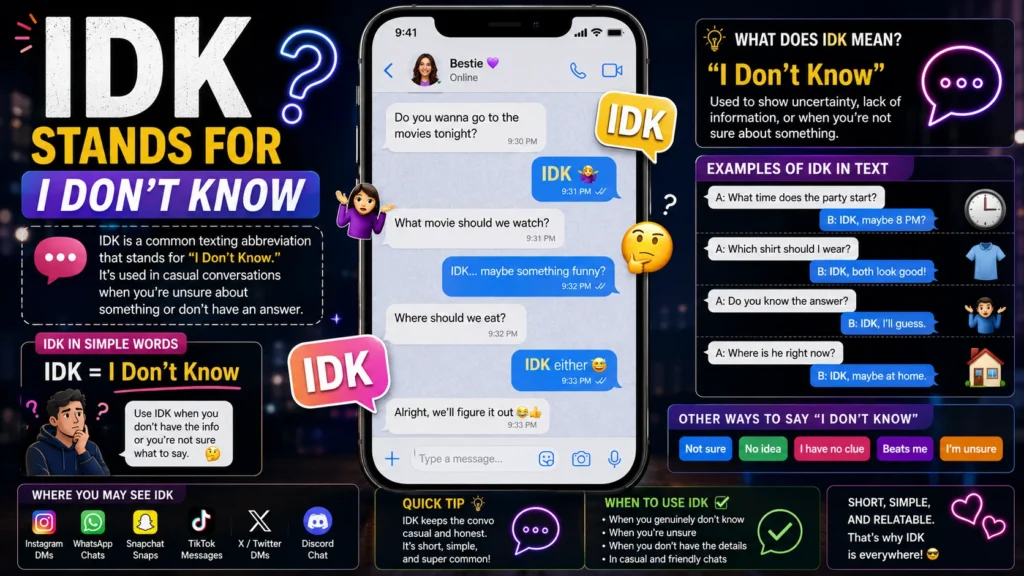
IDK stands for “I Don’t Know.” It is one of the most common texting abbreviations used when someone does not know an answer, is unsure about something, or simply does not want to give a definite response.
Have you ever received a message that simply says “IDK” and wondered whether the person is confused, uninterested, or just being casual? If so, you’re looking at one of the most common abbreviations in modern digital communication. IDK stands for “I Don’t Know,” and people use it every day in text messages, social media comments, group chats, gaming conversations, and DMs. You may see it from friends, classmates, coworkers, or family members. Understanding its meaning is easy, but understanding its tone can be a little more complicated. Depending on the conversation, “IDK” can sound honest, uncertain, playful, dismissive, or even slightly annoyed. In this guide, you’ll learn what IDK means, where it came from, how people use it, what similar abbreviations mean, and how to respond naturally.
Definition & Meaning
IDK stands for “I Don’t Know.”
It is an informal abbreviation used in digital communication when someone doesn’t know something or isn’t certain about an answer.
For example:
Person 1: “What time does the movie start?”
Person 2: “IDK.”
This simply means:
“I don’t know.”
People often use IDK because it is faster to type than the complete phrase.
It can also express uncertainty:
“IDK if I can go tonight.”
Meaning:
“I don’t know if I can go tonight.”
Sometimes IDK is used when someone doesn’t have an opinion.
“Do you like the new design?”
“IDK, it’s okay I guess.”
Here, IDK shows uncertainty rather than a complete lack of knowledge.
IDK at a Glance
| Term | Meaning | Tone |
|---|---|---|
| IDK | I Don’t Know | Casual |
| IDK? | I don’t know or uncertainty | Informal |
| idk | I don’t know | Very casual |
| IDK lol | I don’t know, casually | Playful |
Background & History
IDK developed from the growth of internet slang and mobile texting.
As people began communicating through SMS, instant messaging, chat rooms, and online forums, they started shortening common phrases to save time.
Expressions such as:
- LOL
- BRB
- BTW
- OMG
- TTYL
- IDK
became part of everyday online language.
IDK became especially popular because “I don’t know” is such a common phrase.
The abbreviation later spread across social media platforms such as Instagram, Facebook, Snapchat, TikTok, Discord, and X.
Today, IDK is so recognizable that many people use it even when they are not trying to save typing time. It has become a normal part of casual online communication.
Usage in Various Contexts
Text Messages
“IDK what to wear tonight.”
The person is unsure about what to wear.
Social Media
“IDK why this video is so funny 😂.”
Here, IDK expresses casual uncertainty.
Group Chats
Friend: “Who invited Jake?”
You: “IDK.”
You’re simply saying that you don’t know.
Gaming
“IDK where the enemy went.”
The player doesn’t know where the opponent is.
Casual Conversations
“IDK, maybe we should wait.”
Here, IDK makes the statement sound less certain.
Common Misconceptions & Clarifications
A common misconception is that IDK always means the person genuinely has no idea.
Not necessarily.
People sometimes use IDK to avoid giving a direct answer.
For example:
“Are you going to the party?”
“IDK.”
The person may genuinely be uncertain, or they may not want to commit yet.
Can IDK Sound Rude?
Yes, depending on the context.
Compare:
“IDK.”
with:
“Honestly, I’m not sure.”
The first can sound short or dismissive, especially during a serious conversation.
Adding context can make it friendlier:
“IDK yet, let me check.”
This sounds more helpful.
Similar Terms & Alternatives
| Abbreviation | Full Form | Meaning |
|---|---|---|
| IDK | I Don’t Know | Uncertainty |
| IDC | I Don’t Care | Lack of concern |
| IMO | In My Opinion | Personal opinion |
| TBH | To Be Honest | Honest opinion |
| IK | I Know | Knowing something |
| NGL | Not Gonna Lie | Honest statement |
| IDK | I Don’t Know | Uncertainty |
IDK vs IDC
These are easy to confuse.
IDK = I Don’t Know
IDC = I Don’t Care
They communicate completely different ideas.
IDK vs IK
IDK means you don’t know.
IK means you know.
How to Respond to IDK
Your response depends on the situation.
Casual
“Fair enough 😂.”
Helpful
“No worries, I’ll find out.”
Curious
“Any idea who might know?”
Funny
“Well, that was helpful 😂.”
If Someone Seems Dismissive
“Okay, no worries.”
If you think the person may genuinely be unsure, you can also offer help:
“Want me to check?”
Regional or Cultural Differences
IDK is widely recognized in English-language online communication.
It is especially common among people who regularly use:
- Text messaging
- Social media
- Gaming platforms
- Online forums
- Messaging apps
The basic meaning stays the same across English-speaking communities.
However, the tone may vary. Some people use IDK casually in almost every conversation, while others prefer writing the complete phrase.
Non-native English speakers may also encounter IDK frequently because it is common internet shorthand.
Comparison With Similar Terms
| Term | Meaning | Difference |
|---|---|---|
| IDK | I Don’t Know | Doesn’t know |
| IDC | I Don’t Care | Doesn’t care |
| IK | I Know | Knows |
| IMO | In My Opinion | Gives an opinion |
| TBH | To Be Honest | Introduces honesty |
| NGL | Not Gonna Lie | Casual honesty |
| IDTS | I Don’t Think So | Disagreement or doubt |
IDK is specifically about not knowing or being uncertain.
Usage in Online Communities & Dating Apps
IDK is extremely common in DMs and dating conversations.
For example:
“Are you free this weekend?”
“IDK yet.”
This usually means the person hasn’t decided.
In dating conversations, however, tone matters.
“IDK 😂 maybe.”
can sound playful or uncertain.
But:
“idk.”
as a one-word response to several questions may sound uninterested.
If someone repeatedly responds with short IDK messages, the issue may be the conversation style, not the abbreviation itself.
Hidden or Offensive Meanings
IDK does not have a hidden offensive meaning in normal texting.
It simply means “I Don’t Know.”
However, the abbreviation can sometimes sound dismissive.
For example:
“Where are you going?”
“IDK.”
This may be completely innocent.
But if someone asks an important question and receives only:
“IDK.”
it could sound like the person doesn’t want to discuss it.
The surrounding conversation determines the tone.
Suitability for Professional Communication
IDK is generally too informal for formal professional communication.
Avoid using it in:
- Formal emails
- Business reports
- Job applications
- Client communication
- Academic writing
- Official documents
Instead, use:
“I’m not sure.”
“I don’t have that information.”
“I’ll confirm and get back to you.”
For example:
Instead of:
“IDK when the report will be ready.”
write:
“I’m not sure when the report will be ready, but I’ll confirm the timeline.”
FAQs
What does IDK stand for?
IDK stands for “I Don’t Know.”
What does IDK mean in texting?
In texting, IDK means that someone doesn’t know something or is uncertain about an answer.
Is IDK considered slang?
Yes. IDK is an informal texting and internet abbreviation, although it is now widely recognized.
What does IDK mean from a girl or guy?
The meaning doesn’t change based on gender. It usually means “I Don’t Know,” but the tone depends on the conversation.
Is IDK rude?
Not necessarily. However, replying only “IDK” can sometimes sound short or dismissive depending on the situation.
What is the difference between IDK and IDC?
IDK means “I Don’t Know,” while IDC means “I Don’t Care.”
Can I use IDK at work?
It’s better to avoid IDK in formal workplace communication. Use a clearer phrase such as “I’m not sure” instead.
Conclusion
IDK stands for “I Don’t Know,” and it is one of the most recognizable abbreviations in texting and online communication. People use it to express uncertainty, lack of knowledge, or sometimes a desire to avoid giving a definite answer.
Although IDK is simple, its tone depends on context. “IDK 😂” can sound relaxed, while a short “IDK.” may sometimes feel dismissive. If you’re using it with friends, it’s perfectly normal. In professional communication, however, writing “I’m not sure” or “I’ll check and let you know” is usually a better choice.