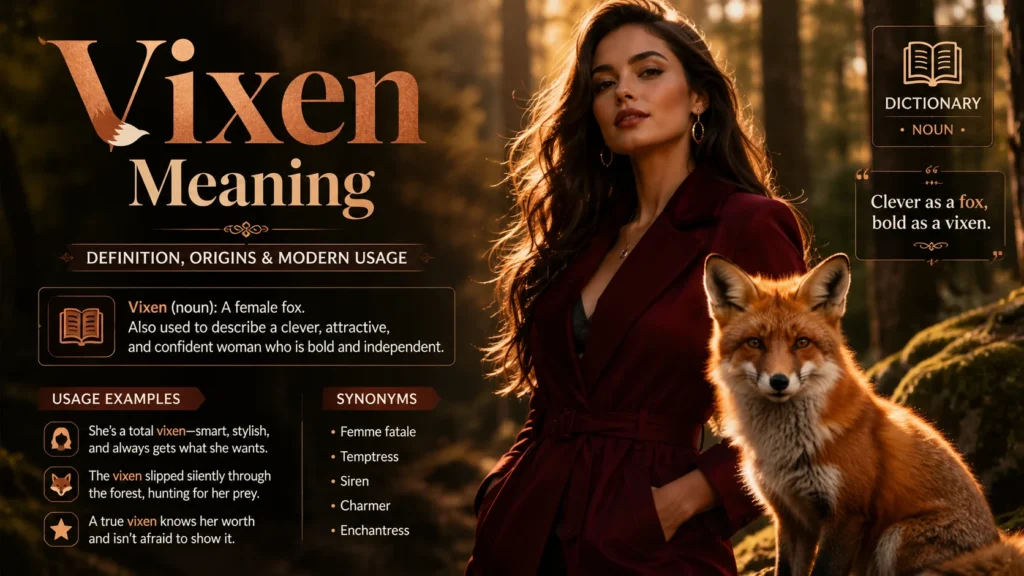

Vixen originally means a female fox, but in modern English it is often used to describe an attractive, confident, bold, or seductive woman. Depending on the context, it can also carry a negative meaning, referring to a woman who is ill-tempered, argumentative, or sharp-tongued. The tone of the word changes based on how and where it is used.
If you’ve come across the word vixen in a movie, novel, song, social media post, or everyday conversation, you may have wondered it’s meant as a compliment or an insult. The answer isn’t always straightforward because vixen has evolved significantly over the centuries.
In today’s world, the word often highlights confidence, beauty, and charisma. However, in some situations, it may imply someone is manipulative, fiery, or difficult to deal with. Understanding the context is the key to interpreting its true meaning.
What Does Vixen Mean?
The word vixen has two primary meanings:
| Meaning | Explanation | Tone |
|---|---|---|
| Female Fox | The biological term for an adult female fox. | Neutral |
| Attractive or Strong-Willed Woman | A woman who is confident, glamorous, seductive, or sometimes mischievous. | Usually Positive |
| Ill-Tempered Woman | Someone considered argumentative, sharp, or unpleasant. | Negative |
Today, the second meaning appears far more often in conversations, entertainment, and pop culture than the original animal definition.
Simple Definition
A vixen is:
- A female fox.
- A confident, stylish, or seductive woman.
- Sometimes a woman with a fiery personality or quick temper.
Because the word has multiple meanings, always pay attention to the context before deciding it is intended as praise or criticism.
Why Is the Word “Vixen” So Popular?
The popularity of vixen comes from its strong imagery. Foxes have long been associated with intelligence, beauty, independence, and cleverness. Over time, these qualities became linked with women who displayed similar characteristics.
You’ll frequently encounter the word in:
- Movies and TV shows
- Romance novels
- Fashion magazines
- Song lyrics
- Celebrity interviews
- Social media captions
- Beauty and lifestyle blogs
For example:
“She walked into the room with confidence. Everyone called her a total vixen.”
Here, vixen suggests someone attractive, stylish, and self-assured.
Another example:
“The villain described the queen as a dangerous vixen.”
In this sentence, the word carries a more negative or suspicious tone.
Origin of the Word Vixen
The history of vixen goes back hundreds of years.
The word comes from Old English “fyxen,” which simply meant female fox. Over time, the pronunciation gradually changed until it became the modern word vixen.
During the Middle Ages, people believed foxes were exceptionally clever and difficult to catch. Female foxes were viewed as particularly protective and resourceful when raising their young.
As English evolved, writers began comparing women with similar traits to foxes. Eventually, vixen became a metaphor describing women who were:
- Clever
- Independent
- Beautiful
- Cunning
- Strong-minded
- Sometimes quarrelsome
This figurative use became increasingly common in literature during the 16th and 17th centuries.
How the Meaning Changed Over Time
The meaning of vixen has shifted dramatically throughout history.
| Time Period | Meaning |
|---|---|
| Old English | Female fox |
| Medieval Period | Clever, fierce female fox |
| 1500s–1700s | Quarrelsome or bad-tempered woman |
| 1900s | Attractive yet fiery woman |
| Modern English | Confident, glamorous, bold, or seductive woman, sometimes with a negative edge |
Today, many people use vixen in a flattering way, while others still associate it with its older negative meaning.
That’s why context matters more than the dictionary definition alone.
How Is Vixen Used Today?
Modern English uses vixen in several different ways.
1. To Describe an Attractive Woman
This is the most common modern usage.
Example:
“She looked absolutely stunning in that red dress. What a vixen!”
Tone: Positive 😊
The speaker is complimenting her confidence and appearance.
2. To Describe a Bold Personality
Sometimes vixen refers to someone fearless and independent.
Example:
“She’s a business vixen who built her company from scratch.”
Tone: Positive and empowering 💼
3. To Describe Someone Fiery
Occasionally, the word implies a woman has a quick temper.
Example:
“Be careful during meetings. She can be a real vixen when she’s upset.”
Tone: Negative ⚠️
Here, the speaker suggests the person may become argumentative or difficult.
4. In Entertainment and Pop Culture
Writers often choose vixen to describe characters who are:
- Mysterious
- Confident
- Glamorous
- Seductive
- Clever
- Dangerous
This usage is especially common in fantasy novels, action films, and comic books.
Example:
“The mysterious vixen charmed everyone before revealing her true plan.”
Is Vixen a Compliment or an Insult?
One of the most common questions people ask is vixen is a compliment.
The answer depends entirely on context.
When It Is a Compliment
Someone may use vixen to praise a woman’s:
- Beauty
- Confidence
- Fashion sense
- Independence
- Charisma
- Bold personality
Example:
“You looked like a total vixen at the party!”
This usually means the speaker thinks the person looked glamorous and confident.
When It Can Be Offensive
The word may sound insulting if it’s used to suggest someone is:
- Mean
- Manipulative
- Aggressive
- Difficult
- Bad-tempered
Example:
“Everyone avoids her because she’s such a vixen.”
Here, the tone is clearly negative.
Best Practice
If you’re unsure how someone will interpret the word, it’s generally safer to choose more straightforward compliments like confident, stylish, elegant, or charismatic, especially in professional or unfamiliar settings.
Common Characteristics Associated With a Vixen
Although every person is different, the word vixen is often linked with these qualities:
| Characteristic | Usually Positive or Negative? |
|---|---|
| Confidence | Positive |
| Intelligence | Positive |
| Beauty | Positive |
| Independence | Positive |
| Charisma | Positive |
| Boldness | Positive |
| Seductiveness | Depends on context |
| Cunning | Neutral |
| Manipulative Behavior | Negative |
| Short Temper | Negative |
These traits explain why the word can carry different emotional meanings depending on the situation.
When Should You Use the Word “Vixen”?
Using vixen appropriately depends on your audience and the setting.
It works well in:
- Fiction writing
- Character descriptions
- Fashion or beauty discussions
- Informal conversations
- Creative storytelling
- Social media captions with a glamorous tone
However, avoid using it in formal or professional communication unless you’re referring to the literal meaning of a female fox or intentionally discussing the word itself. Because some people still associate vixen with negative stereotypes, choosing a clearer adjective is often the better option in workplace or academic settings.
Examples of Vixen in Everyday Sentences
Seeing the word vixen in context makes it much easier to understand. Below are examples showing how its meaning changes depending on the situation.
| Sentence | Meaning | Tone |
|---|---|---|
| “She looked like a complete vixen in that black dress.” | Attractive and confident woman | Positive 😊 |
| “The detective couldn’t trust the mysterious vixen.” | Clever or seductive woman | Neutral |
| “Everyone feared the old vixen because of her temper.” | Bad-tempered woman | Negative ⚠️ |
| “A vixen protects her cubs fiercely.” | Female fox | Neutral |
| “The actress played a glamorous vixen in the movie.” | Stylish, confident character | Positive |
| “People described her as a cunning vixen.” | Intelligent but possibly manipulative | Mixed |
These examples show why context matters. The exact same word can sound flattering in one sentence and insulting in another.
Real-Life Examples of How People Use “Vixen”
Here are some everyday situations where you might hear or read the word.
Example 1: Fashion
“You look like a fashion vixen tonight!”
Meaning: The speaker admires someone’s stylish appearance.
Tone: Positive ✨
Example 2: Movie Review
“The actress plays a fearless vixen determined to outsmart everyone.”
Meaning: A confident, intelligent female character.
Tone: Positive
Example 3: Office Gossip
“She’s a real vixen when deadlines get close.”
Meaning: Someone becomes difficult or short-tempered.
Tone: Negative
Example 4: Wildlife Documentary
“The vixen stayed close to her cubs.”
Meaning: Female fox.
Tone: Neutral
Example 5: Social Media Caption
“Weekend vibes. Feeling like a total vixen. 🔥”
Meaning: Feeling confident, glamorous, and attractive.
Tone: Positive
Is “Vixen” Always About Beauty?
Not at all.
Many people assume vixen only refers to physical attractiveness, but the word often describes personality just as much as appearance.
Someone called a vixen may be:
- Fearlessly confident
- Smart and quick-thinking
- Independent
- Charismatic
- Stylish
- Strong-willed
Depending on the speaker, it may also suggest:
- Manipulative
- Sharp-tongued
- Aggressive
- Difficult to argue with
This wide range of meanings is why understanding the situation is essential.
Vixen vs Similar Words
Many words share similarities with vixen, but they are not interchangeable.
| Word | Meaning | Difference from Vixen |
|---|---|---|
| Foxy | Attractive and stylish | More playful and almost always positive |
| Seductive | Sexually attractive | Focuses mainly on attraction |
| Glamorous | Elegant and fashionable | Does not imply personality |
| Femme Fatale | Attractive woman who leads others into trouble | Much stronger and dramatic than vixen |
| Diva | Confident woman, sometimes demanding | Focuses more on attitude |
| Siren | Someone whose beauty attracts others | Often used metaphorically |
| Temptress | Woman who deliberately seduces | More romantic or dramatic |
Although these words overlap, vixen uniquely combines beauty, confidence, intelligence, and a hint of fierceness.
Vixen vs Fox
People often confuse these terms.
| Fox | Vixen |
|---|---|
| Refers to the animal in general | Specifically refers to an adult female fox |
| Can describe a clever person | Usually refers to a woman or female fox |
| Neutral word | Can be positive or negative depending on context |
Example:
❌ “That male fox is a vixen.”
✅ “That female fox is a vixen.”
Is Calling Someone a Vixen Appropriate?
It depends on your relationship and the setting.
Appropriate Situations
✔ Fiction writing
✔ Movie reviews
✔ Fashion articles
✔ Beauty blogs
✔ Friendly compliments when the person appreciates the term
✔ Social media captions
Situations to Avoid
✘ Workplace conversations
✘ Academic writing
✘ Formal emails
✘ Professional meetings
✘ Speaking to someone you don’t know well
Because some people interpret vixen negatively, using more neutral compliments is usually safer.
Polite Alternatives to “Vixen”
If you want to compliment someone without risking misunderstanding, consider these alternatives.
| Alternative | Best Used For |
|---|---|
| Confident | Professional conversations |
| Elegant | Fashion or formal settings |
| Stylish | Casual compliments |
| Charismatic | Personality |
| Graceful | Respectful compliment |
| Bold | Leadership or confidence |
| Attractive | General compliment |
| Glamorous | Fashion and beauty |
| Sophisticated | Formal situations |
| Empowered | Positive and modern tone |
These words clearly express admiration without the mixed meanings associated with vixen.
Synonyms of Vixen
Depending on the context, possible synonyms include:
- Foxy
- Glamorous
- Seductive
- Alluring
- Beautiful
- Confident
- Bold
- Charismatic
- Fiery
- Clever
- Cunning
- Strong-minded
Remember that no synonym perfectly matches every meaning of vixen, so choose the one that best fits your sentence.
Alternate Meanings of Vixen
Although the two primary definitions are the most common, the word also appears in several other contexts.
1. Wildlife
The official zoological meaning is an adult female fox.
2. Entertainment
Characters in books, comics, television, and films are often named or described as vixens to emphasize beauty, confidence, or mystery.
3. Sports Teams and Brands
Some organizations and businesses use Vixen as a name because it suggests speed, intelligence, confidence, and strength.
4. Christmas Tradition
Many people know Vixen as one of Santa Claus’s reindeer from the famous holiday poem and later Christmas songs. In this context, the name has nothing to do with the dictionary meaning of the word.
Common Mistakes People Make
Understanding a few common mistakes will help you use vixen correctly.
| Mistake | Correct Explanation |
|---|---|
| Thinking it only means an attractive woman | It can also mean a female fox or an ill-tempered woman. |
| Assuming it’s always an insult | Modern usage is often complimentary. |
| Using it in business emails | Better to choose neutral adjectives. |
| Calling any fox a vixen | Only female foxes are called vixens. |
| Ignoring context | The tone changes depending on who says it and why. |
Tips for Using “Vixen” Naturally
If you decide to use the word, keep these tips in mind:
- Think about your audience before using it.
- Consider the context is positive or negative.
- Avoid using it in formal workplace communication.
- Use it carefully in compliments, as not everyone interprets it the same way.
- In creative writing, it works well for describing confident, mysterious, or glamorous characters.
- When referring to wildlife, remember it specifically means a female fox.
Using vixen thoughtfully helps you communicate more clearly and avoid unintended meanings.
FAQs
1. What does vixen mean in slang?
In modern slang, vixen usually refers to a woman who is attractive, confident, bold, or seductive. It is often used as a compliment, especially in fashion, entertainment, and social media. However, depending on the speaker and context, it can also suggest someone who is manipulative or has a fiery personality.
2. Is calling someone a vixen a compliment?
It can be. Many people use vixen to praise someone’s beauty, confidence, or charisma. Others may interpret it as implying the person is cunning or difficult. Because the meaning depends on context, it’s best to know your audience before using the term.
3. What is the original meaning of vixen?
The original meaning of vixen is an adult female fox. This is the oldest dictionary definition, dating back to Old English. The figurative meaning describing a woman developed much later.
4. Does vixen have a negative meaning?
Yes, it can. In some contexts, vixen describes a woman who is bad-tempered, argumentative, or sharp-tongued. Older literature often used the word in this negative sense, although modern usage is frequently more positive.
5. What is the difference between vixen and foxy?
While both words can describe an attractive woman, foxy almost always focuses on physical attractiveness and has a playful tone. Vixen can describe beauty, confidence, intelligence, and independence, but it may also carry negative meanings depending on the context.
6. Can men be called a vixen?
Generally, no. The word vixen is traditionally used for female foxes or women. It is not commonly used to describe men in standard English.
7. Is vixen used in books and movies?
Yes. Authors and filmmakers often use vixen to describe female characters who are glamorous, mysterious, fearless, clever, or seductive. It is especially common in fantasy stories, action films, romance novels, and crime dramas.
8. Should I use the word vixen in professional conversations?
Usually not. Since the word can have different interpretations, it’s safer to use alternatives such as confident, charismatic, stylish, professional, or elegant in workplaces or formal settings.
Conclusion
The word vixen has come a long way from its original meaning of a female fox. Today, it can describe a woman who is confident, attractive, stylish, bold, or independent. At the same time, it may also carry negative connotations, suggesting someone who is cunning or quick-tempered.
Because vixen has multiple meanings, context is everything. In fashion, entertainment, and social media, it is often used as a compliment that celebrates confidence and charisma. In older literature or critical conversations, however, it may be intended as an insult.
If you’re unsure how your audience will interpret the word, choosing more neutral alternatives like confident, elegant, or charismatic is usually the safest option. By understanding its history, tone, and modern usage, you’ll know exactly when and how to use vixen correctly.