
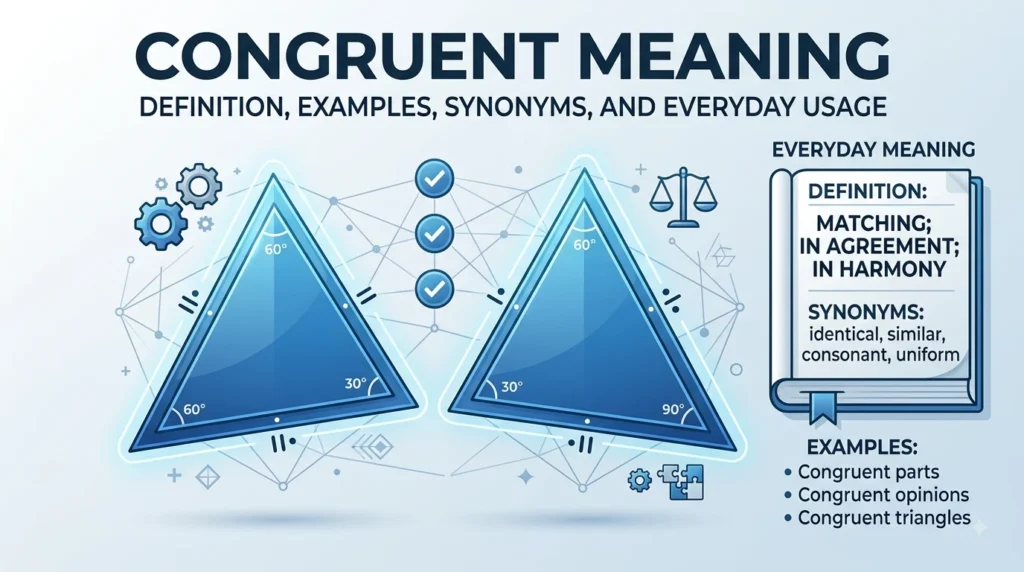

Quick Answer
Congruent means having the same shape and size. In geometry, two figures are congruent when their corresponding parts have matching measurements and one figure can be transformed into the other without stretching, shrinking, or distorting it.
What does congruent mean? In everyday English, congruent can mean something that agrees, matches, or fits with something else. In mathematics, especially geometry, it has a much more specific meaning: two figures are congruent when they have identical size and shape.
The important detail is that position doesn’t matter. A figure can be moved, rotated, or flipped and still remain congruent to another figure. What matters is whether the measurements match exactly.
You’ll encounter the word when studying congruent shapes, triangles, angles, line segments, and geometric proofs. Understanding it also makes related ideas such as similarity much easier.
This guide explains the congruent meaning in simple language, shows practical examples, explains triangle congruence rules, and clears up the difference between congruent, equal, and similar.
For example, two triangles with the same corresponding side lengths are congruent triangles, even if one is turned upside down or reflected.
Simple definition of congruent: Two geometric figures are congruent when they match exactly in shape and size.
| Term | Meaning |
|---|---|
| Congruent | Same shape and size |
| Congruent figures | Geometric figures that match exactly |
| Congruent shapes | Shapes with identical dimensions and form |
| Congruent angles | Angles with equal measures |
| Congruent sides | Line segments with equal lengths |
| Congruent triangles | Triangles with matching corresponding measurements |
| Congruence symbol | ≅ |
What Is the Meaning of Congruent?
The congruent meaning changes slightly depending on context.
In ordinary English, something can be described as congruent when it agrees or corresponds with something else. For example, someone’s actions might be congruent with their stated values. In that sentence, congruent means consistent or in agreement.
In mathematics, however, the word has a precise geometric meaning.
Two figures are congruent when they have exactly matching dimensions and can be made to overlap through movements that preserve their measurements.
So, in geometry:
Congruent = exact geometric match.
The figures don’t have to start in the same position. One might be upside down or facing another direction. If you can move one onto the other without changing its dimensions, they are congruent.
A Simple Example
Imagine two identical pieces of a jigsaw puzzle.
One piece is sitting on a table.
The other has been rotated 180 degrees.
Their orientations differ, but their dimensions remain identical. If one can be placed directly over the other and the edges match perfectly, they are congruent.
That basic idea is the foundation of geometric congruence.
What Does Congruent Mean in Math?
When people ask what does congruent mean in math, they’re usually referring to a relationship between geometric objects.
Congruence tells you that two objects have corresponding measurements that match.
Depending on the object, those measurements might include:
- Side lengths
- Angle measures
- Distances
- Radius
- Diameter
- Other dimensions that define the figure
For example, two line segments measuring 8 inches each are congruent.
Likewise, two angles measuring 60° each are congruent.
Two triangles can be congruent when their corresponding sides and angles match according to an accepted congruence rule.
The key idea is exact correspondence, not simply looking alike.
What Does Congruent Mean in Geometry?
The congruent meaning in geometry is that two figures have the same size and shape and can be matched through rigid transformations.
A rigid transformation changes a figure’s position or orientation without changing its distances or angle measures.
The three basic rigid transformations are:
- Translation: Moving a figure without turning it
- Rotation: Turning a figure around a point
- Reflection: Flipping a figure across a line
Because these movements don’t stretch or shrink the figure, they preserve congruence.
Why Position Doesn’t Matter
Consider two identical squares.
One sits normally on a page.
The other is rotated 45 degrees.
They may look different at first because their positions differ. Yet each side has the same length, and every angle remains 90°.
Rotate the second square back into position and it can overlap the first perfectly.
Therefore, the squares are congruent.
This is why geometry doesn’t require two congruent figures to face the same direction.
What Are Congruent Shapes?
Congruent shapes have matching dimensions and identical geometric form.
Examples include:
- Two squares with the same side length
- Two rectangles with the same length and width
- Two circles with the same radius
- Two equilateral triangles with the same side length
- Two identical regular polygons
The figures can be translated, rotated, or reflected without losing their congruence.
Congruent Shapes Examples
Suppose one rectangle measures 10 cm × 4 cm.
A second rectangle also measures 10 cm × 4 cm.
They are congruent.
Now suppose the second rectangle measures 20 cm × 8 cm.
It has the same proportions, but it is twice as large in each dimension. The two rectangles are similar, not congruent.
This example shows why shape alone isn’t enough.
Congruence requires both matching form and matching size.
What Are Congruent Figures?
The congruent figures definition is broader than the definition of congruent shapes.
A geometric figure can be a shape, angle, line segment, polygon, or another geometric object. Two such figures are congruent when their corresponding measurements match and one can be mapped onto the other through rigid movement.
For example:
- Two line segments with equal lengths can be congruent.
- Two angles with equal measures can be congruent.
- Two triangles with matching corresponding parts can be congruent.
- Two identical polygons can be congruent.
So, congruent figures in geometry are not limited to one particular type of shape.
| Pair | Congruent? | Reason |
|---|---|---|
| Two 5-cm line segments | Yes | Equal length |
| Two 90° angles | Yes | Equal measure |
| Two 6-cm squares | Yes | Matching sides and angles |
| Two 3-4-5 triangles | Yes | Matching corresponding sides |
| 4-cm and 6-cm squares | No | Different sizes |
| 30° and 45° angles | No | Different measures |
What Are Congruent Angles?
Congruent angles are angles with the same measure.
For example:
∠A = 75°
and
∠B = 75°
Therefore:
∠A ≅ ∠B
The angles don’t need to point in the same direction.
One could open upward while another opens sideways. If both measure 75°, they’re congruent.
Congruent Angles Definition
The congruent angles definition is straightforward:
Two angles are congruent when their measures are equal.
This concept becomes especially important when working with triangles.
If two triangles have corresponding angles with equal measures, those relationships can help establish similarity or contribute to a congruence proof when enough additional information is available.
What Are Congruent Sides?
Congruent sides are line segments with equal lengths.
Suppose:
AB = 9 cm
and:
CD = 9 cm
Then:
AB ≅ CD
The segments don’t have to be parallel or point in the same direction. Their locations don’t affect their lengths.
Congruent Sides Definition
The congruent sides definition is:
Two line segments are congruent when they have the same length.
This idea is especially important when proving congruent triangles.
If enough corresponding sides match, you may be able to establish triangle congruence using the SSS or SAS rules.
What Are Congruent Line Segments?
Congruent line segments are simply segments that have identical lengths.
For example:
- Segment AB = 12 inches
- Segment CD = 12 inches
Therefore:
AB ≅ CD
Notice the distinction between the objects and their measurements.
The segments themselves are congruent. Their numerical lengths are equal.
This distinction becomes useful when reading geometry proofs because the congruence symbol ≅ is used for geometric objects, while the equals sign = is generally used for numerical values or measurements.
What Are Congruent Triangles?
Congruent triangles are triangles that match exactly in size and shape.
When two triangles are congruent, every corresponding side has the same length and every corresponding angle has the same measure.
However, you don’t always need to measure all six parts to prove congruence.
Geometry provides several shortcuts.
These are known as triangle congruence theorems or criteria:
- SSS
- SAS
- ASA
- AAS
- HL
These rules are useful because they allow you to establish congruence from a smaller set of known measurements.
How to Prove Triangles Are Congruent
Learning how to prove triangles are congruent becomes much easier once you understand what the letters in each rule represent.
SSS Congruence
SSS means Side-Side-Side.
If three corresponding sides of one triangle have the same lengths as the three corresponding sides of another triangle, the triangles are congruent.
For example:
| Triangle ABC | Triangle DEF |
|---|---|
| AB = 5 cm | DE = 5 cm |
| BC = 7 cm | EF = 7 cm |
| AC = 9 cm | DF = 9 cm |
All three corresponding sides match.
Therefore:
△ABC ≅ △DEF
This is the SSS congruence criterion.
SAS Congruence
SAS means Side-Angle-Side.
Two triangles are congruent when two corresponding sides and the angle between those sides are equal.
The location of the angle matters.
For example:
- AB = DE
- AC = DF
- ∠A = ∠D
Because ∠A lies between AB and AC, the SAS condition is satisfied.
Therefore:
△ABC ≅ △DEF
ASA Congruence
ASA means Angle-Side-Angle.
Here, two corresponding angles and the side between them are equal.
For example:
- ∠A = ∠D
- AB = DE
- ∠B = ∠E
These measurements establish congruence through ASA.
AAS Congruence
AAS means Angle-Angle-Side.
Two triangles are congruent when two corresponding angles and a corresponding side that isn’t between those angles are equal.
AAS differs from ASA mainly in the position of the known side.
HL Congruence
HL means Hypotenuse-Leg.
This criterion applies only to right triangles.
If two right triangles have congruent hypotenuses and one pair of corresponding legs with equal lengths, the triangles are congruent.
The right-angle condition is essential. HL cannot be used for arbitrary triangles.
Triangle Congruence Rules at a Glance
| Rule | Full Name | Required Information |
|---|---|---|
| SSS | Side-Side-Side | Three corresponding sides |
| SAS | Side-Angle-Side | Two sides and included angle |
| ASA | Angle-Side-Angle | Two angles and included side |
| AAS | Angle-Angle-Side | Two angles and a non-included side |
| HL | Hypotenuse-Leg | Right triangle hypotenuse and one leg |
These rules are shortcuts. They don’t replace the definition of congruence. Instead, they provide enough information to prove that two triangles must have the same dimensions.
Why AAA Does Not Prove Triangle Congruence
This is one of the most common mistakes in geometry.
AAA, or Angle-Angle-Angle, can show that two triangles are similar, but it cannot prove that they’re congruent.
Why?
Because angles determine a triangle’s shape, but they don’t determine its size.
Imagine two right triangles with angles:
- 30°
- 60°
- 90°
One triangle could have a hypotenuse of 5 cm.
Another could have a hypotenuse of 10 cm.
Their angles match exactly, so they’re similar.
But their sizes are different.
Therefore, they’re not congruent.
This is the clearest way to remember the distinction:
AAA can establish the same shape, but congruence also requires the same size.
Congruent vs. Similar: What’s the Difference?
The difference between congruent and similar is one of the most important ideas in elementary geometry.
Both concepts involve figures that share the same general shape. The difference is their size.
Congruent
Congruent figures have:
- The same shape
- The same size
- Equal corresponding side lengths
- Equal corresponding angle measures
Similar
Similar figures have:
- The same shape
- Potentially different sizes
- Corresponding angles with equal measures
- Corresponding sides in the same proportion
| Congruent | Similar |
|---|---|
| Same shape | Same shape |
| Same size | Size may differ |
| Corresponding sides equal | Corresponding sides proportional |
| Corresponding angles equal | Corresponding angles equal |
| No scaling required | Scaling may be required |
| Can overlap exactly | May require enlargement or reduction |
An Easy Example
A 4-cm square and another 4-cm square are congruent.
A 4-cm square and an 8-cm square are similar but not congruent.
Why?
Both pairs have the same shape, but only the first pair has the same size.
Congruent vs. Equal: What’s the Difference?
The terms congruent and equal are closely related, but they aren’t interchangeable.
Equal generally describes values or measurements.
For example:
7 = 7
Two numbers are equal.
Congruent generally describes geometric objects that have matching size and shape.
For example:
△ABC ≅ △DEF
means the two triangles are congruent.
You can also say:
- Congruent line segments have equal lengths.
- Congruent angles have equal measures.
- Congruent figures have corresponding parts that match.
So, equality often describes the measure, while congruence describes the geometric relationship.
What Is the Congruent Symbol?
The congruence symbol is:
≅
For example:
△ABC ≅ △DEF
This means Triangle ABC is congruent to Triangle DEF.
It is different from the ordinary equals sign:
=
The equals sign compares values or equations.
The congruence symbol compares geometric objects.
It’s also different from:
≈
which generally means approximately equal.
Why the Order of Letters Matters
Suppose you write:
△ABC ≅ △DEF
The order tells you which vertices correspond.
Therefore:
- A ↔ D
- B ↔ E
- C ↔ F
This means:
- AB ↔ DE
- BC ↔ EF
- AC ↔ DF
And:
- ∠A ↔ ∠D
- ∠B ↔ ∠E
- ∠C ↔ ∠F
Getting the corresponding order right is essential in geometry proofs.
What Are Corresponding Sides and Angles?
Corresponding sides are sides that occupy matching positions in two figures.
Corresponding angles are angles that occupy matching positions.
For:
△ABC ≅ △DEF
the relationships are:
| First Triangle | Second Triangle |
|---|---|
| A | D |
| B | E |
| C | F |
| AB | DE |
| BC | EF |
| AC | DF |
| ∠A | ∠D |
| ∠B | ∠E |
| ∠C | ∠F |
Once you identify these pairs, many geometry problems become much easier.
For example, if AB = 8 cm and △ABC ≅ △DEF, then the corresponding side DE must also measure 8 cm.
You don’t need to calculate it from scratch.
Rigid Transformations and Congruence
A rigid transformation preserves distances and angle measures.
That’s why it preserves congruence.
The three basic rigid transformations are translation, rotation, and reflection.
Translation
A translation slides the entire figure without turning or resizing it.
A square moved 10 centimeters to the right remains the same square.
Rotation
A rotation turns the figure around a fixed point.
A triangle rotated 90° retains every side length and angle measure.
Reflection
A reflection creates a mirror image across a line.
Although the orientation changes, the distances and angles remain unchanged.
These transformations explain why two figures can look different on a page while still being congruent.
How to Identify Congruent Shapes
If you’re trying to figure out how to identify congruent shapes, don’t rely only on appearance.
Use a measurement-based approach.
Step 1: Compare the Shape
Make sure the figures have the same general geometric form.
Step 2: Compare Corresponding Measurements
Check side lengths, angle measures, or other defining dimensions.
Step 3: Look for a Rigid Transformation
Ask whether one figure can be translated, rotated, or reflected to match the other.
Step 4: Check for Exact Matching
If the figures can overlap perfectly without stretching or shrinking, they’re congruent.
This approach works much better than simply saying, “They look the same.”
Congruent Triangle Examples
Here are a few practical congruent triangle examples.
Example One: SSS
Triangle A has sides:
- 4 cm
- 6 cm
- 8 cm
Triangle B has the same three corresponding side lengths.
Because all three sides match, the triangles are congruent by SSS.
Example Two: SAS
Two triangles have:
- One side of 5 cm
- Another side of 7 cm
- An included angle of 40°
If the corresponding measurements in the second triangle are identical, the triangles are congruent by SAS.
Example Three: Rotation
Two identical triangles have the same measurements.
One is rotated 180°.
They remain congruent because rotation doesn’t change any measurement.
Example Four: Reflection
A triangle is reflected across a line.
Its orientation changes, but its dimensions don’t.
The original triangle and reflected triangle are congruent.
Examples of Figures That Are Not Congruent
Understanding non-examples helps sharpen the concept.
Different-Sized Squares
A 4-cm square and a 6-cm square have the same shape but different sizes.
They aren’t congruent.
They are similar.
Different-Sized Circles
A circle with radius 3 cm and another with radius 5 cm aren’t congruent.
Their shapes are both circular, but their sizes differ.
Different Rectangles
A rectangle measuring 5 × 10 cm and another measuring 6 × 10 cm don’t have identical dimensions.
Therefore, they aren’t congruent.
Different Angles
A 40° angle and a 50° angle aren’t congruent because their measures differ.
What Does Congruent Mean Outside Mathematics?
The word congruent isn’t limited to geometry.
In general English, it can describe things that agree, correspond, or are consistent with one another.
For example:
“Her actions were congruent with her beliefs.”
Here, congruent means consistent with or matching.
Another example:
“The evidence was congruent with the original explanation.”
In this context, the evidence supports or agrees with the explanation.
So there are two useful meanings to remember:
General English: matching, corresponding, or consistent.
Geometry: exactly the same shape and size.
The context usually makes the intended meaning obvious.
Why Congruence Matters in Geometry
Congruence isn’t just vocabulary.
It’s a practical tool for proving that geometric figures have identical measurements.
You’ll encounter it in:
- Geometry proofs
- Triangle problems
- Construction
- Architecture
- Engineering
- Computer-aided design
- Manufacturing
- Pattern making
- Spatial reasoning
For example, a manufacturer may need two components with exactly matching dimensions. A geometric model can help establish that the parts are congruent.
In geometry class, congruence allows you to prove that one figure has the same corresponding measurements as another.
Once congruence is established, you can use that relationship to find unknown side lengths and angle measures.
Common Mistakes About Congruence
Same Shape Means Congruent
Not always.
Two figures can have identical proportions but different sizes. Such figures may be similar.
Figures Must Face the Same Direction
No.
Rotation and reflection can change orientation without changing dimensions.
Only Triangles Can Be Congruent
No.
Angles, line segments, polygons, circles, and other geometric figures can have congruent counterparts.
Looking Identical Is Enough
Not for a formal proof.
Visual similarity isn’t mathematical evidence. You need matching measurements or a valid theorem.
AAA Proves Congruence
It doesn’t.
AAA establishes similarity because it tells you the triangles have the same angle structure. It doesn’t guarantee equal size.
Any Two Similar Figures Are Congruent
No.
They become congruent only when their sizes also match.
FAQs
What does congruent mean?
Congruent means having the same shape and size. In geometry, congruent figures have matching corresponding measurements.
What does congruent mean in math?
In math, congruent usually describes geometric objects that have identical dimensions and corresponding parts.
What does congruent mean in geometry?
In geometry, two figures are congruent when they have the same size and shape and can be matched using rigid transformations.
What is a simple definition of congruent?
A simple definition is same shape and same size.
What are congruent shapes?
Congruent shapes have matching dimensions and can overlap perfectly after an appropriate rigid transformation.
What are congruent figures?
Congruent figures are geometric objects whose corresponding measurements match exactly.
What are congruent triangles?
Congruent triangles have matching corresponding sides and angles. Their size and shape are identical.
What are congruent angles?
Congruent angles have equal measures, such as two angles that both measure 60°.
What are congruent sides?
Congruent sides are line segments with equal lengths.
What is the congruence symbol?
The congruence symbol is ≅. It means that two geometric figures are congruent.
What is the difference between congruent and similar?
Congruent figures have the same shape and size. Similar figures have the same shape but may have different sizes.
Conclusion
The easiest way to remember what does congruent mean is to focus on one idea: exact geometric matching.
Two figures are congruent when their shape and size correspond exactly. They don’t have to sit in the same position, face the same direction, or look identical at first glance. Translation, rotation, and reflection can change a figure’s position while preserving its measurements.
The concept becomes especially useful with congruent triangles, where rules such as SSS, SAS, ASA, AAS, and HL help prove that two triangles match. Understanding congruent vs. similar is equally important because similar figures can share the same shape while having different sizes.
Outside geometry, congruent can also mean consistent or in agreement. So when you see the word, always check the context. In geometry, think same shape and same size. In everyday language, think matching or consistent.
See Also More :
- What Does Yield Mean? Definition, Usage, Examples And Comparison In 2026
- Nympho Meaning:Origin, Modern Usage, Synonyms, Examples, and Everyday Context for 2026