
Quick Answer
Exposure and Response Prevention (ERP) is a structured form of cognitive behavioral therapy commonly used for obsessive-compulsive disorder (OCD). It involves gradually facing anxiety-provoking thoughts, situations, or triggers while learning not to perform the usual compulsive response.
Top elements: gradual exposure, response prevention, OCD treatment, anxiety management, coping skills
When anxiety tells you that something feels dangerous, your first instinct may be to escape, avoid it, or perform a ritual that makes the uncomfortable feeling disappear. Exposure and response prevention takes a different approach. Instead of automatically responding to fear with a compulsion or avoidance, ERP helps people gradually face uncomfortable situations and learn that anxiety can decrease without performing the usual ritual. It is commonly associated with OCD treatment and is usually practiced in a structured way with a qualified mental health professional. The goal isn’t to make someone feel anxious for no reason. It’s to build healthier responses to unwanted thoughts, fears, and triggers over time.
What Is Exposure and Response Prevention?
Exposure and Response Prevention, often shortened to ERP, is a behavioral therapy approach that involves gradually confronting anxiety-provoking situations while resisting compulsive behaviors or rituals.
ERP is particularly associated with obsessive-compulsive disorder (OCD).
Example: Someone repeatedly checks whether a door is locked because they fear something bad will happen.
Meaning: ERP may involve gradually facing the uncertainty of leaving the door without repeatedly checking it.
What Does Exposure Mean In ERP?
Exposure means intentionally approaching a situation, thought, image, sensation, or trigger that creates anxiety or discomfort.
The exposure is generally planned and gradual rather than random or overwhelming.
Example: Someone who fears contamination may gradually approach situations involving everyday contact with commonly touched objects.
Meaning: The person practices facing the trigger rather than immediately escaping or avoiding it.
What Does Response Prevention Mean?
Response prevention means resisting the usual compulsive behavior or safety behavior that normally follows the trigger.
The person learns to experience discomfort without automatically performing the ritual.
Example: Someone feels an urge to repeatedly wash their hands after touching something they consider dirty.
Meaning: Response prevention involves practicing not performing the repetitive washing ritual.
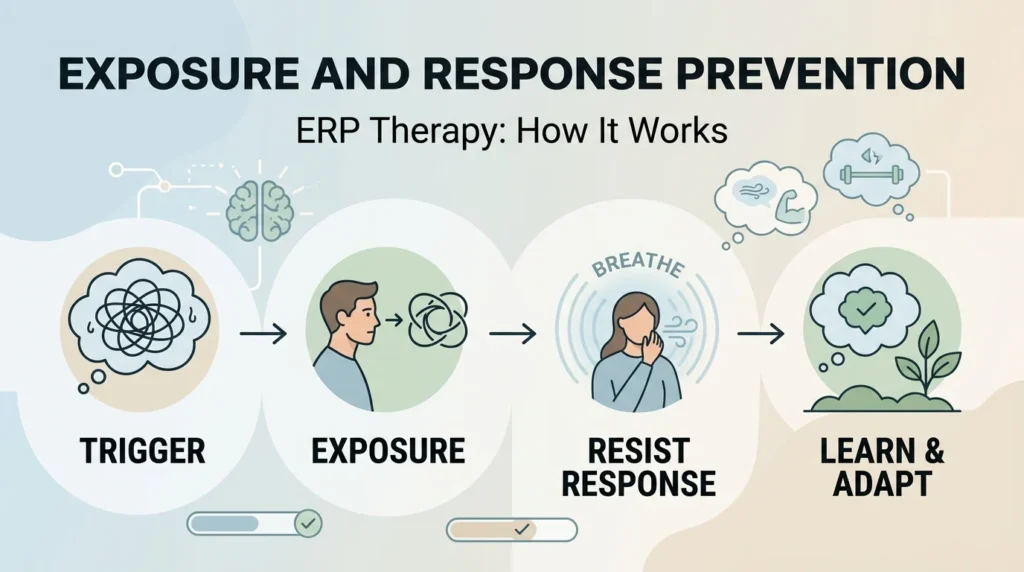
How Does Exposure and Response Prevention Work?
ERP generally follows a structured process.
A person identifies situations that trigger obsessive thoughts or anxiety. They then work through selected exposures while practicing response prevention.
Over time, the person can learn that uncomfortable feelings and uncertainty can be tolerated without relying on compulsions.
Example: A person gradually works through increasingly difficult situations on an ERP plan.
Meaning: The goal is to build tolerance and change the person’s response to anxiety rather than simply chasing immediate relief.
Exposure and Response Prevention For OCD
ERP is widely used as a behavioral treatment approach for OCD.
OCD can involve unwanted intrusive thoughts, images, or urges followed by compulsions intended to reduce distress or prevent a feared outcome.
ERP targets this cycle by helping a person face triggers while reducing reliance on compulsive responses.
Example: Someone has an intrusive fear about contamination and responds by repeatedly cleaning.
Meaning: ERP can help the person practice experiencing the fear without automatically performing the cleaning ritual.
What Is An ERP Hierarchy?
An ERP hierarchy is a list of situations arranged according to how difficult or anxiety-provoking they feel.
A person can begin with a manageable situation and gradually work toward more challenging exposures.
| Level | Example |
|---|---|
| Lower | Thinking about a feared situation |
| Moderate | Looking at a related image |
| Higher | Encountering the situation in real life |
| Advanced | Facing a particularly difficult trigger while preventing the usual compulsion |
The exact hierarchy depends on the individual’s symptoms and treatment goals.
Exposure and Response Prevention Examples
ERP can look different depending on the type of OCD or anxiety trigger.
Contamination Fears
A person may gradually encounter ordinary situations involving perceived contamination while practicing response prevention.
Checking Compulsions
A person may practice checking something once rather than repeatedly returning to make sure it is safe.
Reassurance Seeking
A person may practice tolerating uncertainty without repeatedly asking others for reassurance.
Intrusive Thoughts
A person may learn to tolerate unwanted thoughts without trying to neutralize them through rituals or avoidance.
Example: Someone experiences an intrusive thought and immediately wants to perform a mental ritual.
Meaning: ERP can involve allowing the thought to exist without automatically completing the ritual.
Does ERP Make Anxiety Go Away Immediately?
Not necessarily.
ERP isn’t simply about making anxiety disappear as quickly as possible. A major part of the process involves learning to tolerate discomfort and respond differently to anxiety-provoking thoughts or situations.
Example: Someone feels anxious during an exposure but continues practicing the planned response prevention.
Meaning: The focus is on changing the person’s relationship with the fear rather than demanding instant relief.
What Happens During An ERP Session?
An ERP session can vary depending on the person’s symptoms, goals, and treatment plan.
A session may involve:
- Reviewing recent progress.
- Identifying a target trigger.
- Choosing an appropriate exposure.
- Practicing the exposure.
- Resisting the associated compulsion.
- Discussing what was learned.
- Planning future practice.
Example: A therapist and client review which exposure felt manageable and decide what to practice next.
Meaning: ERP is typically structured around gradual progress rather than randomly confronting fears.
Is Exposure and Response Prevention Uncomfortable?
It can be uncomfortable because it involves facing situations that naturally trigger anxiety or distress.
That discomfort doesn’t mean the treatment is failing.
Example: A person feels a strong urge to perform a compulsion during an exposure.
Meaning: Learning to tolerate that urge without automatically responding to it is part of the therapeutic process.
ERP should be appropriately planned rather than used as a DIY challenge to deliberately overwhelm yourself.
How Long Does ERP Take?
There isn’t one fixed timeline for ERP.
The length of treatment can depend on factors such as:
- Symptoms
- Severity
- Treatment goals
- Individual progress
- Frequency of sessions
- Ability to practice between sessions
- Other mental health factors
Example: One person may progress through certain exposures quickly while another may need more time with each step.
Meaning: ERP is individualized rather than following one identical schedule for everyone.
What Are The Benefits Of ERP?
ERP can help people develop healthier ways of responding to obsessive thoughts and anxiety triggers.
Potential benefits can include:
- Reduced reliance on compulsions
- Greater tolerance of uncertainty
- Improved ability to face feared situations
- Increased confidence
- Better understanding of anxiety patterns
- Greater freedom from repetitive rituals
Example: A person who previously avoided everyday activities begins participating more comfortably.
Meaning: Progress can involve reclaiming activities that were previously controlled by anxiety or compulsions.
ERP vs Avoidance
Avoidance and ERP move in opposite directions.
Avoidance attempts to prevent contact with a feared situation. ERP intentionally approaches selected triggers while reducing the compulsive response.
| Avoidance | ERP |
|---|---|
| Moves away from triggers | Gradually approaches triggers |
| May provide short-term relief | Builds tolerance for discomfort |
| Can reinforce fear | Challenges the fear-response cycle |
| Focuses on escaping discomfort | Focuses on changing the response |
The goal isn’t to force every feared situation immediately. ERP is generally structured around appropriate and gradual practice.
Common ERP Mistakes
ERP can become less useful when people misunderstand what the process is trying to accomplish.
Common mistakes include:
- Starting with an unnecessarily overwhelming exposure
- Treating ERP like a dare
- Using reassurance during an exposure
- Performing hidden mental rituals
- Focusing only on anxiety reduction
- Skipping professional guidance when it is needed
- Expecting instant results
Example: Someone repeatedly checks whether they completed an exposure correctly.
Meaning: The checking itself may become part of the compulsive cycle.
How To Practice ERP Safely
ERP is best developed with guidance from a qualified mental health professional, particularly when symptoms are severe or significantly interfere with daily life.
A professional can help identify appropriate exposures, structure response prevention, and adjust the approach when difficulties arise.
Example: A person feels overwhelmed by a proposed exposure.
Meaning: The treatment plan can be reviewed and adjusted instead of forcing the person through an unsuitable step.
Exposure and Response Prevention And Daily Life
ERP isn’t only about therapy sessions.
A structured treatment plan may include practice between sessions, depending on the individual’s circumstances and professional guidance.
Daily-life practice can help people apply the skills they’ve learned to ordinary situations.
Example: Someone practices resisting a familiar checking ritual during a normal daily activity.
Meaning: The goal is to make healthier responses increasingly useful outside the therapy setting.
FAQs
What does exposure and response prevention mean?
Exposure and Response Prevention is a behavioral therapy approach in which a person gradually faces anxiety-provoking triggers while practicing not performing the usual compulsive response.
What is ERP used for?
ERP is commonly used in the treatment of OCD and is designed to address cycles involving obsessions, anxiety, and compulsive behaviors.
Is ERP the same as CBT?
ERP is closely related to cognitive behavioral therapy and is commonly considered a behavioral treatment approach within CBT.
Does ERP cure OCD?
ERP can be an effective treatment approach for OCD, but results vary from person to person. Treatment should be individualized with appropriate professional guidance.
Is ERP painful?
ERP can feel emotionally uncomfortable because it involves facing feared situations or thoughts, but it should be structured appropriately rather than designed to overwhelm someone.
Can I do ERP by myself?
Some people practice ERP skills outside therapy, but developing an appropriate plan with a qualified professional can be especially helpful for significant or complicated symptoms.
What is an ERP hierarchy?
It is a structured list of triggers or situations arranged from less difficult to more challenging to help guide gradual exposure.
What is response prevention in OCD?
It means resisting the compulsive behavior or ritual that normally follows an obsessive thought or anxiety trigger.
How long does ERP take to work?
There is no universal timeline. Progress depends on the individual, symptoms, treatment plan, and consistency of practice.
Does ERP make anxiety disappear?
The purpose isn’t simply to eliminate anxiety immediately. ERP focuses on learning to tolerate discomfort and respond differently to obsessive fears and urges.
Can ERP help with checking OCD?
Yes. ERP is commonly used to address checking-related compulsions by gradually practicing uncertainty while reducing repetitive checking.
Can ERP help with contamination OCD?
Yes. ERP can involve gradually approaching contamination-related triggers while practicing response prevention.
Why is ERP uncomfortable?
It involves confronting situations or thoughts that trigger anxiety rather than immediately using a familiar compulsion to reduce that discomfort.
Conclusion
Exposure and Response Prevention offers a structured way to face uncomfortable thoughts, fears, and situations while learning to resist compulsive responses. Rather than making anxiety disappear instantly, ERP focuses on building tolerance, reducing dependence on rituals, and creating more flexible responses to uncertainty.
The process can feel challenging, which is why an individualized approach matters. A qualified mental health professional can help create an appropriate hierarchy and determine which exposures make sense for the person’s circumstances. With consistent practice, ERP can become a useful part of learning to respond differently when obsessive thoughts or anxiety show up.
See Also More :
- 300+ How to See Replies on X (Twitter): Complete Guide for Mobile, Desktop and Hidden Conversations 2026
- 200+ Happy Mother’s Day Replies: That Are Sweet, Emotional & Perfect to Send